
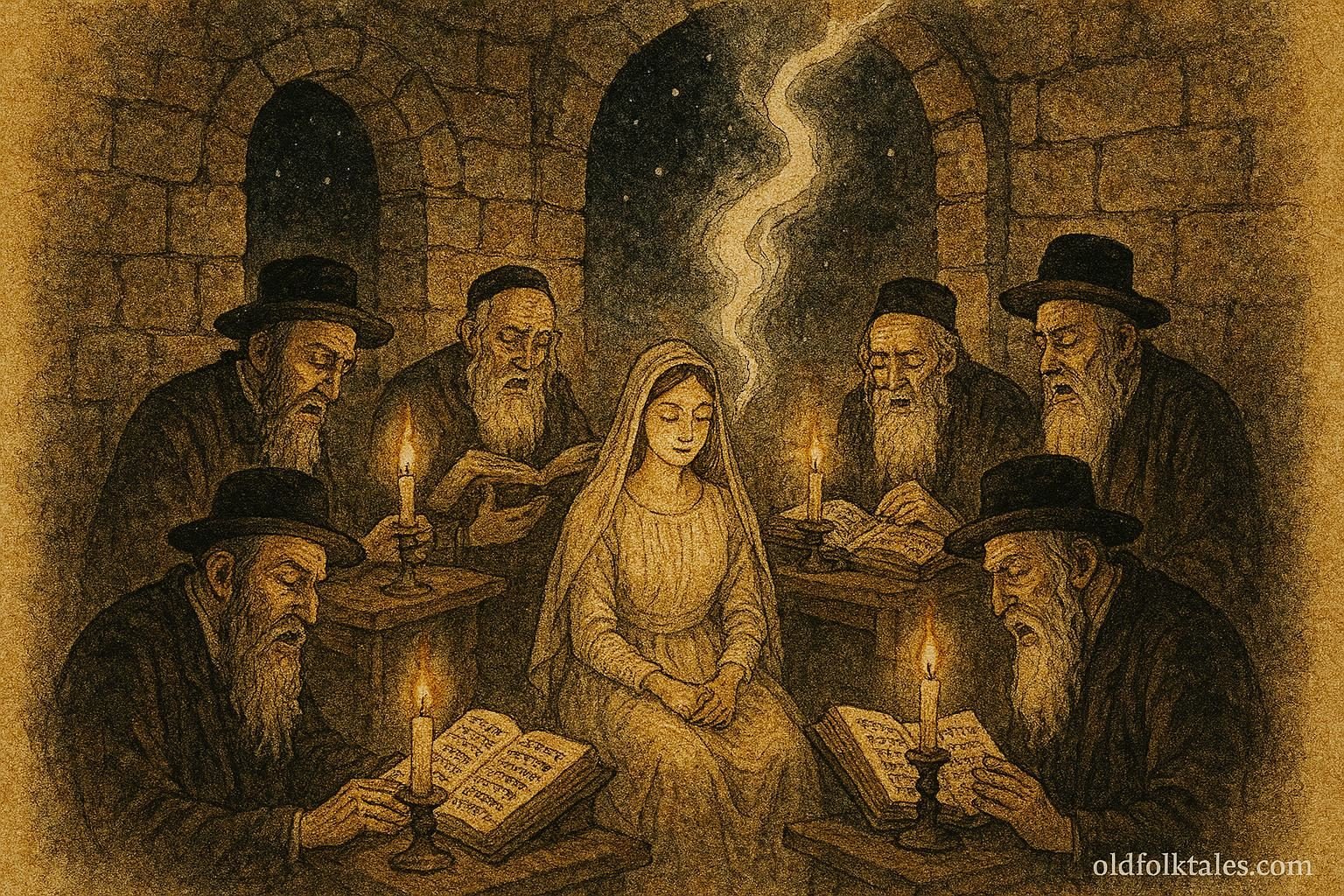
In the hilltop city of Safed, where narrow stone paths wind between whitewashed houses and the air carries prayers like drifting smoke, a wedding was being prepared with joy and solemn care. Safed was known throughout the land as a place of learning and hidden holiness, where mystics studied sacred texts and believed the boundary between worlds was thin. It was here that a young bride, modest and devout, was to begin her new life.
On the morning of her wedding week, those closest to her noticed a change. Her eyes, once calm and gentle, grew restless. Her voice took on tones that did not belong to her. At times she spoke in harsh phrases, using words unfamiliar to her family, words shaped by distant lands. When questioned, she laughed bitterly, and her laughter did not sound like her own.
Fear spread quietly through the household. In Safed, such signs were understood. The elders whispered that the bride was possessed by a dybbuk, a restless soul of the dead that clung to the living. Such spirits, it was believed, were drawn to moments of transition, especially weddings, when the soul stood between past and future.
The family sent for the town’s rabbi, a learned man versed not only in law but in the hidden teachings passed down through generations. He arrived with other scholars, carrying sacred books, shofars, and candles. They formed a circle around the trembling bride, whose body now seemed a vessel for another will.
When the rabbi commanded the spirit to speak, the voice that answered was no longer hers. It named itself as a soul from Poland, far from Safed’s sunlit hills. In life, it had been a man who committed a grave sin, one never confessed, never atoned for. Because of this hidden wrongdoing, his soul found no rest after death. Banished from peace, it wandered until it found refuge within the bride.
The rabbi demanded to know the nature of the sin. The dybbuk resisted at first, mocking the assembly and clinging tightly to its host. The scholars intensified their prayers, reciting sacred names and passages that echoed through the room like waves against stone. At last, the spirit spoke of its wrongdoing, an act of moral failure committed in secrecy, known only to itself and Heaven.
The rabbi listened gravely. He told the dybbuk that no soul could escape judgment, but mercy was possible through truth and rectification. He declared that the spirit had no right to harm the innocent, and that it must depart. The dybbuk howled, its grip loosening as the prayers grew stronger.
At the rabbi’s command, the spirit was ordered to leave through the smallest and least harmful passage. With a final cry, the dybbuk exited through the bride’s small toe. The bride collapsed, unconscious but breathing peacefully. The room fell silent.
Moments later, she opened her eyes. The shadow had lifted. She recognized her family and wept softly, unaware of the words spoken through her lips or the struggle that had taken place within her.
The rabbi then turned to the gathered community. He declared that the dybbuk’s soul required rectification. Acts of charity, prayer, and remembrance were ordered on its behalf, so that the sinner might finally find rest. Only through communal responsibility, the rabbi taught, could spiritual balance be restored.
The wedding proceeded in due time, marked by humility and gratitude. In Safed, the story was remembered not as one of terror, but of moral clarity. It reminded the people that no action is ever truly hidden, and that even after death, the soul must reckon with its deeds.
Moral Lesson
The tale teaches that moral accountability does not end with life. Hidden wrongdoing leaves spiritual consequences, and truth, repentance, and communal responsibility are essential for restoring balance and purity.
Knowledge Check
-
What is a dybbuk in Jewish folklore?
A dybbuk is the restless soul of a sinner that possesses a living person due to unresolved wrongdoing. -
Why was the bride vulnerable to possession?
Weddings are moments of transition, believed to make the soul spiritually exposed. -
Where did the dybbuk originate from?
The spirit identified itself as coming from Poland, where it committed an unconfessed sin. -
How was the dybbuk expelled?
Through ritual prayers and commands, it was forced to exit through the bride’s small toe. -
What action was ordered after the exorcism?
The rabbi required acts of rectification to help redeem the sinner’s soul. -
What is the central lesson of the story?
That moral actions have lasting spiritual consequences beyond death.
Source
Adapted from Israel Folktale Archives (IFA), University of Haifa. IFA 5672. Collected from Miriam Sandberg, born in Lvov, Poland. Recorded in Safed, Israel, 1967.








