In the lush forests of Burma, where bamboo groves swayed in the monsoon winds and ancient pagodas rose above the canopy like golden fingers reaching toward the heavens, there lived a community of birds as diverse and colorful as the land itself. Parrots chattered in the treetops, their emerald and ruby feathers flashing in the dappled sunlight. Sparrows flitted through the undergrowth, their cheerful songs filling the air with music. Kingfishers perched beside crystal streams, their iridescent blue plumage shimmering like precious gems. And among them all, the magnificent peacocks strutted through forest clearings, their extraordinary tail feathers spread like fans adorned with hundreds of mesmerizing eyes.
But there was one bird who believed himself equal, if not superior, to all these splendid creatures: a crow.
This particular crow was not content with his place in the natural order. While other crows went about their business quietly, searching for food, building nests, and living in peaceful cooperation with their fellow birds, this crow spent his days consumed with thoughts of his own importance. His obsession had grown so powerful that it colored every aspect of his existence, transforming what should have been a simple life into an exhausting performance of constant self-promotion.
Click to read all East Asian Folktales — including beloved stories from China, Japan, Korea, and Mongolia.
“Look at me!” the crow would call out from his perch on the highest branch. “See how my feathers gleam like polished obsidian! Observe the intelligence in my eyes! Note the strength of my beak and the power of my wings!”
The other birds would pause in their activities, exchange glances, and then return to their tasks, having learned long ago that engaging with the crow’s boasting only encouraged more of it. But their polite indifference only fueled the crow’s determination to prove his superiority.
Of all the birds in the forest, the crow reserved his most intense jealousy for the peacock. The peacock was beloved by all creatures, admired not just for his breathtaking beauty but also for his gracious nature and gentle demeanor. When the peacock danced, spreading his magnificent tail feathers in a display that seemed to capture all the colors of the rainbow and the stars themselves, even the trees seemed to lean closer to watch, and flowers turned their faces toward him as if he were the sun itself.
The crow could not bear this adulation. “What does the peacock have that I do not?” he would mutter darkly. “He has fancy feathers so what? I have intelligence! I have cunning! I can solve problems that would confound his simple mind. True superiority comes from wit, not appearance!”
One morning, the crow decided he had endured enough. He would challenge the peacock and the other birds to a series of contests that would prove, once and for all, his supremacy over all of them. He flew through the forest, landing on branches and calling out his proclamation to any bird who would listen.
“Attention, all birds of the forest!” he cawed loudly, his voice carrying through the trees. “I hereby challenge the peacock and any other bird who dares to compete with me! We shall hold contests of beauty, talent, and wisdom. When I emerge victorious, you will all acknowledge that I, the crow, am the greatest bird in this forest or indeed, in all of Burma!”
Word of the crow’s challenge spread quickly through the forest. Most birds shook their heads in disbelief at such arrogance, but the peacock, ever gracious, agreed to participate. “If the crow wishes to compete,” he said kindly, “then we shall compete. Perhaps through this, he will learn something valuable.”
The day of the great contest arrived, and birds gathered from every corner of the forest. They perched on branches, lined up along fallen logs, and clustered in clearings to witness the unusual spectacle. Even animals that normally paid little attention to bird affairs monkeys, deer, and wild pigs came to watch, drawn by curiosity and the promise of entertainment.
The first contest was one of beauty. A wise old parrot, respected by all for her fairness and long experience, served as judge. She instructed each contestant to display themselves at their finest.
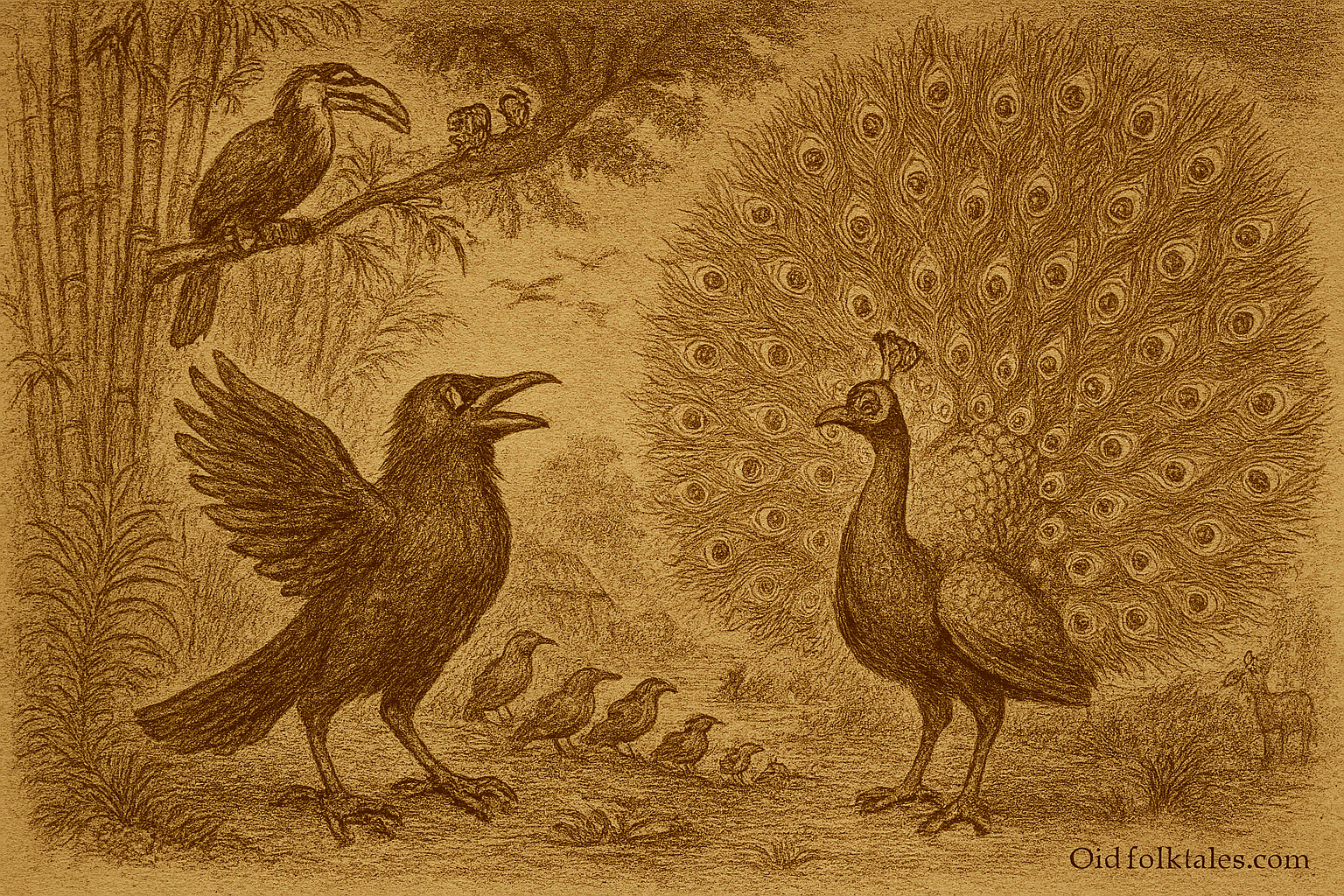
The peacock went first. He stepped into the center of the clearing with quiet confidence, then slowly spread his magnificent tail feathers. The effect was breathtaking. His plumage unfurled like a living tapestry woven from sapphire, emerald, gold, and bronze, each feather adorned with eye-like patterns that seemed to watch the audience with mysterious intelligence. As sunlight filtered through the canopy and touched his feathers, they glowed with an ethereal radiance that made even the flowers pale in comparison. A collective gasp of admiration rose from the assembled creatures.
Then came the crow’s turn. He hopped into the clearing with his chest puffed out, strutting back and forth, tilting his head to show his profile. “Observe!” he cawed. “My feathers are sleek and practical, perfectly designed for flight and survival! My black plumage is dignified and sophisticated, requiring none of the garish showiness of others!”
But despite his loud claims, the gathered birds could see what the crow refused to acknowledge: his ordinary black feathers, while perfectly serviceable, possessed none of the extraordinary beauty of the peacock’s display. When the old parrot announced the peacock as the clear winner of the beauty contest, the crow protested vehemently.
“Beauty is subjective!” he screeched. “This contest proves nothing! Wait until the next challenge you’ll see my true superiority!”
The second contest tested talent specifically, the ability to sing or produce beautiful sounds. Various birds took their turns: the nightingale offered a melody so sweet it brought tears to the eyes of listeners; the mynah bird demonstrated its remarkable ability to mimic human speech and other sounds with perfect accuracy; even a small wren sang a simple but heartfelt tune that touched everyone’s hearts.
The peacock, when his turn came, let out his distinctive call a loud, somewhat harsh cry that was admittedly not melodious in the traditional sense. But he offered it without pretension, making no grand claims about its beauty, simply sharing what he had to contribute.
The crow, however, approached his performance with his usual arrogance. “Prepare yourselves for the most intelligent and sophisticated vocalizations you’ve ever heard!” he announced. Then he proceeded to caw a harsh, grating sound that made several birds wince and cover their ears. He tried different variations: loud caws, soft caws, rapid series of caws, but each version was fundamentally the same unpleasant noise that crows had always made.
“That was magnificent!” the crow declared when he finished. “Did you hear the complexity? The nuance? The sheer intellectual depth of my performance?”
But the other birds only looked at each other in bewilderment. When the old parrot judged the nightingale the winner, with the mynah bird coming in second place, the crow exploded in fury.
“You’re all fools!” he shouted. “You cannot recognize true talent when it’s presented to you! You’re blinded by superficial preferences!”
The third and final contest tested wisdom and problem-solving ability. The old parrot presented a challenge: a sealed bamboo tube contained seeds, but the opening was too narrow for any bird to reach inside with their beak. How could the seeds be retrieved?
Several birds attempted various solutions. The woodpecker tried pecking at the bamboo but couldn’t break through. The parrot tried tilting the tube but couldn’t angle it correctly. Then the peacock, after observing the problem carefully, suggested that if they worked together, several birds could tip the tube over completely, allowing the seeds to roll out.
The crow, however, dismissed this idea immediately. “That’s a simple-minded solution!” he declared. “Watch how a truly intelligent bird solves this problem!”
He approached the bamboo tube with great fanfare, circling it several times while muttering about “strategic analysis” and “cognitive superiority.” He tried pecking at it like the woodpecker had done with no success. He tried shaking it but couldn’t get a proper grip. He tried everything the other birds had already attempted, each time claiming he was employing a more sophisticated approach,but ultimately achieving nothing.
Finally, frustrated and exhausted, the crow gave up. The peacock’s suggestion was implemented, and the seeds were successfully retrieved through cooperative effort.
Throughout all these contests, the crow never once acknowledged his failures. Instead, he blamed the judges for being biased, the other birds for cheating, and the contest rules for being unfair. His constant complaints and excuses began to wear on everyone’s patience.
As the sun began to set and the contests concluded, a wise old hornbill who had watched everything from a distant perch flew down and landed near the crow. The hornbill was ancient, his feathers grayed with age, his eyes holding the wisdom of many seasons. He was respected throughout the forest as a bird who spoke little but said much when he chose to speak.
“Young crow,” the hornbill said in a voice like wind through bamboo, “may I share an observation with you?”
The crow, still sulking from his defeats, snapped, “What could you possibly tell me that I don’t already know?”
The hornbill smiled gently. “I have lived long enough to see many birds come and go. I have seen the truly great and the merely loud. And I have learned one essential truth: the bird who must constantly proclaim his own worth possesses the least. The peacock never boasted about his beauty he simply existed in it. The nightingale never claimed to be the greatest singer she simply sang. True worth, young crow, does not require announcement. It reveals itself through actions, through humility, through cooperation with others.”
The crow opened his beak to argue, but something in the old hornbill’s patient gaze made him pause. For the first time in longer than he could remember, the crow actually listened instead of simply waiting for his turn to talk.
“You lost these contests not because you lack abilities,” the hornbill continued, “but because you were so busy trying to prove you were superior that you couldn’t see your own actual strengths. Crows are clever, resourceful, adaptable creatures. These are genuine gifts. But arrogance transforms gifts into burdens. Pride blinds us to our true nature and prevents us from growing into who we might become.”
The hornbill spread his wings and prepared to return to his perch. Before he flew away, he offered one final thought: “Respect is never demanded, young crow. It is earned through good behavior, kindness to others, and honest acknowledgment of both our strengths and our limitations. The peacock is admired not just for his beauty but because he carries it with grace and shares his gifts without needing applause or acknowledgment.”
After the old hornbill departed, the crow sat alone on his branch as darkness fell over the forest. For the first time, he truly reflected on his behavior. He thought about how exhausting it had been to constantly compare himself to others, to always need to prove his superiority, to never be able to simply exist peacefully in his own nature.
He thought about the peacock, who had competed graciously, accepted victory with humility, and shown no anger or contempt toward the crow despite all the crow’s harsh words. He thought about the nightingale, who sang simply because singing was her gift, not because she needed everyone to acknowledge her talent. He thought about all the birds who lived contentedly, each fulfilling their own nature without constant comparison or competition.
As the moon rose above the forest canopy, casting silver light through the leaves, the crow made a decision. The next morning, he flew to where the peacock was drinking from a stream.
“Peacock,” he said quietly, his voice lacking its usual bombastic tone, “I owe you an apology. I have been arrogant and foolish. I spent so much energy trying to prove I was better than you that I never appreciated your actual qualities or my own. You won those contests fairly, and more importantly, you conducted yourself with grace that I failed to show.”
The peacock looked at the crow with kind eyes. “Your apology is accepted, friend. We each have our own gifts. Perhaps now we can appreciate them in each other rather than compete over them.”
From that day forward, the crow changed. He stopped boasting and started listening. He stopped competing and started cooperating. He discovered that when he worked alongside other birds instead of against them, his natural cleverness and problem-solving abilities truly shone. He found that respect came naturally when he offered it to others first.
The other birds noticed the transformation and welcomed the crow into their community with genuine warmth. And the crow learned that the quiet satisfaction of being valued for his real contributions brought far more contentment than all his loud claims of superiority ever had.
The peacock and the crow eventually became friends, an unlikely pairing that surprised many but demonstrated that humility can bridge any divide and that recognizing our own failings is the first step toward genuine growth.
Click to read all Southeast Asian Folktales — featuring legends from Thailand, Indonesia, Vietnam, and the Philippines.
The Moral Lesson
This Burmese folktale teaches that pride and arrogance lead to isolation and defeat, while humility opens doors to respect and genuine connection. The crow’s constant need to proclaim his superiority prevented him from recognizing his actual strengths and blinded him to the value in others. True worth is demonstrated through actions and character, not through loud self-promotion. When we spend our energy comparing ourselves to others and demanding recognition, we waste the very gifts we claim to possess. Respect cannot be demanded but must be earned through good behavior, cooperation, and the grace to acknowledge both our abilities and our limitations.
Knowledge Check
Q1: What was the crow’s main character flaw in this Burmese folktale?
A: The crow’s primary flaw was his excessive pride and arrogance. He constantly boasted about his supposed superiority over other birds, particularly the peacock, and spent all his energy trying to prove his worth through loud proclamations rather than through genuine actions or cooperation with others.
Q2: What three contests did the crow challenge the other birds to?
A: The three contests were: first, a beauty contest where birds displayed their finest appearance; second, a talent contest focused on singing and producing beautiful sounds; and third, a wisdom contest testing problem-solving abilities, specifically how to retrieve seeds from a sealed bamboo tube.
Q3: Why did the crow lose all the contests despite his confidence?
A: The crow lost because his arrogance blinded him to reality. In the beauty contest, his ordinary feathers couldn’t match the peacock’s magnificence. In the talent contest, his harsh cawing wasn’t melodious. In the wisdom contest, his pride prevented him from accepting the simple cooperative solution others suggested. His need to prove superiority interfered with his actual abilities.
Q4: What role does the wise old hornbill play in the story?
A: The hornbill serves as the story’s moral teacher and voice of wisdom. After observing the crow’s behavior throughout the contests, he gently explains that true worth doesn’t require constant announcement, that arrogance transforms gifts into burdens, and that respect is earned through humility and good behavior rather than demanded through boasting.
Q5: How did the crow change by the end of the story?
A: After reflecting on the hornbill’s wisdom, the crow underwent a complete transformation. He apologized to the peacock, stopped his constant boasting, began listening to others, and started cooperating instead of competing. He discovered that his natural cleverness shone more brightly when used collaboratively, and he found genuine satisfaction in being valued for his real contributions.
Q6: What cultural values does this Burmese folktale emphasize?
A: The story emphasizes core Buddhist and Southeast Asian cultural values including humility over pride, cooperation over competition, self-awareness and honest self-assessment, respect earned through character and actions rather than demanded through status, and the understanding that all beings have their own unique gifts that should be appreciated rather than compared hierarchically.
Source: Adapted from Folklore and Fairy Tales from Burma, a collection of traditional Burmese folk tales preserving the oral storytelling traditions of Myanmar.
Cultural Origin: Burmese folklore, Myanmar (Burma), Southeast Asia