In a modest village nestled among the emerald rice paddies of Burma, where golden pagodas gleamed in the distance and the scent of jasmine floated on the warm breeze, there lived a mother and daughter whose bond had fractured like pottery dropped on stone.
The mother, whose back had curved from years of toil in the fields and whose hands bore the calluses of endless labor, had given everything for her only child. She had worked from dawn until the fireflies danced at dusk, ensuring her daughter never knew hunger. She had traded her own meals so the girl could eat rice with fish curry. She had sewn the finest longyi she could afford, her fingers working by lamplight long after the village had fallen silent, so her daughter might dress with dignity.
Click to read all East Asian Folktales — including beloved stories from China, Japan, Korea, and Mongolia.
But the daughter, now grown into a young woman with smooth skin and quick tongue, had forgotten these sacrifices. Her eyes saw only wrinkles where there had once been beauty. Her ears heard only the slowness in her mother’s speech, not the wisdom carried within those words. Day after day, she let harsh words tumble from her lips like stones rolling downhill.
“Why must you move so slowly, old woman?” she would snap when her mother couldn’t keep pace. “You embarrass me with your bent back and your trembling hands!”
When neighbors gathered for festivals and her mother spoke, sharing memories of harder times and lessons learned, the daughter would interrupt with rolled eyes and dismissive gestures. “Enough of your ancient stories! No one cares about the old days.”
The mother would fall silent, her eyes glistening with unshed tears, but she never raised her voice in anger. She simply continued her work, cooking her daughter’s favorite mohinga for breakfast, mending her clothes when they tore, and praying at the family altar for her child’s happiness.
The village elders noticed this disrespect and shook their heads sadly. They remembered when the mother was young, how she had cared for her own parents with devotion, how she had honored them until their last breath. They whispered among themselves that karma has a way of teaching lessons, though they hoped it would not be too harsh.
One sweltering season when the monsoons refused to come and the air hung heavy as wet silk, illness swept through the village like a hungry ghost. The daughter, despite her youth and strength, fell victim to a fierce fever. It struck her down suddenly, leaving her as helpless as an infant.
She lay on her sleeping mat, unable to rise, unable even to lift a cup to her cracked lips. Sweat poured from her brow, and her body shook with chills despite the oppressive heat. In her delirium, she called out, sometimes in fear, sometimes in pain, her proud voice reduced to weak whimpers.
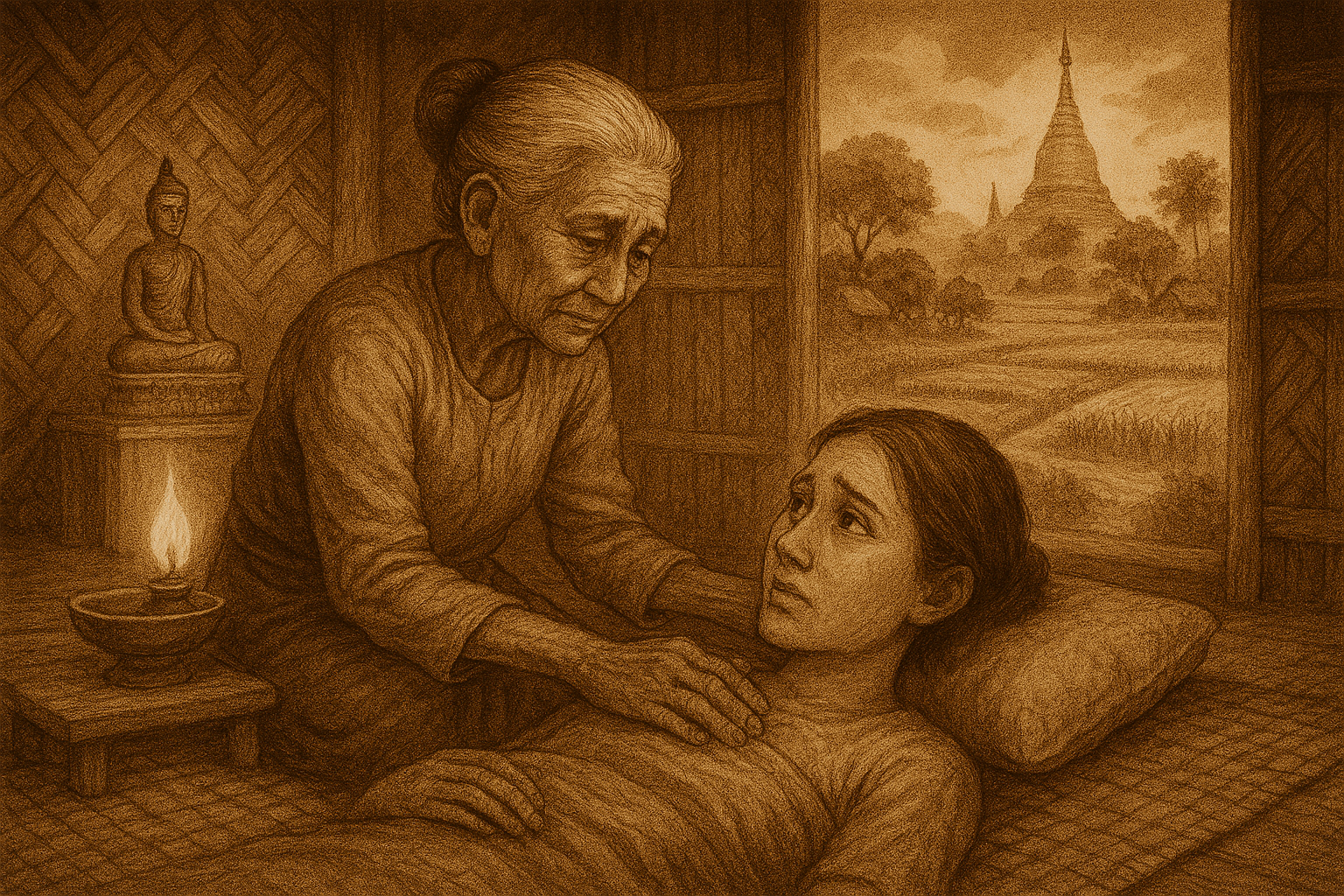
The mother, seeing her daughter struck low, did not hesitate. She did not remind the girl of the cruel words spoken. She did not hold back her care as payment for past insults. Instead, she became a shadow of devotion, never leaving her daughter’s side.
With her weathered hands, gentle as falling petals, she bathed her daughter’s burning forehead with cool water drawn from the village well. She prepared healing broths, holding the bowl steady while coaxing tiny sips past fevered lips. She burned incense at the altar and recited prayers through the long, dark nights when the fever raged its worst. She fanned away mosquitoes and sang old lullabies, the same ones she had sung when her daughter was small and still loved her.
Days stretched into weeks, and slowly, impossibly, the fever broke. The daughter’s eyes cleared, and for the first time in years, she truly saw her mother. She saw the deep lines etched by worry and labor. She saw the thin frame that had gone hungry so she might eat. She saw the love that had never wavered, even when met with only cruelty.
Tears spilled down the daughter’s cheeks, hot with shame and recognition. “Mother,” she whispered, her voice breaking, “I have been a serpent in our home, poisoning the one who gave me life. You sacrificed everything for me, and I repaid you with thorns instead of flowers.”
The old mother smiled, her own eyes wet with joy, and stroked her daughter’s hair. “You are my child, now and always. A mother’s love does not keep accounts.”
From that day forward, the daughter became the devoted child her mother deserved. She spoke only with kindness and respect. She helped with every task, easing the burden from those tired shoulders. She listened to the old stories with genuine interest, recognizing them as treasures she had nearly lost. And when visitors came, she spoke of her mother with pride and gratitude, ensuring everyone knew the depth of her parent’s love and the shame of her former ways.
The village elders nodded with satisfaction. The daughter had learned what so many must learn, though some never do: that parents are precious jewels, not to be taken for granted but honored and cherished, for the love they give is as constant as the stars and as forgiving as the first rain after drought.
Click to read all Southeast Asian Folktales — featuring legends from Thailand, Indonesia, Vietnam, and the Philippines.
The Moral of the Story
This ancient Burmese tale teaches that respecting and honoring one’s parents is essential, regardless of age or circumstance. The mother’s unconditional forgiveness demonstrates that parental love endures beyond all hurt, while the daughter’s transformation shows that it is never too late to recognize our wrongdoings and choose the path of filial piety. In Burmese culture, caring for aging parents is not merely a duty but a sacred privilege, reflecting the Buddhist values of compassion, gratitude, and the karmic bonds between generations.
Knowledge Check
Q1: Who are the main characters in “The Ungrateful Daughter” Burmese folktale?
A: The main characters are a devoted mother who has sacrificed everything for her child, and her adult daughter who disrespects and insults her despite all the mother’s efforts and love.
Q2: What does the daughter’s illness symbolize in this Burmese story?
A: The daughter’s illness symbolizes karmic consequence and serves as a transformative moment that humbles her pride, making her vulnerable and dependent, just as her aging mother had been vulnerable to her cruelty.
Q3: How does the mother respond when her daughter falls sick?
A: Despite enduring years of disrespect and cruel words, the mother immediately cares for her sick daughter with complete devotion, nursing her through the fever without resentment, demonstrating unconditional parental love and forgiveness.
Q4: What is the central moral lesson of this Burmese folktale?
A: The story teaches filial piety the importance of respecting, honoring, and caring for one’s parents. It shows that parental love is unconditional and that children should never take their parents’ sacrifices for granted.
Q5: What cultural values does this story reflect about Burmese society?
A: The tale reflects core Burmese Buddhist values including filial respect, compassion, gratitude, forgiveness, and the concept of karma that our actions, whether respectful or cruel, have consequences that shape our lives.
Q6: How does the daughter change by the end of the story?
A: After experiencing her mother’s selfless care during her illness, the daughter undergoes genuine repentance and transformation, becoming respectful, helpful, and devoted, honoring her mother for the rest of her life.
Source: Adapted from Folklore and Fairy Tales from Burma
Cultural Origin: Burmese (Myanmar)