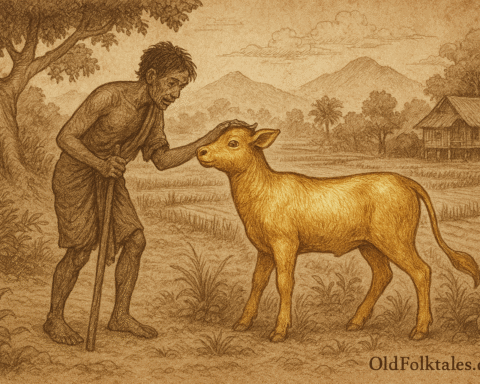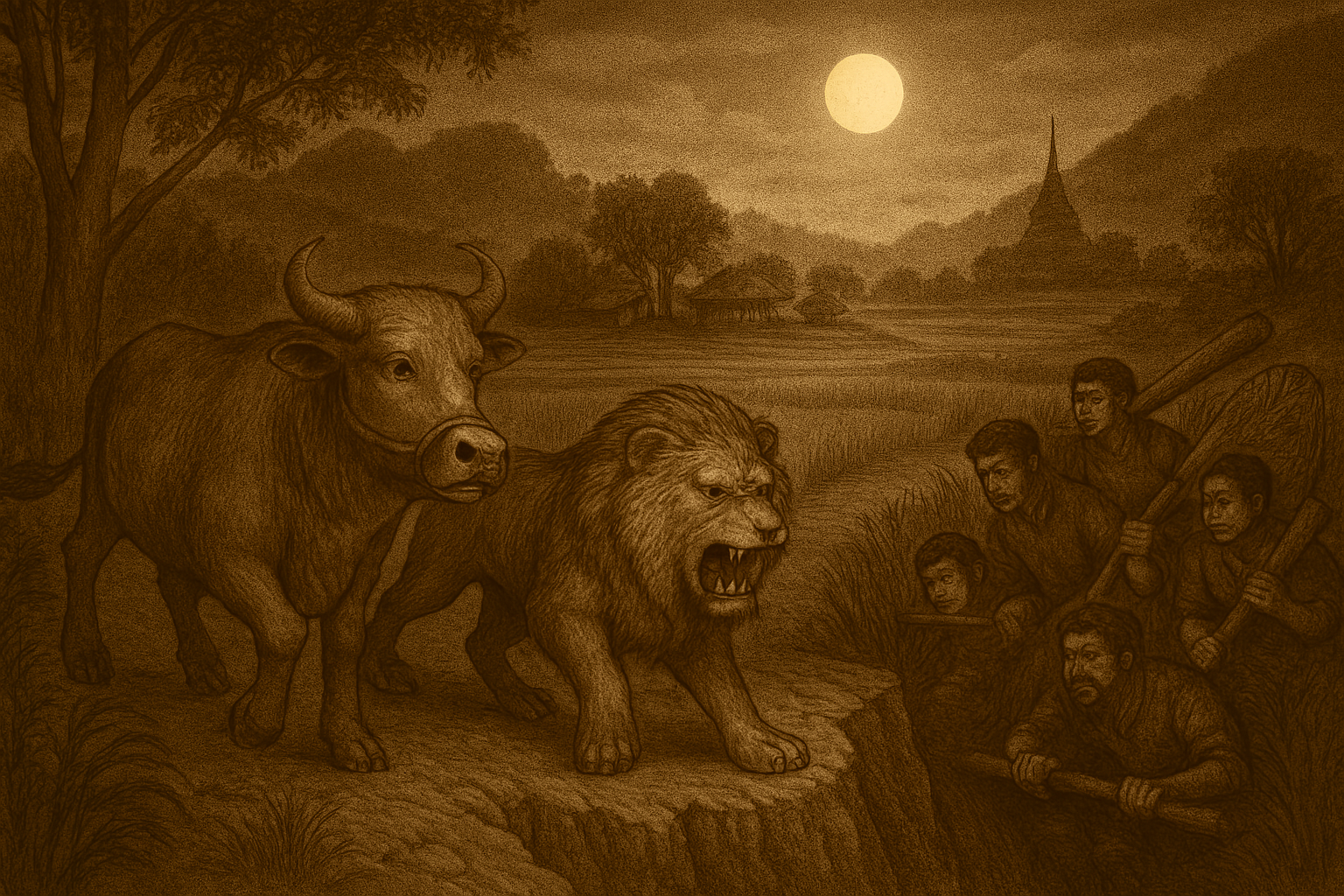
In a peaceful village nestled between the lush green hills of Burma, where terraced rice fields climbed the slopes like giant steps toward the clouds and the air was perfumed with frangipani blossoms, there lived an ox whose reputation spread far beyond the bamboo fences of his home. His coat was the color of rich earth after rain, his horns curved strong and proud, and his eyes held a depth of understanding that seemed almost human.
This ox was no ordinary beast of burden. Each morning, as the first golden rays of sunlight touched the gilded spire of the village pagoda, he would rise from his shelter and begin his daily work. He pulled the heavy wooden plow through the flooded rice paddies, his hooves sinking deep into the thick mud with each deliberate step. The weight of the plow was immense, and the work stretched from dawn until the shadows grew long, yet the ox never complained, never balked, never showed anything but patient dedication to his labor.
Click to read all East Asian Folktales — including beloved stories from China, Japan, Korea, and Mongolia.
The farmers loved him dearly. While other oxen might kick or resist when the work grew hard, this ox remained gentle as a summer breeze. Children would run alongside him in the fields, their laughter ringing out like temple bells, and he would slow his pace to match their small legs. When the elderly village headman needed help moving supplies for the monastery, the ox would kneel without being asked, making it easier to load the heavy sacks of rice onto his broad back.
“He has the heart of a Buddha,” the villagers would say, pressing their palms together in respect. “Strong in body, gentle in spirit, and patient beyond measure.”
But as the seasons turned and the monsoon rains gave way to dry, dusty months, a shadow fell across the village’s peace. Word spread through the settlements like wildfire carried on the wind a lion had been spotted in the nearby forest. Not just any lion, but a massive beast with a mane like thunderclouds and teeth that gleamed white as temple marble. The creature had been driven from the deep jungle by drought and hunger, and now it prowled closer to human habitation, its golden eyes fixed on easier prey.
The cattle became the lion’s target. At first, the villagers lost a young calf at the edge of the grazing fields. Then a cow disappeared during the night, leaving only tracks and a few tufts of hair caught on thorny bushes. Fear rippled through the village like wind through rice stalks. The farmers built higher fences and kept watchfires burning through the darkness, but they knew these measures were temporary. The lion was cunning and desperate, a dangerous combination.
“We must protect our herds,” declared the headman during an emergency gathering beneath the village’s largest banyan tree, its ancient branches spreading like a canopy above the worried faces. “But how can we stand against such a predator? We are farmers, not hunters.”
The villagers murmured in agreement, their voices thick with concern. Some suggested abandoning the outer fields. Others proposed keeping all cattle locked in pens, though everyone knew this would mean the end of grazing and the weakening of their herds. Fear seemed to have no solution, only increasingly difficult compromises.
It was then that the clever ox stepped forward from where he had been standing quietly at the edge of the gathering. He made a low, rumbling sound deep in his chest, catching the headman’s attention. The old man looked into the ox’s intelligent eyes and saw something there understanding, determination, and the glimmer of an idea.
“You have a plan, my friend?” the headman asked softly, and though the ox could not speak in human words, his deliberate movements and purposeful gestures made his intentions clear.
Over the next three days, the ox worked with the villagers to prepare a trap. It was a scheme that required both careful planning and perfect timing. The ox led the men to a narrow ravine at the edge of the forest where a small stream trickled between steep earthen banks. The path was just wide enough for a large animal to pass through, but barely so.
Under the ox’s guidance conveyed through gestures, movements, and that remarkable intelligence that seemed to shine from his eyes the villagers concealed deep pits along the ravine path, covering them with woven bamboo mats and careful layers of leaves and soil. They positioned nets in the trees overhead and placed large logs on the ravine’s edge, held in place by carefully balanced stones.
“But how will we lure the lion here?” asked a young farmer, wiping sweat from his brow.
The ox simply looked at him with those knowing eyes, and the young man understood. The ox himself would be the bait.
On the appointed night, when the moon hung full and silver as a rice bowl in the star-scattered sky, the ox walked deliberately to the edge of the forest. He positioned himself in a clearing where he knew the lion would catch his scent, and then he waited, calm and still as a statue in a temple courtyard.
The lion came as they knew it would, drawn by the scent of prey and maddened by hunger. Its roar split the night air like thunder, sending birds erupting from their roosts in panic. The great cat’s eyes gleamed with predatory hunger as it spotted the ox standing alone, seemingly helpless beneath the moonlight.
The ox did not run in blind panic as the lion expected. Instead, he turned with measured grace and began moving toward the ravine, walking quickly but not so fast that the lion would lose sight of him. The predator gave chase, powerful muscles bunching and releasing as it bounded across the ground, certain of an easy kill.
The clever ox led the lion exactly where he intended, timing each step with precision. As they entered the narrow ravine, the ox leaped gracefully over the hidden pit, his powerful legs carrying him safely across. The lion, focused entirely on its prey and blinded by hunger, could not stop in time. Its massive paws hit the concealed trap, and with a roar of surprise and fury, the great cat crashed through the bamboo covering into the pit below.
Immediately, the hidden villagers emerged from their positions. The nets dropped from the trees. The balanced logs rolled down, blocking the ravine’s exit. The lion was trapped, unable to climb the steep earthen walls or break through the nets and barriers.
The next morning, traveling merchants and hunters passing through took the captured lion far away to distant hills where game was plentiful and villages were few. The threat was ended not through violence, but through cleverness and community cooperation.
The villagers celebrated their victory with a feast at the village center, laying offerings of sweet rice cakes and fresh vegetables before the clever ox. They hung garlands of marigolds around his neck and thanked him with prayers and songs. The ox accepted their gratitude with his characteristic gentleness, then returned to the fields to continue his daily work, as humble and patient as ever.
From that day forward, the story of the clever ox spread throughout Burma. Parents told it to their children, teaching them that true strength comes not just from powerful muscles, but from a sharp mind and a cooperative spirit. The ox had shown that even the gentlest creature, when armed with intelligence and supported by community, could overcome the fiercest predator.
The village prospered, their herds grew fat and healthy, and the clever ox lived out his days honored and loved a living reminder that wisdom paired with strength protects not just oneself, but all those who depend on us.
Click to read all Southeast Asian Folktales — featuring legends from Thailand, Indonesia, Vietnam, and the Philippines.
The Moral of the Story
This Burmese folktale teaches that intelligence combined with physical strength creates true power, especially when used to protect the community. The ox demonstrates that patience, gentleness, and wisdom are not weaknesses but qualities that enable effective problem-solving. Rather than relying on brute force alone, the ox uses his intelligence to devise a plan and his strength to execute it, showing that the greatest protection comes from combining mental and physical abilities with community cooperation. In Burmese Buddhist culture, this reflects the ideal of using one’s gifts whether strength, intelligence, or both in service of others and the greater good.
Knowledge Check
Q1: Who is the main character in “The Clever Ox” Burmese folktale?
A: The main character is a gentle, hardworking ox who labors in the rice fields of a Burmese village. Despite enduring harsh daily work, he remains patient and kind,and is beloved by all the villagers for his gentle nature and intelligence.
Q2: What threat does the village face in this story?
A: A large, hungry lion driven from the jungle by drought begins hunting the village’s cattle. The lion kills several animals and threatens the entire herd, creating fear throughout the community and endangering their livelihood.
Q3: How does the clever ox defeat the lion?
A: Rather than fighting the lion with brute strength, the ox uses intelligence to devise a trap. He works with villagers to prepare hidden pits and nets in a narrow ravine, then acts as bait to lure the lion into the trap where it is safely captured.
Q4: What does the ox symbolize in this Burmese tale?
A: The ox symbolizes the combination of strength and intelligence, showing that true power comes from using both physical abilities and mental wisdom. He also represents humility, patience, and selfless service to the community despite his remarkable capabilities.
Q5: What is the central moral lesson of “The Clever Ox”?
A: The story teaches that intelligence paired with strength protects the community most effectively. It shows that gentle, thoughtful problem-solving combined with physical capability and community cooperation is superior to brute force alone.
Q6: What cultural values does this story reflect about Burmese society?
A: The tale reflects Buddhist values of using one’s gifts in service of others, the importance of community cooperation, and the ideal of combining wisdom with action. It emphasizes that strength without intelligence is incomplete, and that true heroes protect others through thoughtful planning.
Source: Adapted from Folklore and Fairy Tales from Burma
Cultural Origin: Burmese (Myanmar)