In a bustling riverside village along the Yellow River, floods were a constant threat. The villagers had long learned to respect the river, building levees and performing seasonal rituals to appease its restless waters. Among them lived a humble potter, known for his skill in shaping clay into figures that seemed almost alive. Though he lived modestly, he cared deeply for his community, often mending broken pottery for his neighbors without asking for payment.
One year, heavy rains swelled the Yellow River beyond its usual bounds. The waters began to spill into homes and fields, isolating families and livestock. Boats were scarce, and the villagers struggled to rescue those trapped in their houses or clinging to rooftops. Desperation hung thick in the air as the river’s currents grew stronger each hour.
Moved by the plight of his neighbors, the potter conceived a plan. He took a large mound of clay, shaping it with care into a magnificent horse. He worked tirelessly through the night, imagining the horse galloping through the rising waters, rescuing those stranded on rooftops and in trees. When he finished, the horse’s eyes gleamed as though filled with spirit, and its body seemed poised to spring to life. The potter whispered a prayer, calling upon the river spirits and ancestors to guide his creation.
Journey through enchanted forests and islands in our Southeast Asian Folktales collection.
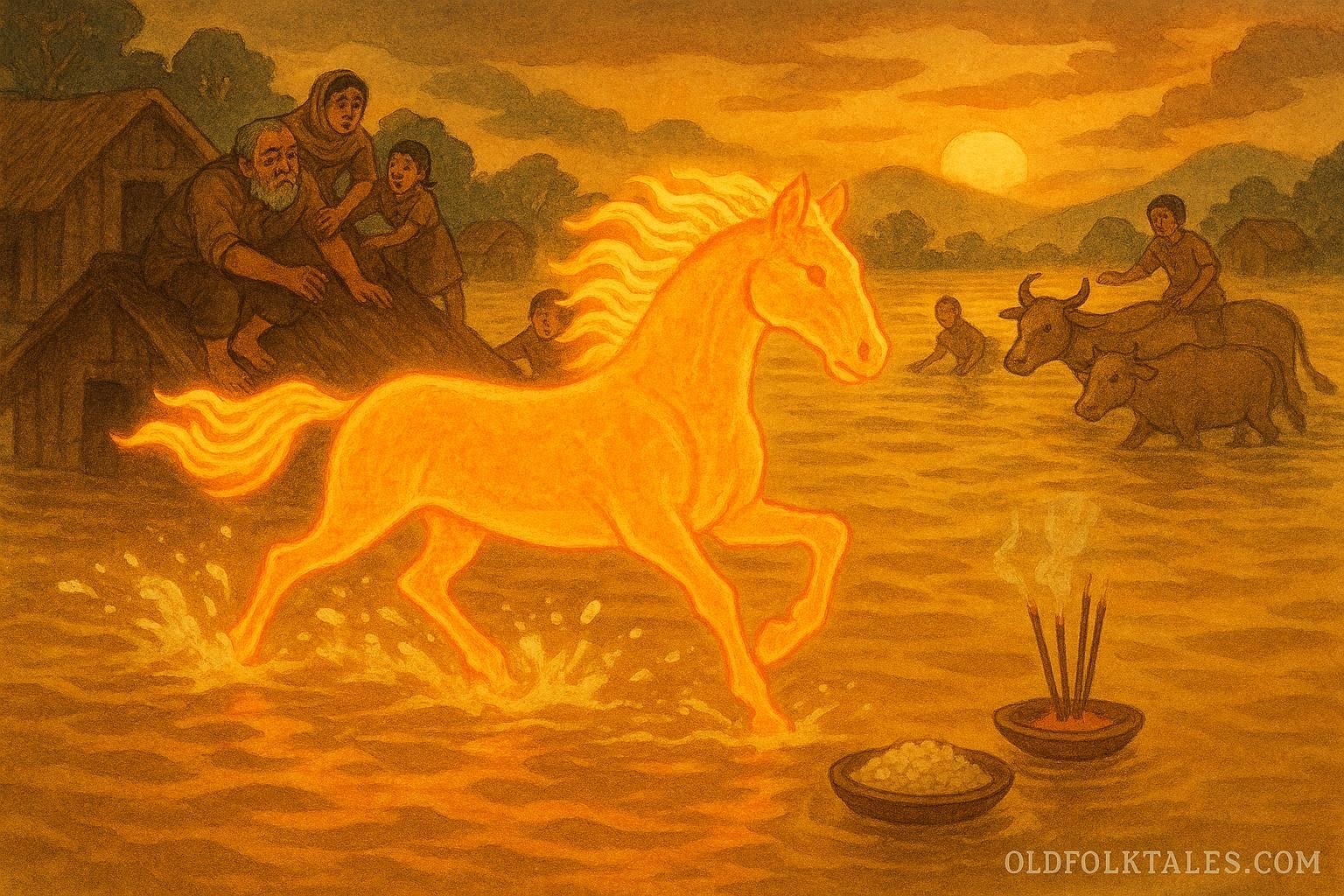
At dawn, as the first light reflected off the swollen river, the clay horse stirred. Its hooves struck the water with surprising strength, and it began to move along the river, weaving through the currents with grace and purpose. Villagers watched in astonishment as the horse approached their flooded homes. With gentle nudges and careful movements, the horse helped families climb onto its back, carrying them to safety on higher ground. It guided livestock through safer paths, preventing the animals from being swept away.
The river’s floods continued for several days, but each time danger threatened, the clay horse appeared at the water’s edge, tirelessly rescuing those in peril. Villagers came to recognize the horse not as ordinary clay, but as a temporary spirit brought to life by the potter’s devotion, ingenuity, and selfless concern for others. Children whispered stories of the magical horse as they huddled with their families, and the elders reflected on the meaning of impermanence, seeing the horse as both a blessing and a reminder of life’s fragility.
When the rains finally subsided and the river returned to its normal course, the villagers eagerly went to thank the potter for his miraculous creation. Yet, they found the clay horse lying still in the sun, its form once again solid and earthy. The villagers realized that the horse had fulfilled its purpose and returned to the earth, leaving behind only the memory of its courage and sacrifice. They celebrated the potter’s gift with offerings of incense and flowers, honoring both him and the clay horse’s spirit.
In the years that followed, the story of the clay horse became a teaching tale for the village. Parents recounted it to children to emphasize the importance of selflessness, vigilance, and cooperation during crises. They explained that just as the horse appeared when needed and disappeared when its work was done, human efforts should be directed toward serving the community without seeking eternal glory. The story also reinforced respect for nature, reminding villagers that the river’s power demanded attentiveness and care.
The potter himself continued his humble work, never claiming credit for the clay horse. When asked about it, he would simply smile and say that his hands had followed his heart. Villagers believed that the spirit of the clay horse remained with the river, watching over them during future floods and storms. Over time, the tale spread to neighboring villages along the Yellow River, inspiring similar acts of communal devotion and care.
Through generations, the Clay Horse of the Yellow River symbolized the delicate balance between human creativity and natural forces. It embodied impermanence, showing that heroic deeds do not require immortality but rather arise from timely action, compassion, and moral courage. Villagers learned to act wisely, to help without expectation, and to recognize that each moment carries the potential for extraordinary acts that leave lasting moral impact.
Even today, storytellers along the Yellow River recount the tale during the flood season. They remind children and adults alike that bravery can take many forms and that the most important virtues are humility, compassion, and dedication to the common good. The clay horse remains a symbol of hope, a fleeting yet enduring reminder that selfless action can save lives and inspire generations, even if it disappears once its purpose has been fulfilled.
Moral Lesson
The clay horse teaches that true heroism arises from selfless service, compassion, and moral courage. Acts of kindness and protection may be temporary, but their impact endures in the lives they touch and the communal bonds they strengthen. Life’s impermanence calls for timely action and devotion to the welfare of others without expectation of reward.
Knowledge Check
- Why did the potter create the clay horse?
He created it to rescue villagers and livestock stranded by the flooding Yellow River. - How did the clay horse assist the villagers?
It carried people to safety and guided livestock through safe paths during the floods. - What does the clay horse symbolize in the story?
It symbolizes selflessness, impermanence, and heroic action undertaken for the community. - Why did the clay horse return to clay after the floods?
Its purpose had been fulfilled, illustrating the theme of impermanence and the temporality of heroic deeds. - How did the villagers honor the potter and the clay horse?
They offered incense, flowers, and told the story to future generations as a lesson in courage and community service. - What broader lesson does the story teach about human action and natural forces?
It teaches that attentive, compassionate, and timely human action can mitigate natural dangers and strengthen communal bonds.
Source
Adapted from Yellow River Basin Folklore Survey Archives, 2015.
Cultural Origin
Northern riverine folklore traditions.