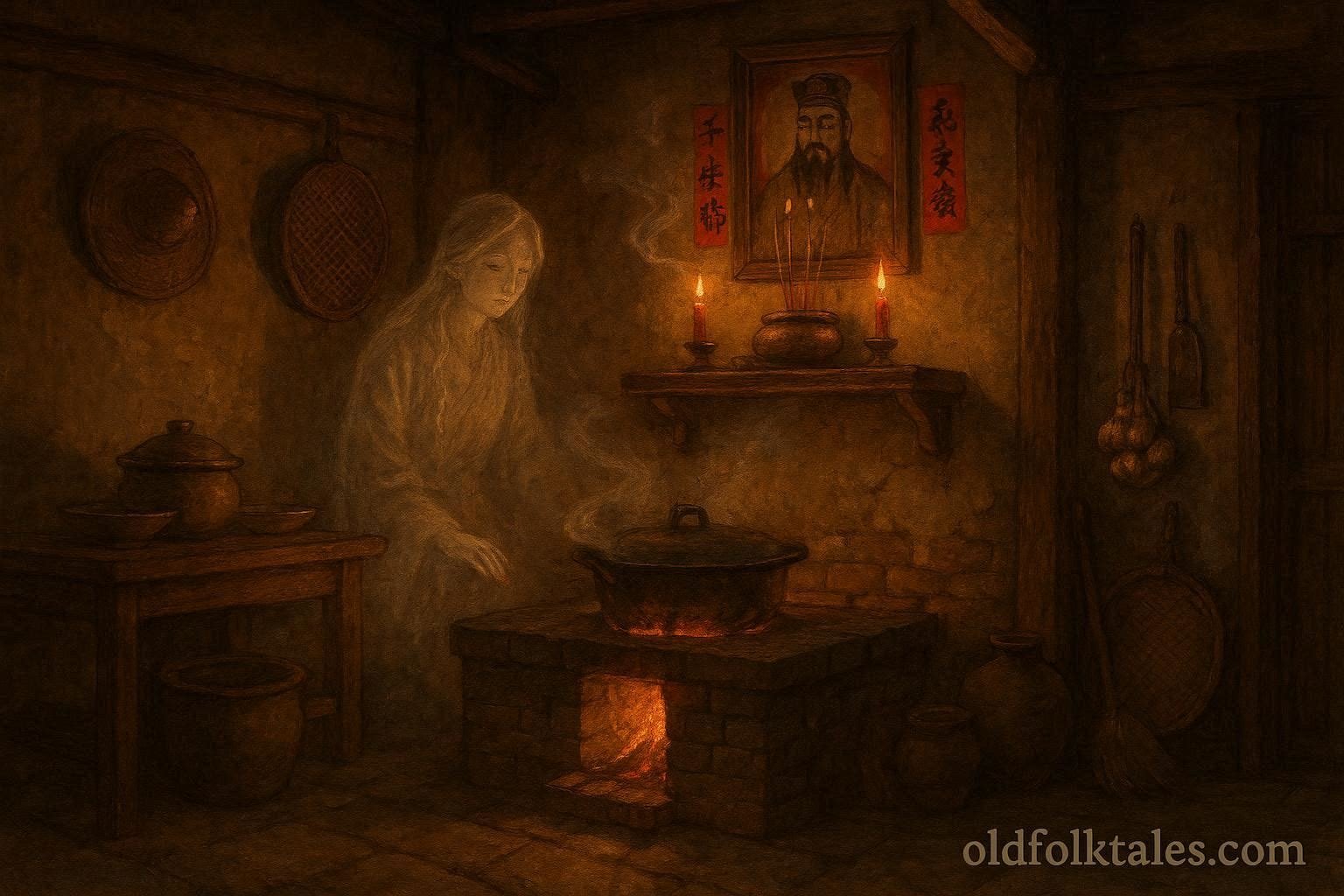
Smoke rose each morning from the kitchens of ancient Chinese homes, curling upward through roof tiles and disappearing into the sky. The hearth was not merely a place of cooking. It was the heart of the household, where warmth, nourishment, and family harmony were sustained. In one such household lived a man named Zhang Dan, whose life would one day become inseparable from the very fires he once took for granted.
Zhang Dan was not born wicked. In his youth, he was known as a diligent farmer and a devoted husband to a woman named Lady Guo. Together they tilled their land, shared modest meals, and prayed quietly for fortune. Their home was humble but filled with contentment. Yet as years passed, Zhang Dan grew restless. He envied wealthier neighbors and resented the simplicity of his life. When prosperity finally came through a good harvest, it brought arrogance instead of gratitude.
Blinded by pride, Zhang Dan abandoned Lady Guo and married a younger woman who admired his newfound status. He spent lavishly, neglected his duties, and treated servants harshly. Lady Guo, though cast out, did not curse him. She returned to her family with dignity and continued her life with patience and virtue. Zhang Dan, however, soon found that fortune is fickle when guided by greed.
Journey through enchanted forests and islands in our Southeast Asian Folktales collection.
Within a few years, drought struck. Crops failed. His wealth vanished. The younger wife left him when hardship replaced comfort. Zhang Dan wandered from village to village, reduced to begging. His fine clothes turned to rags, and hunger hollowed his face. Winter arrived with cruel indifference, and Zhang Dan collapsed one evening near a familiar doorway, unaware that fate had led him back to the home of the woman he once betrayed.
Lady Guo recognized him at once, though he did not recognize her. Without revealing herself, she welcomed the beggar inside, gave him warm food, and offered shelter. Zhang Dan ate ravenously, tears falling into his bowl as shame stirred within him. Something in the kindness of the household felt painfully familiar. When he finally lifted his eyes and recognized Lady Guo, the weight of his actions crushed him.
Overcome with guilt, Zhang Dan fled into the kitchen, unable to face her forgiveness. In his despair, he threw himself into the hearth fire, believing death was the only atonement for his betrayal. Flames roared upward, but instead of consuming him entirely, they transformed him. The smoke rose thick and heavy, carrying his spirit skyward.
The Jade Emperor, ruler of Heaven, observed all that had transpired. Moved by Zhang Dan’s repentance and Lady Guo’s unwavering virtue, he issued a judgment that would shape generations. Zhang Dan would not vanish from existence. Instead, he would become Zao Jun, the Kitchen God, bound eternally to the hearths of human homes. His task would be to observe the conduct of families and report their deeds to Heaven at the end of each lunar year.
Thus, Zao Jun descended back to earth, no longer flesh and bone but spirit and flame. He took residence above kitchen stoves, watching quietly as meals were prepared, arguments unfolded, and acts of kindness or cruelty passed unseen by others. Families did not always remember his presence, but he never forgot his duty.
As years passed, stories spread of the Kitchen God. Parents reminded children to behave respectfully in the kitchen. Spouses softened harsh words near the hearth. It was said that Zao Jun saw everything. At the end of the year, he ascended to Heaven to deliver his report. Households hoping for a favorable account offered him sweets and sticky rice cakes, believing sweetness would soften his words and sugar would seal his lips from harsh truths.
Lady Guo was also honored. In many tellings, she became associated with domestic virtue, a silent counterpart to the Kitchen God’s watchful eye. Together, they represented the balance of accountability and compassion within family life.
Over generations, the ritual of sending off the Kitchen God became deeply rooted. On the twenty third day of the twelfth lunar month, families cleaned their kitchens, burned incense, and offered prayers. Children were taught that morality was not only a public matter but a private one, lived out in daily actions behind closed doors.
Zao Jun never spoke aloud. His presence was subtle, like warmth from embers or the quiet crackle of firewood. Yet his influence shaped behavior more effectively than fear alone. People remembered that he had once been human, deeply flawed, capable of great harm but also sincere remorse. His story reminded families that redemption was possible, but accountability was unavoidable.
In time, the origin of Zhang Dan faded into myth, but the lesson remained vivid. The Kitchen God did not punish directly. He observed. He remembered. And once each year, truth ascended to Heaven, just as smoke rises from a hearth.
Even today, in homes where incense is lit and offerings are made, the spirit of Zao Jun endures. Not as a threat, but as a reminder that the smallest daily actions shape the moral fabric of a household. The kitchen, once again, remains the heart of the home, watched over by a god who learned the cost of neglecting virtue only after losing everything.
Moral Lesson
This story teaches that moral accountability begins at home and that private actions matter as much as public ones. True repentance arises from recognizing one’s faults and accepting responsibility. While forgiveness can be offered, consequences remain, and lasting redemption comes through service, humility, and constant self reflection.
Knowledge Check
- Who was Zhang Dan before becoming the Kitchen God?
He was a farmer who abandoned his virtuous wife after gaining wealth. - What led to Zhang Dan’s downfall?
His arrogance, greed, and neglect of moral responsibility caused his fortune to collapse. - How did Lady Guo respond when Zhang Dan returned as a beggar?
She showed kindness and offered him food and shelter without revealing her identity. - Why did Zhang Dan throw himself into the hearth fire?
He was overwhelmed by guilt and believed death was the only atonement for his actions. - What role did the Jade Emperor assign to Zhang Dan?
He transformed him into Zao Jun, the Kitchen God who observes households and reports to Heaven. - Why do families offer sweets to the Kitchen God before the new year?
They believe sweetness will encourage a favorable report of their conduct.
Source
Adapted from Peking University Folk Religion Digital Resources, 2015.
Cultural Origin
Traditional Han Chinese household folklore.