Long before the world settled into its familiar rhythms, when the deserts of Mahra stretched unbroken beneath an open and listening sky, the Moon and the Sun lived together upon the earth. They were sisters, born of the same ancient light, yet utterly different in nature. The Sun was bold and radiant, moving freely across the land with warmth that awakened seeds and stirred life from the sand. The Moon, by contrast, was gentle and cool, her presence quiet as a whispered prayer, her glow soft enough to soothe the restless night.
By day, the Sun delighted in her dominion. She rose proudly above the dunes, painting the desert gold and filling the air with heat and vigor. Creatures basked openly in her light, and travelers welcomed her guidance across the wide plains. The Moon watched from shaded places, content to wait for night, when her calm silver glow could spread without rivalry.
But when darkness fell, the Moon’s troubles began. Her gentle light drew the attention of many beings who wandered the desert after sunset. Animals lingered too close, unsettled by her presence. Stranger still were the jinn, spirits of the unseen world, who were drawn to her cool radiance and followed her wherever she went. They whispered, hovered, and circled, finding comfort in her softness but giving none in return. The Moon felt herself constantly observed, never alone, never at peace.
Night after night, the Moon withdrew farther into the desert, yet the creatures followed. Her heart grew heavy with fear and exhaustion. She loved the earth, but it no longer felt safe beneath her feet. At last, overwhelmed, she resolved to seek counsel from one older and wiser than herself.
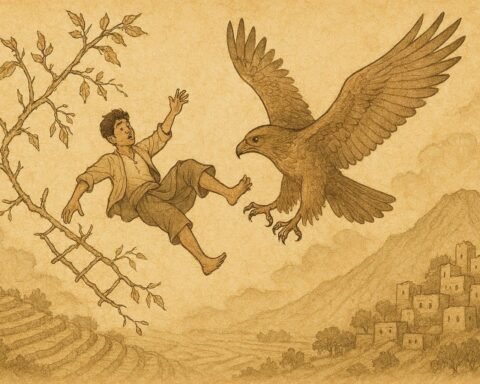
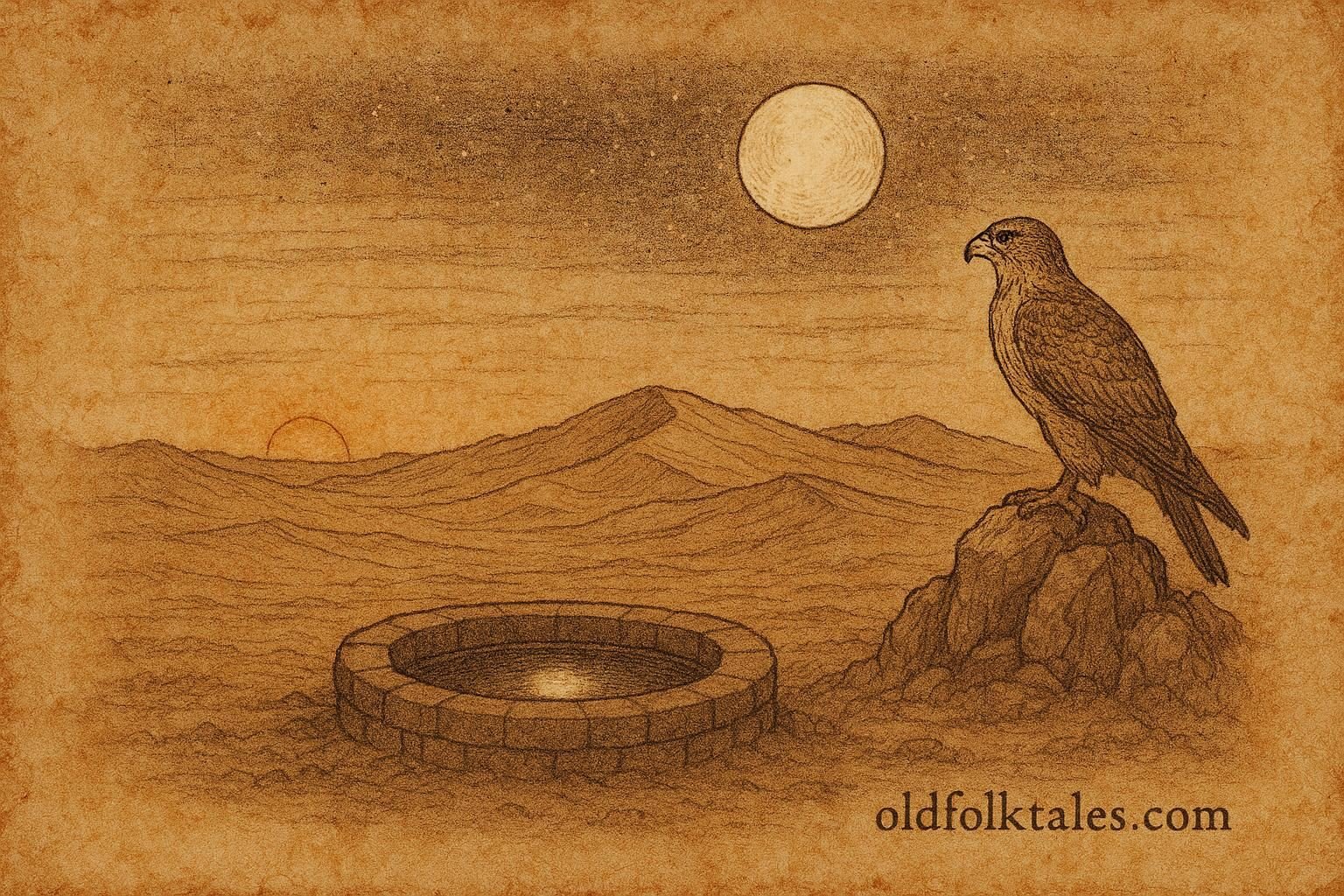
High above the plains lived Rukham, the great bird, a giant falcon whose wings cast shadows like clouds over the land. It was said that Rukham had seen the world from its first shaping and understood paths hidden from ordinary sight. The Moon approached him with humility and poured out her sorrow, speaking of the creatures, the jinn, and the ceaseless unrest that followed her gentle light.
Rukham listened in silence, his keen eyes reflecting ancient understanding. When she finished, he spoke slowly. He told her that he could not fight every creature or spirit that troubled her. Such battles, he said, never truly end. Then he offered her a different kind of wisdom. “If the world overwhelms you,” he said, “you must rise above it.”
The Moon asked how this could be done. In answer, Rukham lifted her upon his vast wings and carried her to the highest peak he knew. From there, the desert stretched endlessly below, and the air thinned with height. For a moment, the Moon felt hope. Yet even there, she sensed the pull of the world, the gaze of beings below. The height was not enough.
Seeing her despair, Rukham brought her back down and left her to reflect. Alone in the quiet hours before dawn, the Moon wandered until she came upon a deep, still well hidden among the rocks. Its surface was dark and calm, holding the sky within it like a secret. As she gazed into the water, she saw her own reflection shining upward, brighter and freer than she had ever felt upon the ground.
In that moment, understanding came to her. Gathering all her light, the Moon poured herself into the well, becoming reflection rather than form. Her image rose, lifted by the pull of the heavens, and launched itself into the vast sky above the desert. There, beyond the reach of jinn and wandering creatures, she found stillness and peace.
When the Sun awoke and searched for her sister, the earth felt strangely empty. The Sun’s warmth spread across the land, but her joy was dimmed by absence. When she finally looked upward and saw the Moon shining far above, her light calm and distant, she understood what had been done. Though she missed her sister deeply, she accepted the choice that had been made.
The Sun agreed to follow the Moon across the sky each day, chasing her from horizon to horizon. Yet she would never catch her, for the Moon now belonged to the heavens, not the earth. Thus they became bound in eternal movement, one ruling the day, the other guiding the night, their paths forever close yet never touching.
From that time onward, the Moon waxed and waned, sometimes full and bright, sometimes thin and hidden, reminding all who watched her that distance can change shape but not presence. The people of Mahra say this is why the Moon lives in the sky, serene and unreachable, watching over the world without being consumed by it.
Moral Lesson
This Yemeni creation myth teaches that peace is sometimes found not by confrontation, but by transcendence. When gentleness is threatened, wisdom may lie in rising beyond harm rather than enduring it.
Knowledge Check
1. Where did the Sun and Moon originally live in this Yemeni myth?
They lived together on the earth in the Mahra desert.
2. Why was the Moon distressed living on earth?
She was constantly harassed by desert creatures and jinn drawn to her gentle light.
3. Who did the Moon seek for help and guidance?
She sought the great bird Rukham, a giant falcon.
4. What advice did Rukham give the Moon?
He told her she must rise above the world rather than fight it.
5. How did the Moon ultimately reach the sky?
She reflected herself through a well and launched into the heavens.
6. What natural phenomenon does this story explain?
It explains why the Moon lives in the sky and the nature of its phases.
Source and Cultural Origin
Source: Yemeniat, category “أساطير خلقية” (Creation Myths).
Cultural Origin: Mahra region, eastern Yemen.