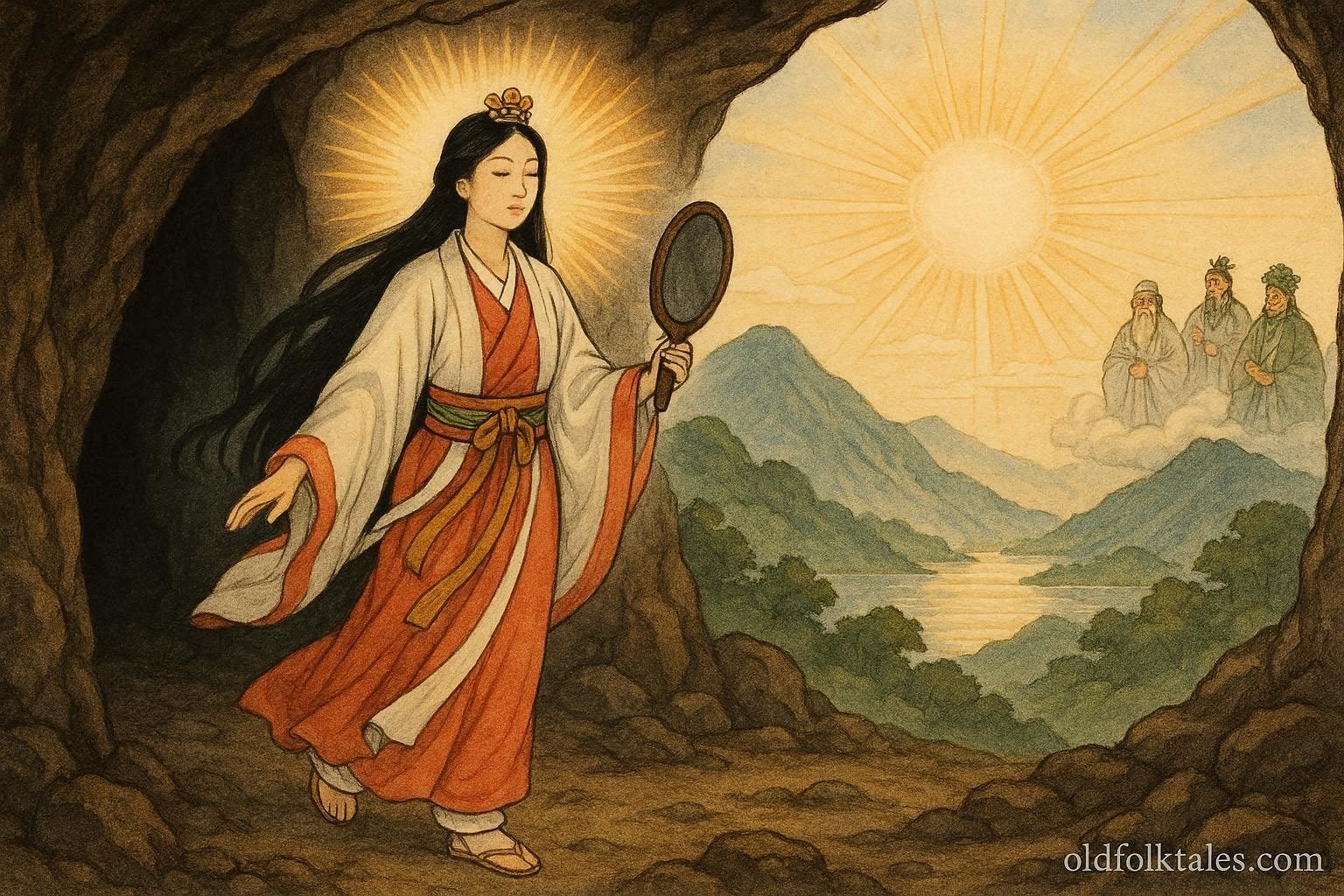
In the age before the sun shone freely across the heavens, the world had fallen into a deep shadow. Amaterasu, the radiant sun goddess, had withdrawn into a celestial cave, leaving the land and its people in darkness. Her anger and sorrow were profound. The gods had quarreled among themselves, and the dissonance of the heavens had driven her to seclude herself, fearing the chaos outside. Without her light, crops failed, rivers grew sluggish, and mortals trembled with fear. The birds no longer sang, and even the mountains seemed to bow in silent lament.
The other deities gathered in counsel, their voices echoing across the celestial plane. They knew that Amaterasu’s absence threatened all existence. How could they coax the sun goddess from her cave? Many suggestions were offered. Some gods argued for force, to drag her from her sanctuary. Others proposed clever tricks, to entertain or distract her. Among them stood the goddess Uzume, known for her exuberance, courage, and unshakable spirit. Uzume spoke gently yet firmly. She would not force Amaterasu, for no light born of coercion could restore harmony. Instead, she would create joy so irresistible that the sun goddess would be drawn to it naturally.
Uzume set to work beneath the mouth of the cave. She danced with abandon, stamping her feet, shaking her limbs, and turning her body in rhythms both comical and captivating. She overturned a wooden tub and danced upon it, her laughter and movements echoing across the shadows. The other gods joined in, clapping, singing, and banging drums, their joy and mischief forming a chorus that stirred the air and penetrated even the deepest recess of the cave.
Journey through enchanted forests and islands in our Southeast Asian Folktales collection.
Curious, Amaterasu peered from her retreat, drawn by the sounds and laughter. She glimpsed Uzume’s reflection in a polished bronze mirror that the gods had prepared. The mirror shone with divine brilliance, capturing the reflection of the lively dance. Amaterasu, seeing her own luminous visage mirrored and combined with the joy around her, felt a tug at her heart. She had been secluded, but in that reflection, she glimpsed not only herself but also the celebration of life that had continued in her absence. The mirror did more than reflect; it reminded her of her central place in the cosmos.
The gods had anticipated this. When Amaterasu inched forward to see the source of the laughter and the light, they gently placed a braided rope across the entrance to prevent her from retreating immediately. Her curiosity, mingled with delight and recognition of the communal joy, overcame her fear and anger. She stepped fully into the open, and the heavens were immediately illuminated. Sunlight poured across the mountains, rivers sparkled, and the earth exhaled in relief. Birds took flight, flowers lifted toward the warmth, and mortals bowed in awe and gratitude.
With her emergence, the world returned to balance. The mirror had fulfilled its purpose: it had shown the sun goddess her own radiance reflected in the harmony and happiness of the cosmos. It had not coerced but invited, reminding Amaterasu of the joy that her presence could bring. From that day forward, the mirror was revered not only as a tool but as a symbol of insight, self-reflection, and the power of encouragement over force. It came to represent the principle that even the mightiest beings can be guided by patience, creativity, and reverent admiration.
Amaterasu’s light restored the rhythms of life. Farmers tilled their fields beneath the renewed sun, children played in golden sunlight, and the rivers teemed with fish. The mountains regained their majesty, the skies their clarity, and the celestial bodies resumed their proper dance. The mirror remained in the care of the gods, a sacred object that reminded all of the delicate interplay between light and shadow, authority and persuasion, solitude and community. Even the mischievous Uzume was honored, her laughter now remembered as the spark that drew the sun out of sorrow.
Legends say that when shadows gather too long in hearts or homes, one can look to the mirror of Amaterasu’s cave as a symbol that joy, patience, and reflection can overcome even the deepest gloom. The story teaches that guidance comes not always through force, but through invitation, understanding, and shared delight. It also reminds mortals that the light within each being is mirrored in the happiness and harmony of the community, and that one can inspire others without coercion or confrontation.
Explore timeless legends from China, Japan, and Korea in our East Asian Folktales collection.
Moral Lesson:
True leadership and influence arise from compassion, insight, and encouragement rather than force. Encouraging joy and harmony can restore balance and illuminate even the darkest situations.
Knowledge Check:
1 What prompted Amaterasu to hide in the cave?
Answer: The quarrels and dissonance among the gods caused her sorrow and anger, leading her to retreat.
2 How did the gods attempt to bring Amaterasu out of hiding?
Answer: They organized a joyful and lively celebration, including Uzume’s dance, singing, and drumming.
3 What was the role of the mirror in the story?
Answer: The mirror reflected Amaterasu’s radiant image, reminding her of her importance and drawing her out of the cave.
4 Why did Uzume’s dance succeed where force would have failed?
Answer: Because it invited Amaterasu with joy and curiosity rather than coercion, appealing to her willingly.
5 What changes occurred in the world when Amaterasu emerged?
Answer: Light returned, rivers flowed, crops grew, animals flourished, and harmony was restored.
6 What is the broader lesson about leadership and influence?
Answer: Encouragement, creativity, and understanding can guide others more effectively than coercion, and shared joy can restore balance.
Source:
Adapted from Kokugakuin University Shinto Classics Archive, 2010.
Cultural Origin:
Ancient Japanese mythological tradition.