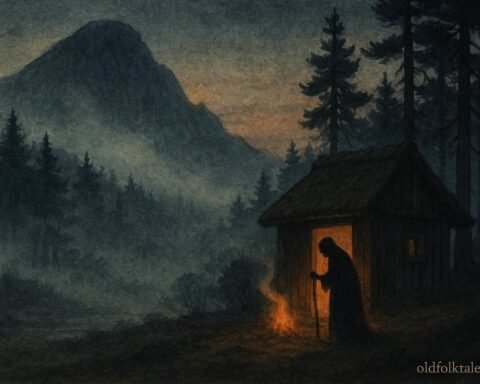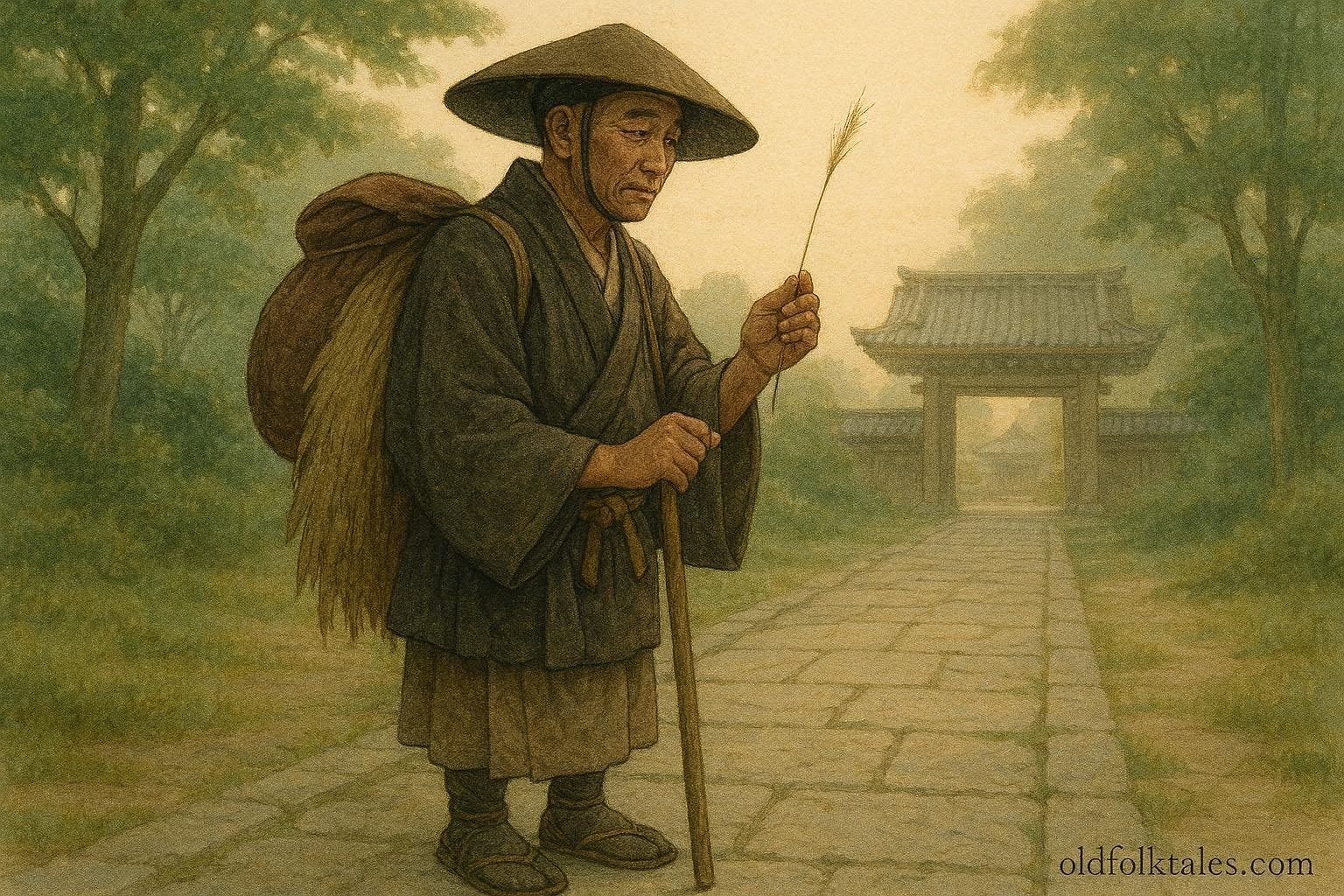
At the edge of a quiet road leading into the hills stood a small temple that few travelers noticed anymore. Its wooden gate leaned slightly, and moss crept along the stone steps, softened by years of rain and prayer. One morning, as the sun lifted itself above the treetops, a young man named Taro knelt before the temple altar with empty hands and an anxious heart. He had no land, no family wealth, and no skill that brought steady income. What he did possess was a deep belief that effort guided by faith could still shape a life.
Taro had wandered from village to village seeking work, often trading his labor for a bowl of rice or a place to sleep. Each rejection weighed heavily on him, yet he refused to curse his fate. That morning, he bowed deeply and asked the temple deity for guidance, not riches, but a path forward. When he rose from the floor, the air felt still and watchful, as if something unseen had heard him.
Outside the temple, a single straw lay across the stone path, pale and ordinary. As Taro stepped forward, his foot caught the straw, nearly causing him to fall. He laughed quietly at himself, then stopped. Remembering the teachings he had heard since childhood, he believed that nothing encountered immediately after prayer was meaningless. He picked up the straw and tucked it carefully into his sleeve.
Journey through enchanted forests and islands in our Southeast Asian Folktales collection.
As he continued down the road, a horsefly buzzed around his head, persistent and irritating. Acting on impulse, Taro tied the straw around the insect. The fly struggled, then rested, bound gently but firmly. A short while later, he encountered a woman trying to calm her crying child. The child’s eyes fixed on the fluttering fly tied to the straw, and his tears turned to laughter. Grateful for the moment of peace, the woman offered Taro three rice dumplings in exchange for the simple toy.
Taro accepted with gratitude. He ate one dumpling and saved the others, mindful that each step forward mattered. As the day grew warmer, he walked toward a village market, where merchants gathered with carts and baskets. At the edge of the square, a man called out in frustration as he searched for something to quench his thirst. Seeing Taro with the dumplings, the man offered a cup of fresh water in exchange for one. Taro agreed.
With the remaining dumpling, he continued onward until he reached a roadside orchard. The farmer there admired the neat wrapping of the food and asked where it came from. When Taro explained, the farmer smiled and traded him three oranges for the last dumpling.
The oranges grew heavy in Taro’s hands, both in weight and meaning. He felt as though the path itself was unfolding beneath his feet. Later that afternoon, he met a traveling merchant whose goods had spoiled under the sun. The merchant eagerly exchanged a piece of fine cloth for the oranges, hoping to restore his reputation with customers.
As Taro walked on, the cloth caught the attention of a wealthy household. Their daughter had fallen ill, and her mother believed that new fabric would lift her spirits. Taro offered the cloth without hesitation, and in return, the family gave him a small silver coin.
The coin felt cold and unfamiliar in his palm. Instead of spending it quickly, Taro paused, recalling the quiet presence he had felt at the temple. He chose to wait. Soon after, he encountered a man lamenting the loss of a tool essential for his trade. Taro offered the silver coin to help him replace it. Touched by the kindness, the man insisted on giving Taro a measure of rice far greater than the coin’s worth.
The rice became the foundation of the next exchange. A village elder noticed Taro distributing food to the hungry and asked about his journey. When Taro told the story of the straw and the steps that followed, the elder nodded with deep respect. He offered Taro a piece of land to cultivate, believing that such a man would bring harmony to the soil.
Seasons passed, and Taro worked tirelessly. The land flourished under his care. Crops grew strong, and neighbors came to him for advice. Each success traced its roots back to that first moment outside the temple. Taro never forgot the straw, which he kept pressed between the pages of a worn prayer book.
Years later, Taro was no longer known as a wanderer. He became known as a benefactor, a man who shared wealth freely and remembered hardship clearly. When asked how he achieved his fortune, he never spoke of cleverness or luck. He spoke instead of attentiveness, patience, and trust in the unseen order that connects effort with opportunity.
On certain mornings, Taro returned to the temple. He knelt on the same stone floor and placed a bundle of straw before the altar, not as payment, but as remembrance. He believed that wealth gained without gratitude would vanish as easily as it appeared.
The villagers began calling him the Straw Millionaire, not because of how much he owned, but because of how humbly it began.
Moral Lesson:
True prosperity grows through patience, gratitude, and faith in small beginnings. When people remain attentive to guidance and treat every exchange with sincerity, even the simplest object can become the seed of great fortune. Wealth earned through integrity brings lasting fulfillment rather than fleeting gain.
Knowledge Check:
1 What did Taro do immediately after leaving the temple?
Answer: He picked up a single straw from the path
2 Why did Taro keep trading rather than spending quickly?
Answer: He believed each step forward had meaning and guidance
3 What was Taro’s first trade involving the straw?
Answer: He tied it to a fly and traded it to comfort a child
4 What quality allowed Taro’s fortune to grow steadily?
Answer: Patience combined with faith and generosity
5 Did Taro seek wealth when he prayed at the temple?
Answer: No he asked for guidance rather than riches
6 Why did Taro continue visiting the temple after becoming wealthy?
Answer: To remember gratitude and the humble beginning of his fortune
Source:
Adapted from National Museum of Japanese History Folktale Manuscripts, 2012.
Cultural Origin:
Muromachi period moral folklore of Japan.