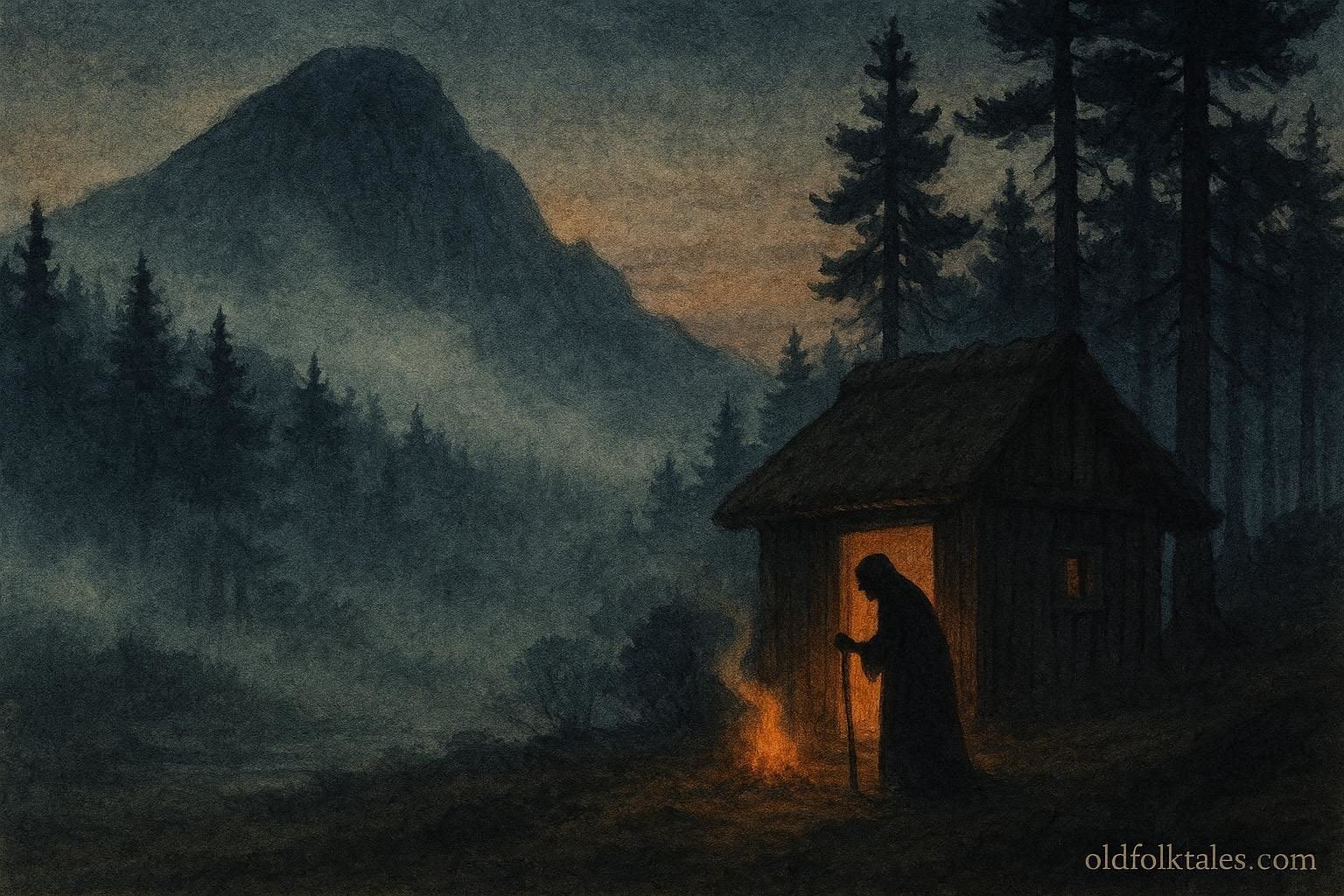
Mist clung tightly to the mountain paths of the north, settling between twisted pines and jagged rocks like breath held too long. Travelers who passed through Adachigahara often felt the weight of the silence pressing against their thoughts. Even the birds seemed reluctant to sing there. It was said that the mountain listened, and that it remembered every footstep ever taken upon its slopes.
One autumn evening, two monks traveling from a distant temple found themselves delayed by heavy rain. Their sandals were soaked, their robes heavy with water, and the daylight was slipping quickly behind the ridges. When they reached a small hut nestled against the mountainside, relief washed over them. Smoke curled gently from the roof, and the faint glow of firelight flickered through the cracks in the wooden walls.
An elderly woman opened the door when they called out. Her hair hung loose and gray, her eyes sharp and restless. She welcomed them inside without warmth or hostility, only a quiet acceptance. The hut was sparse, containing little more than a hearth, a kettle, and straw mats laid unevenly across the floor. The woman offered the monks shelter for the night, warning them not to look into the back room under any circumstances.
Journey through enchanted forests and islands in our Southeast Asian Folktales collection.
The monks agreed. Travelers were taught that hospitality came with rules, and gratitude required obedience. As they warmed themselves by the fire, the woman busied herself preparing millet porridge. Her movements were stiff, almost unnatural, as though her joints resisted her will. The younger monk noticed this but said nothing. Fear, he believed, often grew from imagination.
As the night deepened, wind howled against the hut, rattling the wooden frame. Shadows danced along the walls, stretching and shrinking with the firelight. The older monk recited prayers softly, grounding his mind. The younger monk, however, felt a tightening in his chest. The woman’s eyes flicked repeatedly toward the back room, as though listening for something unseen.
Unable to quiet his thoughts, the younger monk remembered the warning. Curiosity crept into his mind, feeding on unease. When the woman stepped outside to gather firewood, he rose and moved toward the forbidden room. His hand trembled as he slid the door open just a fraction.
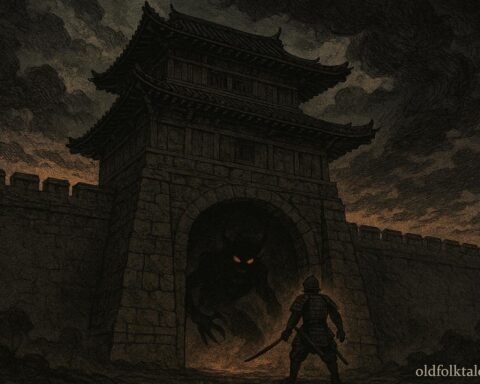
Inside lay a sight that froze his breath. Bones littered the floor, stripped clean and stacked in careful piles. Skulls stared back at him, their hollow eyes reflecting the firelight. A wave of terror surged through him as understanding struck. The woman was no hermit. She was the mountain witch of Adachigahara, a devourer of travelers, whispered about in fearful prayers and half remembered legends.
The monk staggered back to his mat, heart pounding. When the woman returned, her gaze fixed instantly upon him. A slow smile spread across her face, revealing teeth too sharp and too many. The air in the hut grew heavy, thick with menace.
She accused the monk of breaking her rule. Her voice shifted as she spoke, deepening and echoing unnaturally. She declared that fear and disobedience revealed weakness, and weakness invited consumption. Her body began to change before their eyes. Her limbs lengthened, her skin darkened, and her shadow stretched across the walls like a living thing.
The older monk stood calmly. He did not reach for weapons or flee. Instead, he began chanting sutras with unwavering focus. His voice filled the hut, steady and clear. The words carried neither accusation nor fear, only recognition. He addressed the woman not as a monster, but as a being trapped by hunger and despair.
The witch screamed, clawing at the air. The chant pressed against her like light against darkness. She raged that humans feared what they created and punished what reflected their cruelty. As her fury burned, cracks appeared in her monstrous form. Beneath the demon, the outline of a suffering woman emerged.
She collapsed to the floor, her transformation unraveling. In broken words, she confessed that she had once been abandoned in the mountains during a famine. Starvation drove her to madness, and madness turned her into what the villagers feared. Each traveler she consumed fed not only her body but her bitterness toward humanity.
The older monk listened without judgment. He spoke of impermanence and compassion, of how fear multiplies suffering when left unexamined. He offered prayers not to banish her, but to release her from the cycle she was trapped within.
As dawn approached, the witch’s body weakened. With the first rays of sunlight, she dissolved into ash, carried away by the mountain wind. The hut collapsed quietly into the earth, leaving only scorched stones and silence behind.
The monks continued their journey, forever changed. The younger monk learned that fear unchecked invites destruction, while compassion reveals truth. The mountain of Adachigahara remained, its paths still treacherous, its silence still heavy. Travelers who passed through afterward spoke of a strange calm that replaced the terror, as though the mountain itself had exhaled after centuries of holding its breath.
Villagers told the tale not as a warning against witches alone, but as a reminder that monsters are often born from human neglect, and that fear reflects the shadows people refuse to face within themselves.
Moral Lesson:
Fear grows strongest when curiosity lacks wisdom and compassion is withheld. True moral strength lies not in fleeing what terrifies us, but in understanding how suffering shapes cruelty. When humans confront fear with humility and empathy, even the darkest forces lose their power.
Knowledge Check:
1 Why did the monks seek shelter in the mountain hut?
Answer: They were delayed by heavy rain and nightfall
2 What rule did the elderly woman give the monks?
Answer: She warned them not to open the back room
3 What did the younger monk discover in the forbidden room?
Answer: He found piles of bones and skulls
4 How did the older monk respond to the witch’s transformation?
Answer: He chanted prayers calmly and showed compassion
5 What caused the woman to become a witch originally?
Answer: She was abandoned during a famine and driven by starvation
6 What lesson did travelers learn from the story of Adachigahara?
Answer: That fear and neglect can create monsters while compassion can release them
Source:
Adapted from Tohoku University Japanese Oral Narrative Archive, 2013.
Cultural Origin:
Northern Japanese mountain folklore.