Morning mist drifted across the hills of Ōtsu as monks of Mii dera began their daily rituals. The temple stood quietly above Lake Biwa, its wooden halls resting among ancient cedars. For generations, the deep voice of its great bronze bell had marked the passing of hours, calling monks to prayer and reminding villagers of the rhythm of disciplined life. The bell was not merely an object of metal. It was believed to hold spiritual resonance shaped by countless chants, vows, and acts of devotion.
On a cold autumn morning, the bell did not ring. The temple courtyard remained silent long after the sun rose. Monks searched the grounds and soon discovered the unimaginable. The bell was gone. The platform stood empty, its ropes cut cleanly, its absence echoing louder than any sound it had ever made.
News spread quickly. Some whispered that thieves from rival temples had taken it out of jealousy. Others feared divine displeasure. The abbot ordered prayers and restraint, warning that anger would only deepen misfortune.
Journey through enchanted forests and islands in our Southeast Asian Folktales collection.
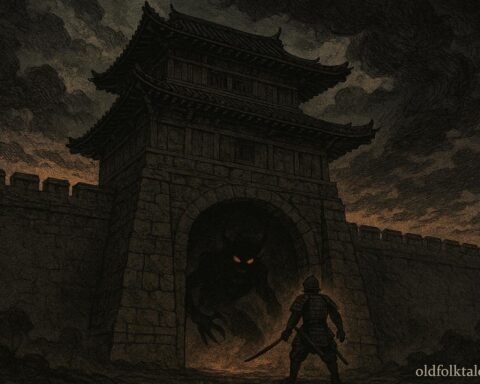
Far from the temple, a group of soldiers laughed as they dragged the bell down a mountain path. They had stolen it under cover of night, believing its bronze could be melted for profit or glory. One among them boasted that no curse could touch a man of strength.
Yet the bell resisted their intentions from the moment it left the temple grounds. The ropes snapped repeatedly. The ground beneath it cracked. Horses refused to move when harnessed near it. Each night, the men heard low humming sounds as though the bell whispered prayers into the dark.
When they reached a village by the lake, the leader ordered the bell struck to prove it was harmless. The sound that followed was not clear or resonant. It was heavy and distorted, rolling across the water like a lament. Soon after, illness spread among the group. One soldier fell into madness, claiming monks appeared in his dreams chanting his name. Another broke his leg without cause.
Villagers grew fearful and refused shelter. Crops near the bell withered. Fish vanished from the shore. The men argued among themselves, blaming one another. Greed turned quickly into terror.
Desperate, they attempted to melt the bell in a furnace. The fire burned strangely cold. The metal refused to soften. Instead, the bell cracked the furnace stones, collapsing the structure and injuring several men.
One night, as the soldiers slept uneasily, the bell vanished. At dawn, it was discovered back at Mii dera, resting perfectly upon its platform. The ropes were intact. No footprints marked the path it had taken.
The monks gathered in awe. The abbot ordered purification rites and days of chanting. When the bell was finally struck again, its voice rang clear and deep, washing the hills with calm.
The soldiers who survived were said to wander the roads as beggars, haunted by misfortune. Some sought forgiveness at temples, living out their days in service.
From that time forward, the bell of Mii dera was treated with renewed reverence. Parents warned children that sacred objects carry unseen weight. Monks taught that karma moves without haste but never without purpose.
The bell continued to ring, not as a threat, but as a reminder. Sound fades, but consequence does not.
Moral Lesson:
Sacred objects are not possessions to be exploited. They embody collective faith, intention, and spiritual responsibility. When greed overrides respect, suffering follows naturally. Karma restores balance without anger, teaching through consequence rather than force.
Knowledge Check:
1 Where was the bell originally kept?
Answer: At the Buddhist temple of Mii dera
2 Why did the soldiers steal the bell?
Answer: They sought profit and glory from its bronze
3 What strange events followed the theft?
Answer: Illness, fear, failed attempts to move or melt the bell
4 How did the bell return to the temple?
Answer: It returned on its own without human aid
5 What happened to the soldiers afterward?
Answer: They suffered misfortune and lived with regret
6 What lesson did the bell teach the community?
Answer: That sacred property demands respect and karmic balance
Source:
Adapted from National Diet Library of Japan Classical Temple Legends Archive, 2012.
Cultural Origin:
Heian period Buddhist temple folklore.