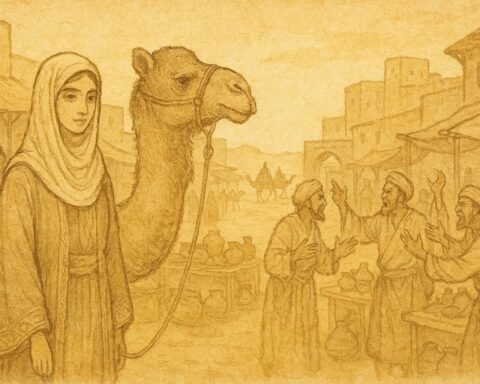
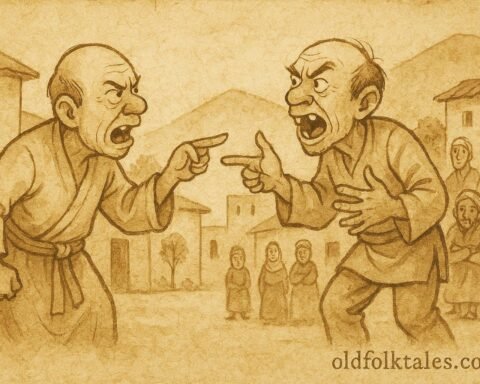
In the bustling souq of Manama, where merchants called out their wares and the aroma of roasting beans drifted through narrow lanes, there once stood a small coffee shop owned by two brothers. It had been their father’s livelihood, a modest place where traders paused to rest and travelers shared news over steaming cups of Arabic coffee. When the father passed away, the brothers inherited the shop and what little he left behind.
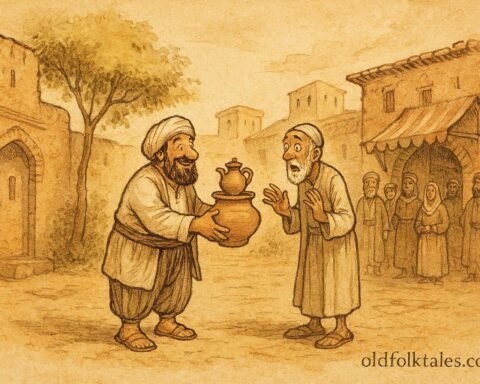
Among the inheritance was a brass dallah, old but finely shaped, said to have been in the family for generations. The elder brother, whose heart leaned toward possession and advantage, claimed the dallah for himself. He had heard the whispers that the pot never emptied, that no matter how often coffee was poured, it would always be full again. To the younger brother, he handed a stack of empty cups and told him to be satisfied.
The brothers agreed to divide the shop itself, setting up separate counters beneath the same roof. From the first day, their differences were clear. The elder brother guarded the magic coffee pot closely. He poured coffee sparingly, watching each cup as if it were a coin slipping from his hand. He measured his smiles and weighed every gesture, believing wealth came from keeping what one had.
The younger brother, with only empty cups before him, served as best he could. He greeted customers warmly, offered water when coffee ran out, and spoke kindly even when he had little to give. Though his counter seemed poorer, people lingered there longer, drawn by his patience and open manner.
One afternoon, as the sun dipped low and the souq slowed, a dervish entered the coffee shop. His clothes were worn by travel, and dust clung to his sandals. His eyes, however, were calm and searching. He first approached the elder brother and asked for coffee.
With a tight expression, the elder brother poured a cup from the brass dallah and set it down without a word. His hand lingered protectively over the pot, and his gaze followed the dervish as if counting what he had given away.
The dervish thanked him politely and moved on.
At the younger brother’s counter, the dervish asked again, this time for anything that could ease his thirst. The younger brother had no coffee to offer. Still, he did not turn the traveler away. He brought out his last dates and a bowl of cool water, placing them before the dervish with genuine respect.
“Please,” he said, “take what little I have.”
The dervish ate and drank, then looked at the empty cups stacked neatly beside the counter. He smiled, and in that moment, the air seemed to grow still.
“For your hospitality,” the dervish said, “these cups are blessed. Whenever you serve a thirsty person with a pure heart, they will fill with the finest Arabic coffee.”
With that, he departed into the evening crowd, leaving no trace behind.
The next morning, the younger brother arranged his cups as usual. When a tired merchant stopped by and asked for coffee, the younger brother lifted an empty cup, meaning to apologize. Before he could speak, the cup filled in his hands, releasing a rich, familiar fragrance. The merchant drank and praised the taste, spreading word through the souq.
From that day on, the miracle repeated itself. The cups filled only when the younger brother served with sincerity, never when he tried to test the blessing for himself. His counter became a place of warmth and relief, known for coffee that comforted both body and spirit.
Meanwhile, the elder brother noticed a change in his own dallah. At first, the coffee lost its richness. Soon, it turned bitter. One morning, when he poured a cup, thick mud spilled out instead. Shocked and angry, he scrubbed the pot and tried again, but the same foul substance emerged. Customers turned away, murmuring among themselves.
As weeks passed, the younger brother’s side of the shop grew crowded, visited by sailors, traders, and travelers from across the Gulf. The elder brother’s counter stood increasingly empty. Watching his brother prosper, he felt confusion and regret, realizing too late that the magic he relied upon had never been in the pot alone.
In time, the souq remembered the lesson more than the miracle. People spoke of the two brothers and the coffee that rewarded open hands. And the younger brother continued to serve, knowing that generosity, once given, has a way of returning in fuller measure.
Moral Lesson
This folktale teaches that true wealth flows from generosity and sincere hospitality. Possessions without kindness become empty, while humble offerings given with a pure heart create lasting abundance.
Knowledge Check
-
Where does the story take place?
In Manama’s traditional souq in Bahrain. -
What object did the elder brother inherit?
A magic brass coffee pot that never emptied. -
What did the younger brother receive?
Only empty cups and his share of the coffee shop. -
Who was the mysterious visitor?
A traveling dervish who tested the brothers’ hospitality. -
What caused the younger brother’s cups to fill?
Serving thirsty people with sincerity and generosity. -
What lesson does the tale emphasize?
That generosity brings true prosperity, while greed leads to loss.
Source: Adapted from storyteller Ali Al-Mannai’s recordings preserved at the Shaikh Ebrahim Center, Manama (2005), reflecting Bahraini oral tradition and mercantile morality tales.