In the old quarters of Muharraq, where coral-stone houses caught the sea breeze and courtyards rang with the sound of looms, lived a woman named Fatima. She was known across the island for her mastery of sadu, the traditional weaving that turned wool and thread into living patterns. Her hands moved with calm precision, and her eyes carried the memory of designs taught by mothers and grandmothers. When Fatima worked, the threads seemed to breathe. Diamonds and lines flowed like water, and colors held stories older than the streets themselves.
Merchants sought her work, and women gathered to watch her weave, not out of envy, but out of reverence. Yet not all who saw Fatima’s skill felt admiration. Among those who watched from the edges was a sorceress, a woman consumed by jealousy. She could not bear that a craft born of patience and tradition should outshine her own dark arts. Whispering words of spite, she laid a curse upon Fatima’s hands.
The next morning, as Fatima sat at her loom, her fingers began to tremble. The thread slipped. The pattern broke. Again and again she tried, but the shaking only worsened. By nightfall, the finest weaver in Muharraq could no longer pass a shuttle through the warp. Grief settled over her house like dust.
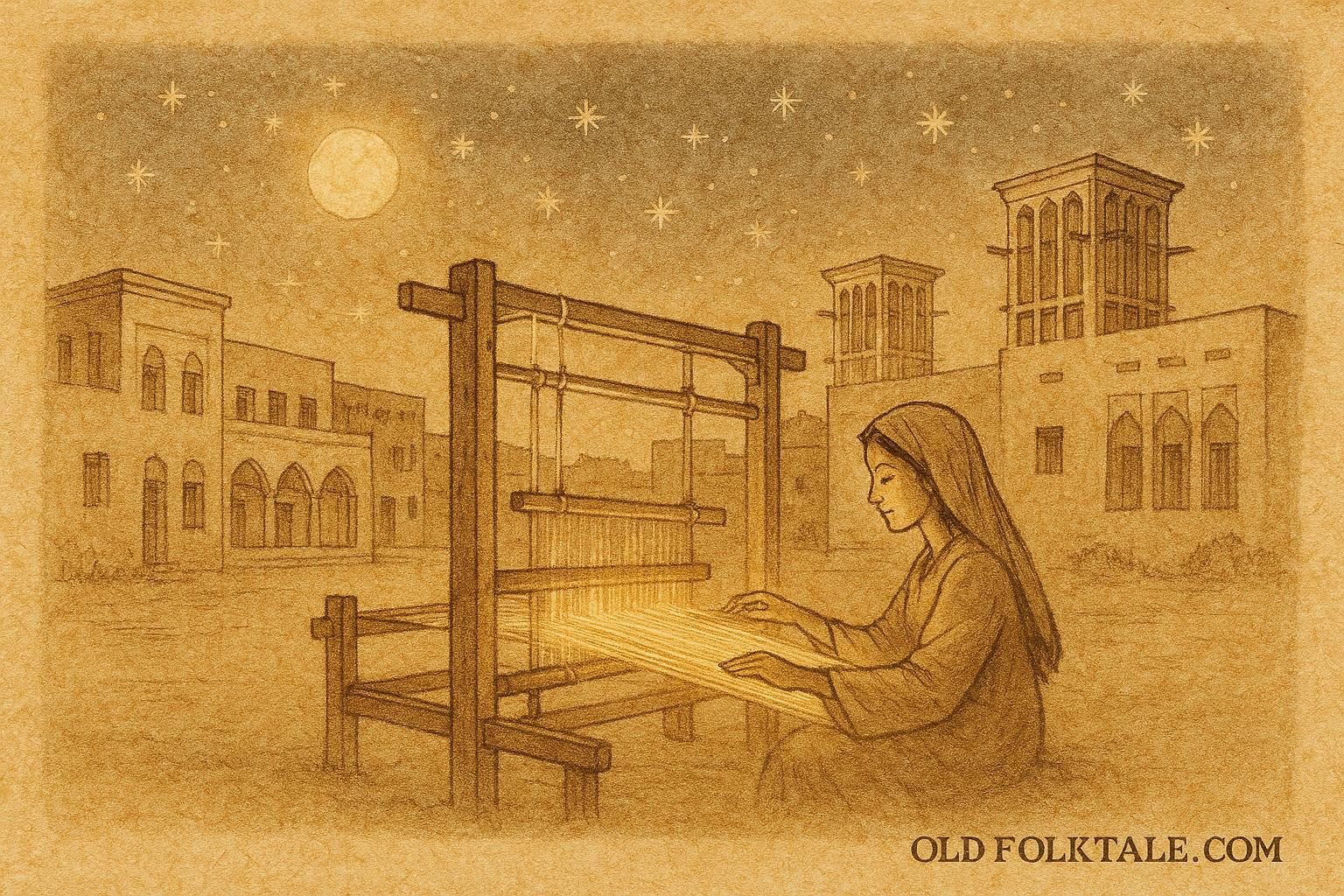
Fatima did not cry out in anger. Instead, she withdrew into silence. When the moon rose, she stepped into the courtyard and looked up at the stars that had guided sailors and pearl divers for generations. She prayed with humility, asking not for revenge, but for the strength to weave again, to honor the knowledge entrusted to her.
That night, as the sky deepened, something wondrous occurred. Threads of light descended gently, glowing like moonbeams. They gathered before her, forming a loom unlike any she had known. Its frame shimmered, and its threads sang softly, as if the night itself were breathing.
Fatima approached without fear. When she touched the loom, her hands steadied. The trembling ceased. She began to weave.
The threads responded to her intent, revealing images beyond ordinary sight. As her shuttle moved, scenes emerged within the tapestry. She saw Bahrain’s past, pearl divers descending into blue depths, women spinning wool in shaded rooms, children learning the rhythms of craft. Then the images shifted, showing futures yet to come, generations of women weaving, teaching, and preserving what had been given to them.
By dawn, the tapestry was complete. It held the island’s memory and promise, bound together by skill and devotion.
The sorceress, sensing the power of what had been made, crept into Fatima’s home. She reached for the tapestry, intending to claim it as her own. But the woven images stirred. The cloth lifted and wrapped around her, drawing her into its patterns. Her form dissolved into thread, her jealous spirit fixed forever within the design she had sought to steal.
When the sun rose, the sky loom vanished, leaving only the tapestry and Fatima’s steady hands. The curse was broken.
Fatima returned to her earthly loom, her skill restored. She did not keep the secret of the sky patterns to herself. Instead, she taught her daughters the designs she had learned beneath the stars. These patterns were passed from mother to daughter, becoming treasured heirlooms among the weavers of Muharraq. Each thread carried remembrance, resilience, and the quiet power of women’s craft.
Moral Lesson
This folktale teaches that patience, faith, and devotion to one’s craft can overcome envy and harm. True skill, when rooted in tradition and shared across generations, becomes a source of healing and lasting strength.
Knowledge Check
-
Who is Fatima in the story?
She is the finest sadu weaver in Muharraq. -
What causes Fatima’s hands to tremble?
A curse cast by a jealous sorceress. -
Where does Fatima seek help?
She prays beneath the stars in her courtyard. -
What is the sky loom made of?
Celestial threads and moonlight. -
What happens to the sorceress?
She is woven into the tapestry as a pattern. -
What is passed down through generations?
The sky patterns taught to Fatima’s daughters.
Source: Women’s storytelling circle recordings archived at BACA, focusing on craft traditions. Originating from weaving communities of Muharraq, Bahrain, early 20th century.