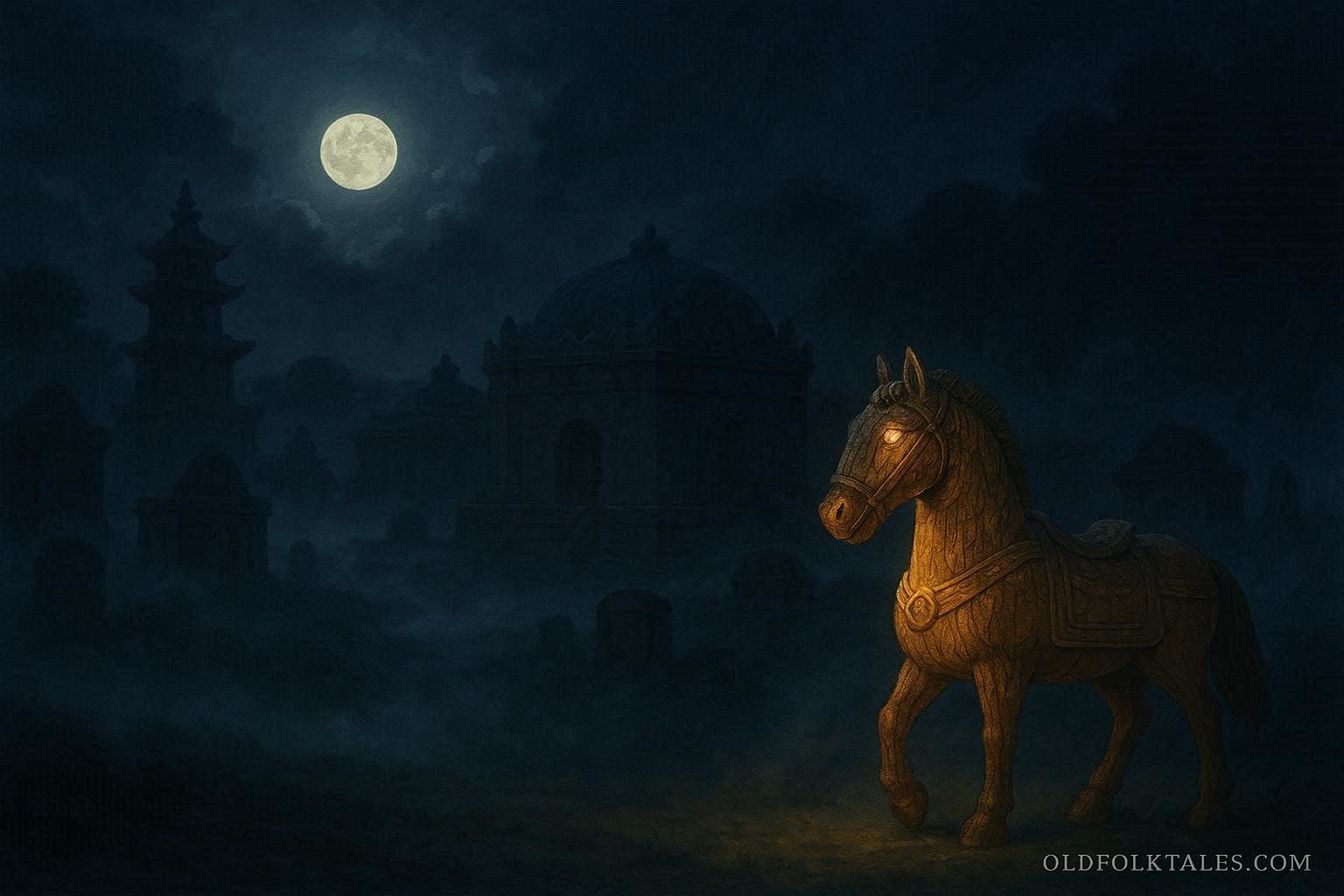
In the ancient kingdom of Baekje, where kings were laid to rest with treasures and sacred relics, there stood an intricately carved wooden horse at the entrance of the royal tombs. Its presence was initially ornamental, a symbol of the king’s authority and the skill of the artisans. But legends say that at night, when the moonlight touched its polished surface, the horse would come alive. Its wooden hooves would clatter softly against the stone floors, and its eyes would glow like amber lanterns, scanning for intruders.
Young Soo-min, an apprentice guard, had heard whispers of this phenomenon from the elders in the palace. They spoke of times when the horse had chased away thieves and warded off those who sought to defile the sacred resting places. Skeptical yet curious, Soo-min decided to witness this for himself. One moonlit night, he hid behind a cluster of stone lanterns, eyes fixed on the silent statue. As the hour of midnight approached, the wooden horse stirred. Its mane rippled as though caught in an unseen wind, and it took careful steps around the tombs, inspecting the surroundings with a quiet vigilance that seemed almost alive.
Soo-min’s heart pounded with awe and a touch of fear. He realized that the horse was more than a statue; it embodied the protective spirit of the ancestors, a guardian that transcended ordinary understanding. Throughout the night, the wooden horse patrolled the tombs, detecting a small band of thieves attempting to enter. With a sudden stomp and a neigh that echoed like rolling thunder, it startled the intruders, who fled in terror, leaving their tools and provisions behind. Soo-min, amazed, noted every detail to recount to the elders the following day.
Journey through enchanted forests and islands in our Southeast Asian Folktales collection.
The next morning, the horse had returned to its original position, immobile as ever, its carved eyes serene and unblinking. No trace of movement remained, leaving only the memory of its nocturnal guardianship. Soo-min understood that the wooden horse was a bridge between the living and the ancestors, a tangible manifestation of moral and spiritual protection. It reminded the people that the sanctity of the tombs and respect for the past demanded vigilance, honor, and devotion.
Over time, the legend of the wooden horse spread throughout Baekje. It became common for palace guards and villagers to offer small tokens of respect to the figure before beginning their duties, placing incense or polished stones at its base. Parents told their children that those who were dishonest or disrespectful would never see the horse move, while those who upheld honor and piety might catch a glimpse of its nightly patrol. This tradition instilled a sense of moral responsibility, linking everyday conduct to the protection of the kingdom’s sacred spaces.
As decades passed, Soo-min became an elder himself, recounting his encounter with the wooden horse to younger guards. He emphasized that the magic of the horse was not merely in its ability to move or frighten intruders, but in its embodiment of the ancestral will and the protective spirit that watched over the living. The wooden horse symbolized the continuity of duty, the unbroken connection between past and present, and the principle that guardianship required vigilance, respect, and unwavering moral integrity.
The horse also served as a lesson that true guardianship requires no reward or recognition. It acted not for fame or acknowledgment but because the sacred order demanded it. In this way, the wooden horse became a living symbol of ethical conduct, reinforcing values of loyalty, responsibility, and reverence for those who came before. Even today, visitors to the reconstructed Baekje tombs often pause at the figure of the horse, sensing a quiet power that transcends time.
Through the story of the wooden horse, the people of Baekje learned that protection comes in many forms. Sometimes it is tangible and immediate, other times unseen but equally effective. The guardian did not judge lightly; it acted decisively when the sanctity of the tombs was threatened. Its presence taught humility, courage, and respect, reminding all that the past is not inert but alive, watching and guiding the present.
Moral Lesson:
Respect for ancestors and sacred spaces ensures protection and moral guidance. Vigilance, integrity, and honor are rewarded, while greed and disrespect bring consequences. True guardianship acts without expectation of recognition.
Knowledge Check:
- What protects the royal tombs at night in Baekje?
Answer: The wooden horse - How does the horse respond to intruders?
Answer: It patrols the tombs and frightens or chases away thieves - What lesson does the wooden horse teach the villagers?
Answer: Respect for ancestors, moral vigilance, and the importance of honor and integrity - Why did the horse return to its original position by dawn?
Answer: Its nightly patrol is a supernatural act; it resumes stillness as part of its sacred duty - How did Soo-min and other villagers show respect to the wooden horse?
Answer: By offering incense, polished stones, and acknowledging its guardianship - What does the wooden horse symbolize beyond physical protection?
Answer: The ancestral will, ethical conduct, continuity between past and present, and moral guardianship
Source:
Adapted from Buyeo National Museum Baekje Records, Baekje Cultural Heritage Digital Archive, 2011
Cultural Origin:
Baekje period royal folklore