Along the windswept coastline of Ras Al-Ardh, where the sea met the land with quiet determination, lived an old fisherman named Hamad. His face was lined by years of sun and salt, and his hands were rough from mending nets that had seen better days. Though he had spent his entire life on the water, fortune had never favored him. The villagers knew him as a man of honest labor but persistent misfortune.
Each dawn, Hamad pushed his small boat into the sea and cast his net into the familiar waters. Each dusk, he returned with nothing but empty nets and tired limbs. Still, he did not complain. Fishing was the craft he had inherited from his father, and perseverance was the only wealth he believed truly belonged to him.
For forty days, Hamad cast his net at Ras Al-Ardh without catching a single fish. The tides shifted, the winds changed, and other fishermen returned with modest hauls, yet Hamad’s nets remained barren. Some villagers whispered that the sea had turned against him. Others urged him to give up and seek help from relatives inland. Hamad listened politely, but every morning he returned to the same spot, believing that patience was a form of faith.
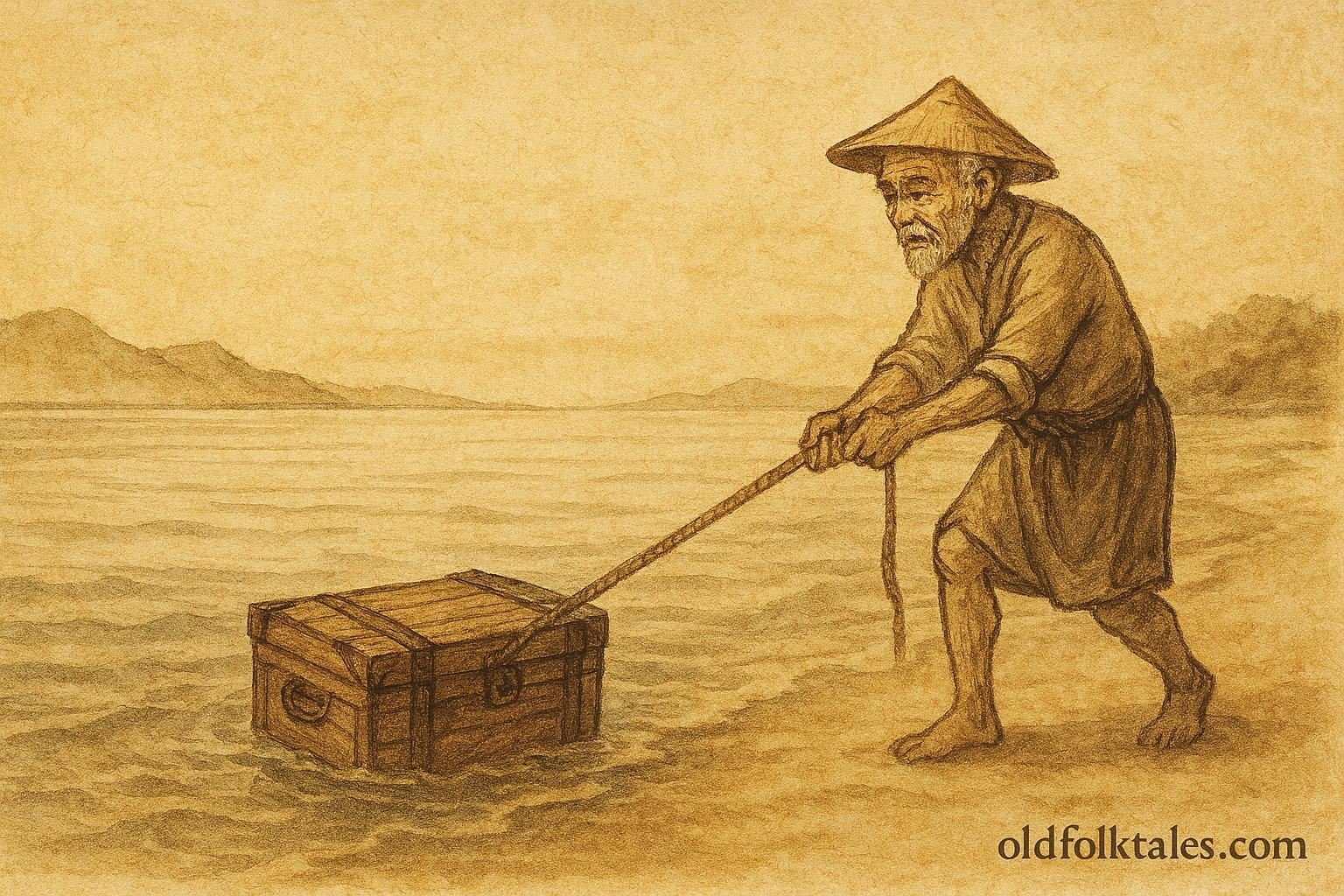
On the forty-first day, as the sun rose pale over the horizon, Hamad cast his net once more. This time, it did not move with the water as it usually did. Instead, it sank heavily, pulling against his arms with unexpected force. With effort and quiet determination, he hauled it back into the boat.
Entangled in the net was a chest, darkened by age and crusted with salt. Its weight suggested promise, and for a brief moment, Hamad’s heart stirred with hope. Perhaps the sea had finally chosen to reward him.
When he opened the chest on shore, the villagers gathered around. Inside, there was no gold, no jewels, no signs of sudden wealth. Instead, they found old copper coins, worn smooth by time. Beneath them lay a glass bottle, sealed carefully. Inside the bottle was a note, its writing faded but still legible.
The note was from a sailor who had been shipwrecked centuries earlier. It spoke of loss, survival, and leaving behind what little he had in the hope that it might serve others better than himself. The coins, the sailor wrote, were never meant to enrich a single man, but to benefit a community.
Hamad read the note aloud, his voice steady but his eyes thoughtful. He closed the chest quietly. Though the coins could have eased his own hardships, he felt the weight of the sailor’s words more than the weight of the metal.
That same week, Hamad brought the chest before the elders of the village. The mosque, the heart of their community, had fallen into disrepair. Its roof leaked, and its walls bore the marks of age. Hamad offered the coins for its restoration, asking nothing in return.
The repairs were completed, and the mosque stood renewed, its presence strengthened by collective gratitude. Hamad did not become wealthy, but his name was spoken with respect. The villagers no longer saw him as unlucky, but as a man whose perseverance and humility had brought lasting honor.
Moral Lesson
This folktale teaches that true fortune lies not in personal gain, but in patience, integrity, and service to the community. Honor earned through selflessness outlasts wealth gained for oneself.
Knowledge Check
-
Who is the main character of the story?
Hamad, an elderly fisherman from the Kuwaiti coast. -
Where does the story take place?
At Ras Al-Ardh, a historic coastal point in Kuwait. -
What does Hamad find on the forty-first day?
A heavy chest containing old copper coins and a note. -
Who wrote the note found in the chest?
A shipwrecked sailor from centuries earlier. -
How are the coins ultimately used?
To repair the village mosque. -
What cultural value does the story emphasize?
Community welfare over personal wealth.
Source: Published in the National Council for Culture, Arts and Letters magazine “Arabi” (مجلة العربي), Issue #312, 1984. Kuwaiti oral tradition associated with Ras Al-Ardh.