In a small village nestled among the green rice paddies of Vietnam, there lived a man named Chau San. He was poor, owning nothing but a humble thatched hut and the worn clothes on his back. Yet despite his poverty, Chau San possessed something far more valuable, a wife whose heart overflowed with loyalty and kindness. She never complained about their meager meals of rice and vegetables, never sighed over her faded áo dài, and never spoke a harsh word even when the rains leaked through their roof.
Each morning, Chau San’s wife would wake before dawn to tend their small garden, her hands working the soil with gentle determination. She would cook what little they had with such care that even plain rice seemed like a feast. When Chau San returned home tired from his labor in the fields of wealthier neighbors, she greeted him with a warm smile that made their dim hut feel like a palace. Her love was constant, like the monsoon rains that nourished the land.
Click to read all East Asian Folktales — including beloved stories from China, Japan, Korea, and Mongolia.
Chau San knew he was blessed. Often, as they sat together in the evening light, sharing their simple dinner, he would look at his wife and feel his heart swell with gratitude. “I am the richest man in the world,” he would tell her, “for I have you.”
Then one day, fortune smiled upon Chau San in an unexpected way. While working in a wealthy merchant’s field, he discovered a clay pot buried beneath an old banyan tree. When he pried it open, his eyes widened in disbelief inside lay silver coins, gleaming jade ornaments, and gold pieces that caught the sunlight like captured stars. It was a treasure beyond his wildest dreams, likely hidden by someone long ago and forgotten by time.
Chau San brought the treasure home, his hands trembling with excitement. His wife rejoiced with him, tears streaming down her face not for the wealth itself, but because she hoped her husband’s burdens would finally be lifted. “Now you won’t have to labor so hard in the sun,” she said softly, touching his weathered hands.
With his newfound wealth, Chau San bought land and built a fine house with carved wooden pillars and a tile roof that gleamed red in the sunlight. He purchased silk robes embroidered with dragons and phoenixes and filled his home with lacquered furniture and porcelain vases. Merchants and officials began to visit him, praising his good fortune and enjoying his generous hospitality.
But as Chau San’s wealth grew, something dark began to take root in his heart. He started to forget the days of struggle, the nights when his stomach growled with hunger, and the patient love that had sustained him through those difficult years. He looked at his wife still dressed simply, still speaking softly, still tending to their home with the same gentle devotion and a terrible thought entered his mind.
“She is too plain for a man of my position,” he told himself, comparing her to the elaborately dressed wives of other wealthy men. “She doesn’t know how to conduct herself among people of quality. She embarrasses me.”
Chau San began to treat his wife with coldness. He spoke to her with sharp words where once there had been only kindness. He refused to let her join him when guests visited, keeping her hidden away like something shameful. The woman who had loved him through poverty now found herself cast aside in prosperity, her heart breaking a little more each day.
His wife endured this treatment in silence, still performing her duties faithfully, still hoping that the man she loved would return to her. But the villagers noticed Chau San’s cruel behavior, and they whispered among themselves. “He has forgotten who stood by him when he had nothing,” they said, shaking their heads in disapproval.
Then misfortune struck, swift and merciless as a summer storm. Chau San made poor investments, trusting the wrong people with his money. His business ventures failed one after another. Thieves broke into his fine house and stole much of what remained. Within a year, his wealth had vanished like morning mist, and he found himself once again poor but now burdened with debts he could not repay.
The merchants and officials who had once flattered him now turned away. The friends who had enjoyed his hospitality disappeared like shadows at noon. Chau San stood alone in his crumbling house, surrounded by broken dreams and empty rooms, and finally understood what he had lost.
His faithful wife, despite everything, had remained. She stood before him now, her eyes filled not with anger or triumph, but with the same patient love she had always carried. Without a word, she began to rebuild their life, working even harder than before, never once reminding him of how he had treated her.
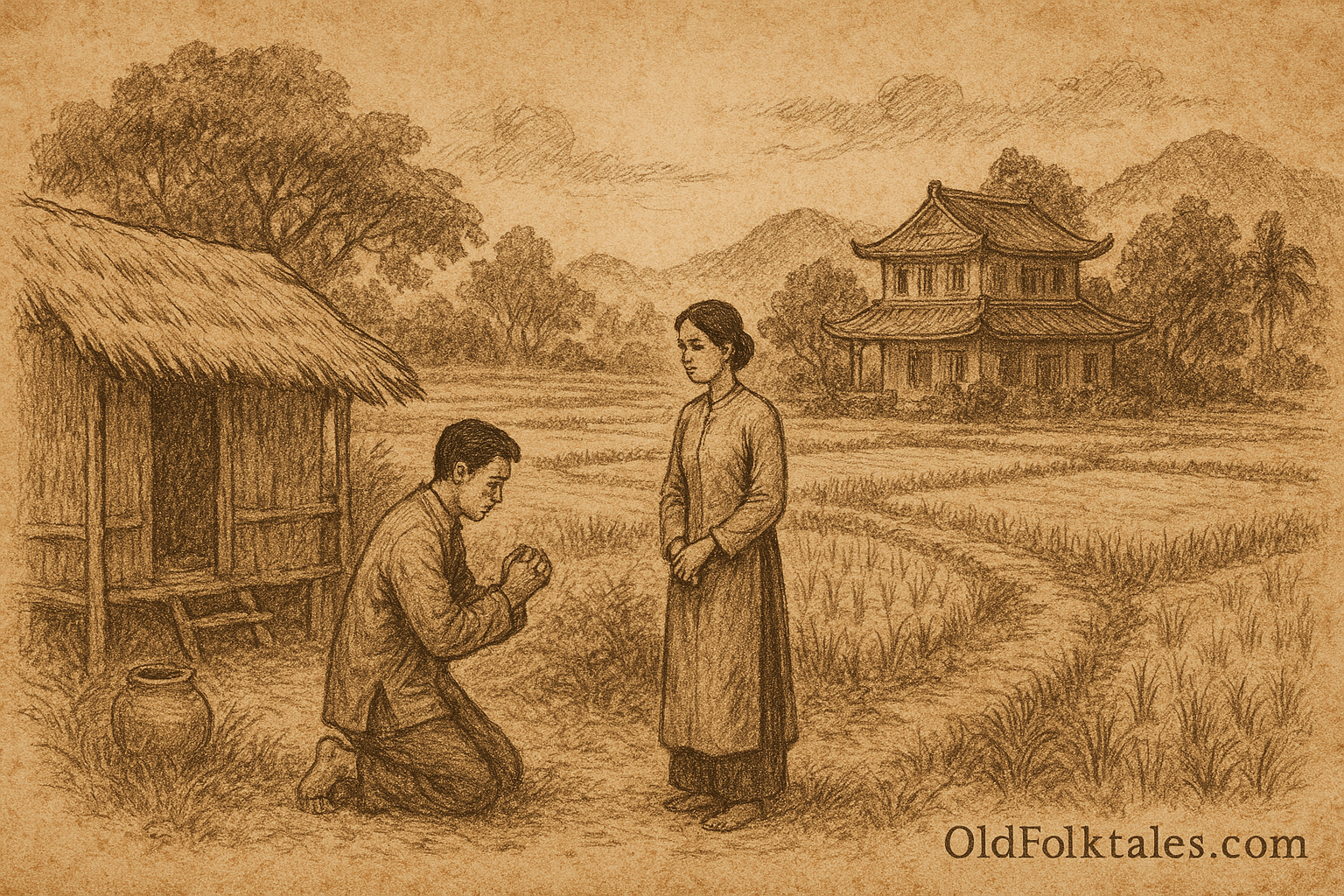
Chau San fell to his knees before her, shame and regret crushing his chest like a heavy stone. “Forgive me,” he whispered, tears streaming down his face. “I had everything when I had you, and I was too blind to see it. Wealth made me proud and cruel. I became a stranger to myself.”
His wife helped him to his feet, her touch gentle as always. “We will begin again,” she said simply. And though they remained poor for the rest of their days, Chau San never again forgot the true value of loyalty, humility, and a faithful heart.
Click to read all Southeast Asian Folktales — featuring legends from Thailand, Indonesia, Vietnam, and the Philippines.
The Moral Lesson
This tale reminds us that wealth and success can test our character more severely than poverty and hardship ever could. True prosperity lies not in material possessions but in loyalty, gratitude, and humility. When we forget those who stood by us in difficult times, we lose something far more precious than money, we lose our humanity and the relationships that give life meaning. The greatest treasure is a faithful heart that loves us through both abundance and scarcity.
Knowledge Check
Q1: Who was Chau San and what was his situation at the beginning of the story?
A1: Chau San was a poor but kind man living in a Vietnamese village with his loyal and devoted wife. Despite owning only a humble thatched hut and working in the fields of wealthier neighbors, he was content because of his wife’s unwavering support and love.
Q2: How did Chau San acquire his wealth in the folktale?
A2: Chau San discovered a buried clay pot containing silver coins, jade ornaments, and gold pieces while working in a wealthy merchant’s field beneath an old banyan tree. This forgotten treasure transformed him from a poor laborer into a wealthy man.
Q3: What changes occurred in Chau San’s character after he became wealthy?
A3: After gaining wealth, Chau San became proud, ungrateful, and ashamed of his wife. He began treating her with coldness and cruelty, speaking harsh words to her and hiding her from his guests, forgetting how she had supported him through years of poverty.
Q4: What is the symbolic meaning of Chau San’s wife in Vietnamese folklore?
A4: Chau San’s wife symbolizes unwavering loyalty, patience, unconditional love, and moral constancy. She represents the Vietnamese cultural values of devotion and faithfulness that remain steady regardless of external circumstances or material status.
Q5: What lesson does the story teach about sudden wealth and success?
A5: The story teaches that sudden wealth and success can corrupt character and lead to pride, ingratitude, and moral decline. It warns that prosperity tests our values more severely than poverty, and that forgetting those who supported us in hardship leads to the loss of what truly matters.
Q6: How does this Vietnamese folktale reflect cultural values about marriage and loyalty?
A6: The tale emphasizes traditional Vietnamese values of marital devotion, humility, and gratitude within family relationships. It teaches that a faithful partner is life’s greatest treasure and that prosperity should strengthen rather than weaken the bonds of loyalty and respect between husband and wife.
Source: Adapted from traditional Vietnamese folklore, variations of which appear in Folk Tales from Indochina collected by Jeanne Cuisinier.
Cultural Origin: Vietnam