In the Al-Qurain area, where the desert winds brushed against clusters of old stone houses, there stood a ruined home that no one dared to enter after sunset. Its walls were cracked, its doorway half-collapsed, and above it rose a broken بَريدَج, the traditional wind tower once used to cool the rooms below. By day, the house appeared lifeless and ordinary. By night, it became something else entirely.
People whispered that a طيف, a wandering phantom, haunted the place. They said strange cries drifted across the sand after dusk and that shadows moved where no living person stood. Children hurried past the house, and even grown men avoided looking at it directly. In the evening gatherings of the diwaniya, stories about the house grew darker with each retelling. Fear, shaped by imagination, settled firmly into the minds of the listeners.
Among the villagers lived a young man named Daham. He was known for his steady temperament and his sharp mind rather than reckless bravado. Unlike others, he listened quietly when tales of the haunted house were told. He noticed how no one could agree on what the phantom looked like or what it wanted. Some claimed it wailed like a grieving soul. Others insisted it whispered names on the wind. To Daham, these contradictions planted seeds of doubt.
One night, after another long discussion filled with nervous laughter and uneasy glances, Daham spoke. He said that fear thrived where understanding did not, and that he would spend the night in the ruined house to learn the truth. His words fell heavily in the room. Some urged him not to tempt danger. Others admired his courage but warned him that unseen forces could not be reasoned with.
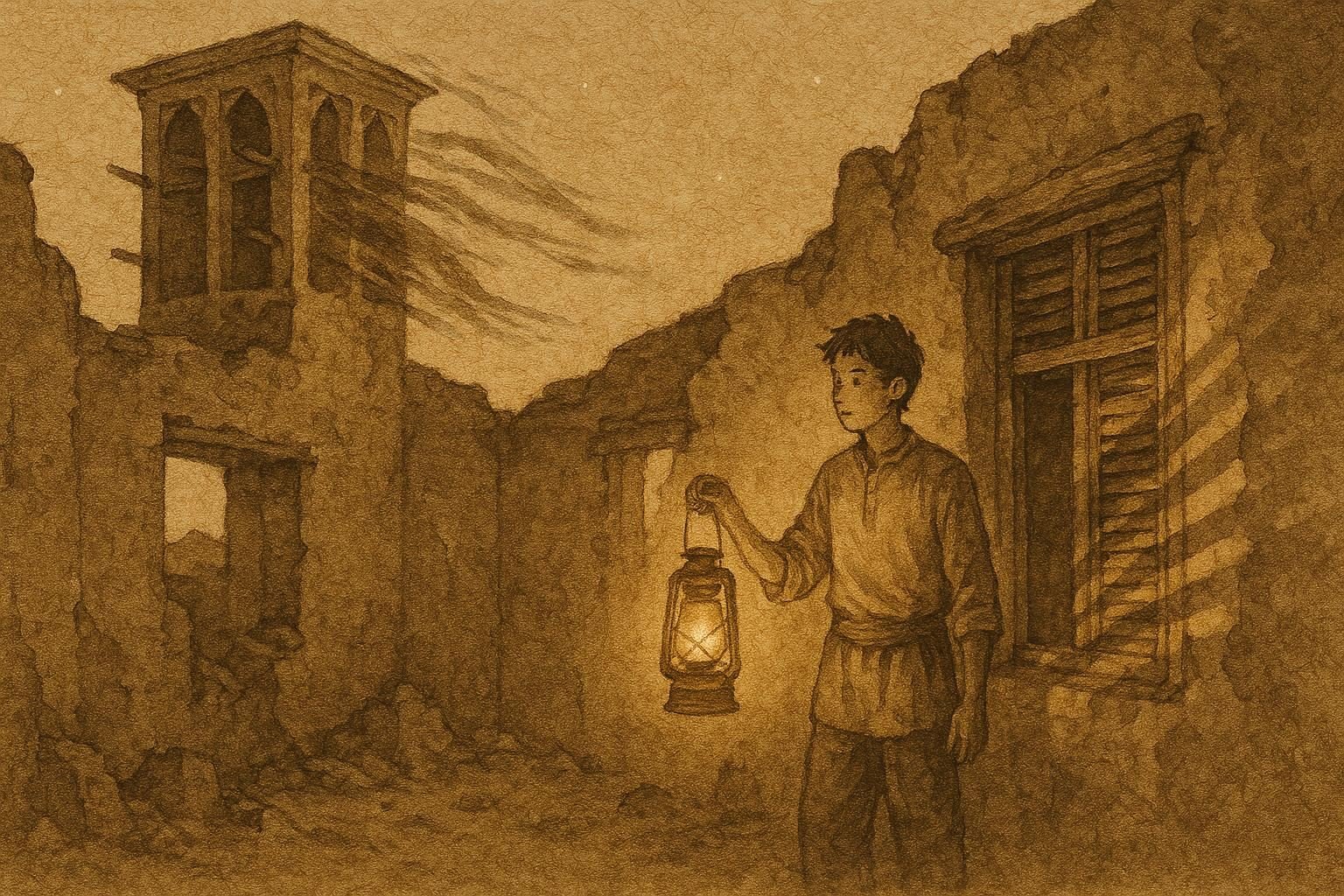
Before dawn the next day, Daham prepared himself. He carried no weapons and no charms, only a small lantern and a clear intention to observe carefully. As the sun set, he walked alone toward the abandoned house. The air grew cooler, and the sky deepened into shades of indigo. The house loomed ahead, silent and unmoving.
Inside, the scent of dust and old wood filled the air. Daham placed his lantern on the ground and sat against a wall, listening. At first, there was only silence. Then, as the night deepened, a low, mournful sound echoed through the rooms. It rose and fell like a breath, sending a chill through the empty space.
Daham did not flee. He stood and followed the sound. As the wind strengthened, it rushed through the broken wind tower above, forcing air through narrow gaps and cracks. The result was a hollow howl that echoed through the house, shaping itself into something that resembled a voice.
Then he noticed movement. A wooden shutter, loosened by age, swung back and forth with the wind. Its shadow stretched across the walls, twisting and shrinking as the lantern’s flame flickered. From a distance, the shadow looked like a shifting figure, restless and alive.
Daham spent the rest of the night observing these simple causes. Each sound and shadow had a clear explanation. When dawn arrived, the phantom vanished with the retreating night.
At sunrise, Daham returned to the village. The people gathered as he explained what he had discovered. He described the broken بَريدَج, the wind’s path through it, and the swinging shutter that cast frightening shapes. Slowly, fear loosened its grip. What had once been a haunted house became a reminder of how the unknown can deceive the senses.
Moral Lesson
This folktale teaches that fear often arises from misunderstanding. By observing calmly and seeking truth, illusions lose their power, and reason restores peace.
Knowledge Check
-
Where does the story take place?
In a ruined house in the Al-Qurain area of Kuwait. -
Who is Daham?
A brave and thoughtful young man who seeks truth over superstition. -
What was believed to haunt the house?
A طيف, or phantom. -
What caused the frightening sounds?
Wind howling through a broken wind tower. -
What created the moving shadows?
A loose wooden shutter swinging in the wind. -
What lesson does the story convey?
Fear diminishes when the unknown is understood.
Source: Collected in the Bait Al-Outha (بيت العوثة) oral history project. Kuwaiti folktale traditionally shared in diwaniya storytelling gatherings.