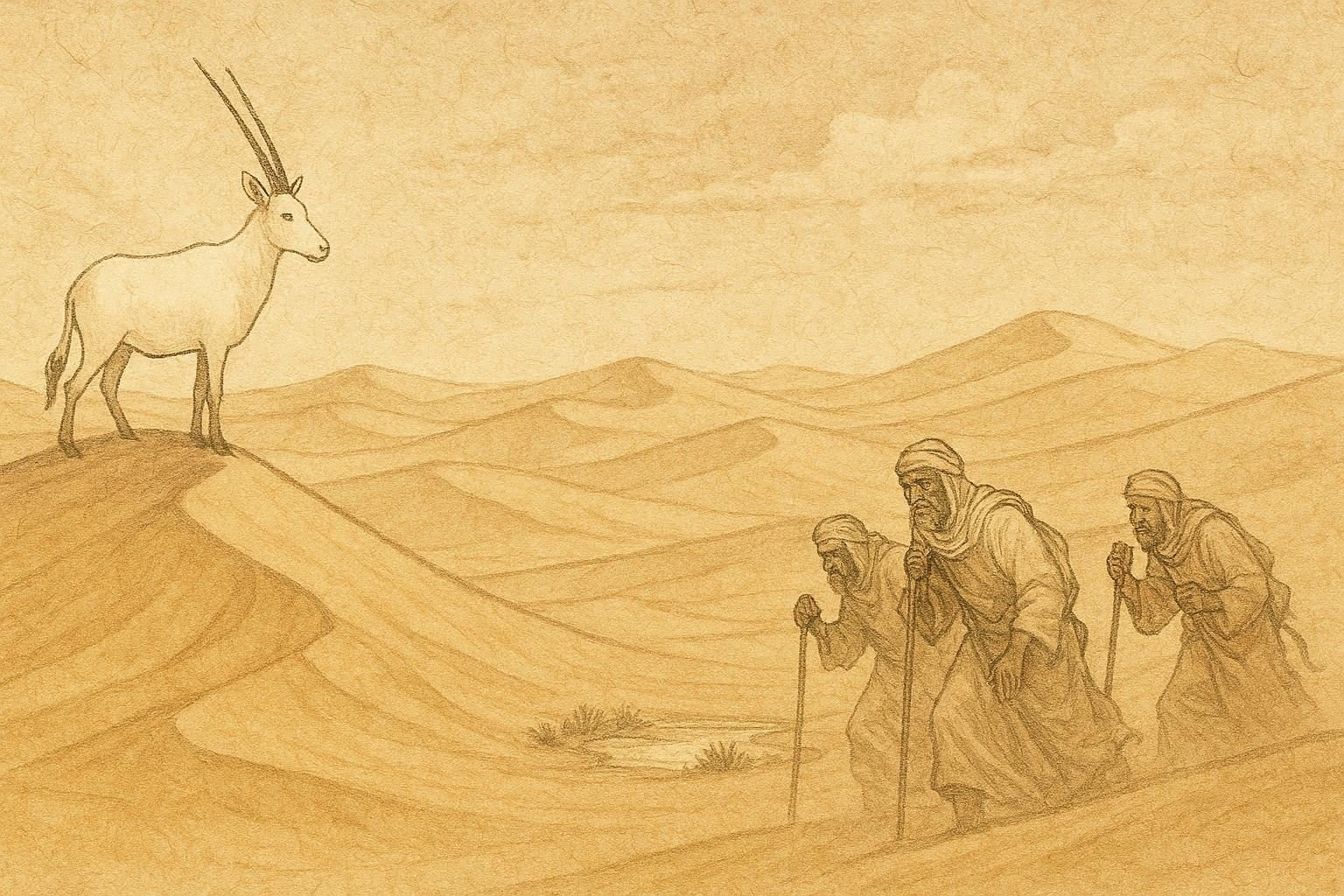
In the vast reaches of the Emirati Empty Quarter, where the land rolls endlessly in waves of sand and the horizon dissolves into heat and sky, a small Bedouin hunting party once found itself lost. These men were sons of the desert, raised among dunes and stars, taught from childhood how to read wind, track, and silence. Yet even the most experienced travelers knew that the Rub’ al Khali yields its mercy sparingly.
For many days, the men had searched for game across familiar grazing routes that suddenly felt unfamiliar. The wind erased their marks, and the sun pressed down without pause. Their water skins grew lighter with each hour. The desert, usually a companion, became distant and severe.
At night, they rested in shallow hollows, sharing what little remained of their provisions. Their speech grew sparse. Hunger dulled their senses, and doubt crept quietly into their thoughts. Some wondered if they had angered the land. Others feared they had missed a sign meant to guide them home.
On the morning when their strength was nearly spent, they saw something that made them stop.
Atop a dune ahead stood an oryx.
Its coat was pure white, untouched by dust, glowing softly in the early light. Its long, straight horns rose calmly, and its stance was steady, unafraid. It did not bolt or lower its head. It simply watched.
One of the younger men lifted his spear, driven by hunger and instinct. But the eldest among them placed a hand on his arm. Among Emirati Bedouin, the oryx was never regarded as ordinary prey. It was spoken of with respect, a creature bound to omen and meaning, often associated with hope and divine favor.
The oryx turned and walked away.
It moved slowly, pausing at intervals, as though ensuring the men followed. The hunters exchanged glances. Without words, they gathered their remaining strength and walked after it.
Across the dunes the oryx led them, through low valleys and rising crests where no tracks lingered. The sun climbed, then softened. More than once the men faltered, but each time they lifted their eyes, the white form was still there, waiting.
As the afternoon light warmed, the oryx stopped beside a cluster of shrubs growing where no shrubs should have been. Beyond them lay a sight that brought tears to weary eyes. A hidden spring flowed quietly between stones, its water clear and cool. Around it grew grass and grazing plants, preserved by the desert as a secret.
The men fell to their knees. They drank deeply and filled their skins, resting beneath the fragile shade. When they looked again for the oryx, it was gone.
No tracks marked where it had stood. No sound followed its departure. Only the spring remained, steady and life-giving.
The eldest hunter spoke softly, reminding them that not all guidance comes clothed in words or human form. Among Emirati Bedouin, such moments were understood as barakah, a blessing granted when hope seemed distant. The oryx had not come as prey. It had come as a guide.
The men returned safely to their people, carrying the story with reverence. From then on, the tale of the white oryx was told around desert fires and passed from elder to youth. It became a reminder that the desert speaks to those who listen, and that mercy often appears when it is least expected.
Moral Lesson
This Emirati folktale teaches that patience, humility, and respect for nature allow divine guidance to reveal itself, even in moments of despair.
Knowledge Check
-
Where does the story take place?
In the Emirati section of the Rub’ al Khali, the Empty Quarter. -
Why do the hunters follow the oryx instead of hunting it?
Because the oryx is seen as a sacred sign and bearer of blessing. -
What does the oryx lead them to?
A hidden spring and grazing land that saves their lives. -
What spiritual concept does the oryx represent?
Barakah, meaning divine blessing. -
How does the oryx behave differently from ordinary animals?
It does not flee and deliberately guides the hunters. -
What lesson does the story pass to future generations?
That guidance and hope appear when faith and patience endure.
Cultural Source
Source: Emirati oral tradition recorded in the Zayed National Museum archives, based on testimonies from elders of the Al Murrah and Bani Yas tribes, reflecting Bedouin heritage of the United Arab Emirates.