In the open desert lands where dunes stretch wide and the sky hangs close to the earth, animals were observed closely by the people who lived there. From these observations arose many lessons, told as simple stories that carried deep meaning. Among them was the tale of the falcon and the crow, a story often shared with children to teach respect and understanding.
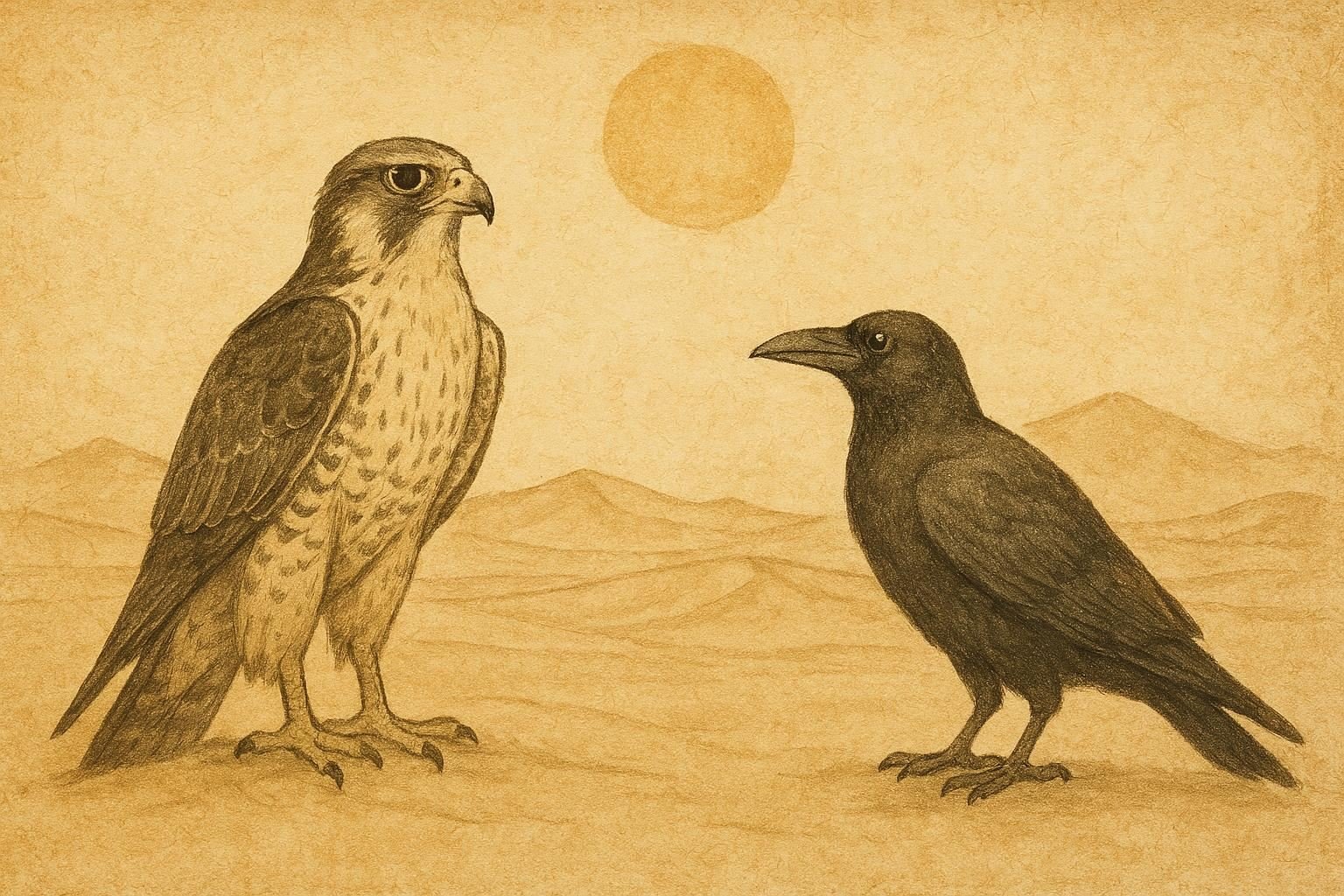
High above the desert floor, a hunting falcon circled the air with effortless grace. Its wings cut through the wind, and its sharp eyes scanned the land below. The falcon was admired by all creatures of the desert. It was swift, strong, and favored by hunters who trained its kind for the chase. The falcon knew its value and took pride in its beauty, its skill, and its noble place in the sky.
Below, on a rocky rise near the sands, perched a crow. Its feathers were dark and dull against the brightness of the day. Its call was rough and carried sharply across the still air. The falcon, noticing the crow, descended slightly and watched it with amusement.
The falcon laughed and spoke with scorn. It mocked the crow for its black feathers, calling them ugly and heavy. It ridiculed the crow’s voice, saying it was harsh and unpleasant compared to the falcon’s silent flight. From the falcon’s view, beauty and strength were one and the same, and the crow possessed neither.
The crow listened quietly. It did not answer at once, nor did it show anger. When it finally spoke, its voice was calm and steady. The crow told the falcon that strength could not always be measured by appearance or admired skill. It suggested that true endurance was known only when one was tested by hardship.
The falcon scoffed at this. It boasted of its speed and hunting power, claiming no creature of the desert could outlast it. Hearing this, the crow proposed a challenge. The test would be simple and fair. Both birds would remain under the open midday sun, without shade or shelter, and see which could endure the desert’s harshness the longest.
Confident in itself, the falcon accepted without hesitation.
As the sun climbed to its highest point, the heat pressed down upon the land. The sand shimmered, and even the wind seemed to retreat. The two birds took their places in the open, fully exposed to the burning light.
At first, the falcon stood proudly. It lifted its head and spread its wings slightly, believing its strength would easily carry it through. But as time passed, the heat grew heavier. The falcon’s breath quickened. Its feathers trapped the warmth, and its body, made for swift movement and cool heights, began to suffer.
The crow remained still. Accustomed to long hours beneath the sun, it shifted only slightly, conserving its strength. Its dark feathers, shaped by life in harsh conditions, did not trouble it as the heat intensified.
The falcon began to weaken. Its confidence faded as exhaustion took hold. Unable to bear the heat any longer, it retreated, seeking relief from the sun’s relentless glare. The test was over.
The crow had prevailed.
Seeing this, the falcon felt shame. It realized that it had judged the crow by its own standards, believing that beauty and admired skill were the only measures of worth. The crow reminded the falcon that every creature was shaped by its environment and purpose, and that endurance came from adaptation, not pride.
From that day onward, the falcon no longer mocked the crow. The story was remembered and shared as a lesson drawn from the desert itself.
Moral Lesson
This folktale teaches that one should not judge others by personal strengths or appearances, for true worth lies in adaptation, endurance, and respect for differences.
Knowledge Check
-
Which animals are central to the story?
The falcon and the crow. -
Why does the falcon mock the crow?
Because of the crow’s black feathers and harsh call. -
What challenge does the crow propose?
Enduring the harsh midday desert sun without shade. -
Why does the falcon fail the test?
It is not adapted to prolonged exposure to intense heat. -
What allows the crow to succeed?
Its natural adaptation to desert conditions. -
What lesson does the falcon learn?
That judging others by one’s own standards leads to error.
Cultural Source
Source: Appears in Dr. Saeed Abdullah Salman’s collection of animal fables, reflecting Emirati desert observations and the cultural importance of the falcon in the Arabian Peninsula.