In the golden age of the Khmer kingdom, when magnificent temples rose toward the heavens and the land prospered under wise governance, there ruled a king named Preah Bat Thong. He was handsome and intelligent, skilled in statecraft and warfare, beloved by his people for his just laws and generous spirit. Yet beneath this admirable exterior, a seed of pride had taken root in his heart, growing slowly like a vine that eventually strangles the tree it climbs.
The royal palace in Angkor was a marvel of carved stone and gilded spires, its walls adorned with dancing apsaras and scenes from sacred texts. King Thong would walk through his grand halls, admiring his reflection in polished bronze mirrors, listening to the constant praise of courtiers who compared his wisdom to that of the gods themselves. With each compliment, his pride swelled a little more, until he began to believe he was indeed superior to ordinary mortals.
Click to read all East Asian Folktales — including beloved stories from China, Japan, Korea, and Mongolia.
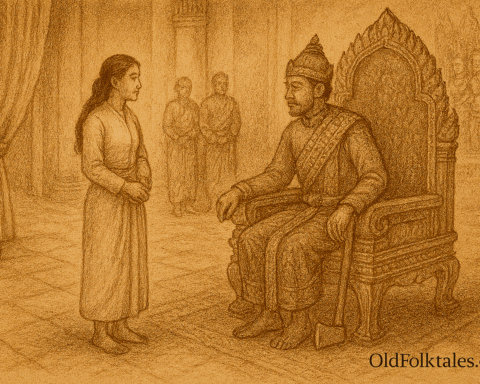
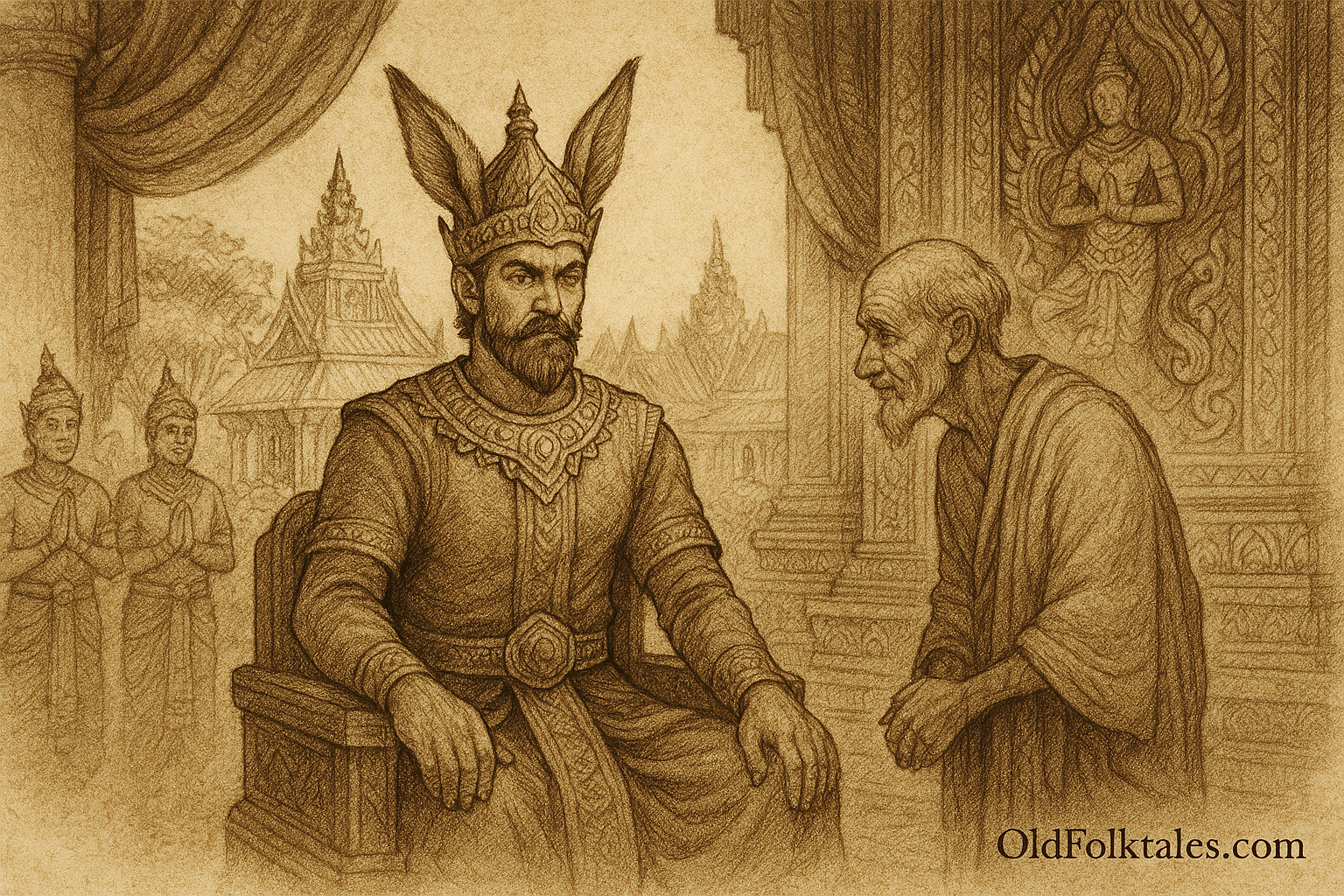
One fateful day, a wandering holy man arrived at the palace seeking an audience with the king. The sage was ancient and bent with age, his simple saffron robes dusty from long travels, his eyes holding the depth of accumulated lifetimes of wisdom. He came offering the king a blessing, but first, he had words of counsel.
“Your Majesty,” the holy man said, bowing respectfully but not obsequiously, “you have built a great kingdom and earned much admiration. But remember that all earthly glory is temporary as morning dew. A ruler’s true greatness lies not in his crown but in his humility before the cosmic order.”
King Thong, surrounded by flattering courtiers and drunk on his own achievements, felt a flash of anger at these words. Who was this ragged wanderer to lecture him about humility? He was the king, chosen by heaven itself to rule! His accomplishments spoke for themselves.
“Old man,” the king replied with barely concealed arrogance, “I need no lessons in greatness. Look around you at what I have built. My wisdom exceeds that of my ancestors. My reign will be remembered when yours is forgotten dust.”
The holy man’s eyes grew sad, for he saw the poison of pride that had infected the king’s heart. “Then I offer you a different gift, Your Majesty. May you wear the outward sign of your inward condition, that you might learn what you refuse to hear.”
Before the king could respond, the holy man raised his hand in blessing, and a strange sensation rippled through King Thong’s body. The sage turned and departed, leaving the palace as quietly as he had arrived.
That night, as the king prepared for bed, he happened to glance in his mirror and froze in horror. Where his human ears had been, now sprouted large, furry donkey ears, unmistakable and grotesque. He touched them with trembling hands, hoping it was an illusion, but they were terribly real, warm and alive, twitching at every sound.
The king’s anguished cry brought servants running, but he quickly ordered them away, claiming sudden illness. For hours he sat alone, staring at his transformed reflection, understanding with sinking dread that this was the holy man’s punishment for his arrogance. A donkey, the symbol of stubbornness and foolishness, now marked him visibly.
By morning, King Thong had made his decision. No one must ever know. He would hide this shameful deformity behind elaborate headdresses and turbans, maintaining the illusion of perfection that his pride demanded. He issued a proclamation that from this day forward, he would adopt a new royal style, always wearing ceremonial headgear that completely covered his ears, claiming it was a fashion inspired by divine visions.
The courtiers, ever eager to please, immediately adopted similar styles, praising the king’s innovative aesthetics. The people marveled at their ruler’s evolving grandeur. Only King Thong knew the desperate truth he concealed beneath layers of silk and gold.
But there was one person who could not be deceived forever: the royal barber, a humble man named Virak who had served the palace for twenty years. The king trusted no one else to cut his hair, and eventually, Virak had to be summoned.
When the barber arrived at the private chamber and the king reluctantly removed his turban, Virak’s eyes widened in shock. There, unmistakable and impossible to deny, were the long donkey ears sprouting from his master’s head.
“You have seen my shame,” the king said, his voice heavy with threat and desperation. “You will tell no one, upon pain of death. If word of this spreads, you and your entire family will be executed. Do you understand?”
Virak, trembling, bowed deeply. “I swear by all that is sacred, Your Majesty, I will never speak of this to any living soul.”
The barber kept his word, but the burden of the secret grew heavier with each passing day. He would lie awake at night, the knowledge pressing on his chest like a physical weight. He wanted to tell his wife, his friends, anyone who might share the burden, but the threat of death kept his lips sealed. The secret festered inside him like an infected wound, poisoning his peace and disrupting his sleep.
Weeks passed, and Virak grew thin and haggard, his health deteriorating under the strain of his terrible knowledge. His wife worried, his children asked what troubled him, but he could say nothing. The secret was consuming him from within.
Finally, unable to bear it any longer, Virak remembered an old custom practiced by those burdened with secrets they could not share. He would tell the secret to the earth itself, releasing the pressure without breaking his vow of silence to any living person.
Late one night, when the moon hung full and bright above the palace, Virak slipped away to a quiet grove outside the city walls. There, among the rustling bamboo and whispering palms, he knelt and dug a small hole in the soft earth with his bare hands.
Leaning close to the opening, he whispered urgently: “The king has donkey ears! The king has donkey ears!” Three times he spoke the words, pouring his anguish into the receptive soil. Then he filled the hole carefully, patted down the earth, and returned home feeling, for the first time in weeks, a measure of relief.
The seasons turned. Rain fell on the spot where Virak had whispered his secret, and sun warmed the earth. From that exact place, a grove of bamboo began to grow, shooting up with unusual vigor, its stalks thick and strong, its leaves rustling with peculiar insistence in every breeze.
Months later, a young musician traveling past the grove cut several bamboo stalks to make a new flute. He carved and shaped the instrument with care, then raised it to his lips to test its sound. But instead of the pure notes he expected, the flute produced words, clear as spoken speech: “The king has donkey ears! The king has donkey ears!”
Startled, the musician tried again, but the result was the same. Amazed, he brought the flute to the market and demonstrated its strange property. Other people cut bamboo from the same grove, and every instrument made from those stalks spoke the same message: “The king has donkey ears!”
The story spread like wildfire through the kingdom. Within days, everyone from the highest noble to the humblest farmer knew the secret. People whispered and wondered, some laughing, others shocked, but all curious about their king’s hidden deformity.
King Thong heard the rumors and knew that his carefully guarded secret had been revealed. Rage and shame warred in his heart. He summoned Virak, intending to execute the barber for breaking his oath. But Virak explained, truthfully, that he had told no living soul, only whispered to the earth in his desperation.
“The truth revealed itself, Your Majesty,” Virak said quietly. “I kept my word to you, but the earth itself cannot keep secrets. Nature speaks what we try to hide.”
The king sat heavily on his throne, feeling the weight of his situation. He could execute the barber, but that would not silence the bamboo or restore his secret. He could deny the rumors, but they were already everywhere, impossible to contain. Finally, he understood that the holy man’s curse could not be hidden because its purpose was to teach, not merely to punish.
The next morning, King Thong appeared before his assembled court wearing no turban or headdress. His donkey ears were visible to all, impossible to miss or deny. A collective gasp rippled through the crowd.
“My people,” the king said, his voice humble for the first time in years, “what you have heard is true. I bear donkey ears as a mark of my arrogance and pride. A holy man offered me wisdom, and I responded with contempt. This is my punishment, and I deserved it. I have learned that no secret can be buried forever, and that truth will always find a way to be revealed. I have learned that pride makes fools of us all, and that a king is still only a man who can fall victim to his own worst qualities.”
The people listened in awed silence. Some felt pity, others satisfaction that the proud king had been humbled, but all recognized the courage it took to make such an admission.
In time, the holy man returned to the palace. He found a changed king, one whose eyes now held wisdom earned through humiliation rather than arrogance born of praise. “You have learned your lesson,” the sage said gently. “Wear your ears proudly now, for they are no longer a mark of shame but a reminder of wisdom gained.”
And though the king’s ears remained those of a donkey for the rest of his life, he became known as one of the wisest rulers in the kingdom’s history, for he never forgot the lesson they taught him about pride, truth, and the limits of human power.
Click to read all Southeast Asian Folktales — featuring legends from Thailand, Indonesia, Vietnam, and the Philippines.
The Moral Lesson
This tale teaches that pride comes before a fall, and that truth cannot be permanently hidden no matter how carefully we try to bury it. Secrets have a way of revealing themselves, often in unexpected ways, because truth seeks expression like water seeks lower ground. The story emphasizes that accepting our flaws with humility brings more wisdom and respect than hiding them behind walls of pride. True greatness lies not in maintaining a perfect image but in acknowledging our imperfections and learning from them. Nature itself conspires to reveal what we attempt to conceal, for the universe favors truth over deception.
Knowledge Check
Q1: Who was King Preah Bat Thong and what was his fatal flaw?
A1: King Preah Bat Thong was a handsome, intelligent, and capable ruler of the Khmer kingdom who governed justly and built magnificently. However, his fatal flaw was excessive pride that grew from constant praise and admiration. He began believing himself superior to ordinary mortals and above the need for humility or wise counsel.
Q2: How did the king receive his donkey ears and what did they symbolize?
A2: The king received donkey ears as punishment from a holy man after arrogantly dismissing the sage’s counsel about humility. The ears symbolized stubbornness and foolishness, serving as an outward manifestation of his inner condition of pride and arrogance. They were meant to teach him the lesson he refused to learn through words.
Q3: What oath did the royal barber Virak make and why did it torment him?
A3: Virak swore upon pain of death never to tell any living soul about the king’s donkey ears. This secret tormented him because carrying such knowledge alone became an unbearable psychological burden. He grew thin, haggard, and sick from the weight of the secret, as it festered inside him like an infected wound.
Q4: How did Virak attempt to release his burden without breaking his oath?
A4: Virak went to a quiet grove outside the city and whispered his secret three times into a hole he dug in the earth, following an old custom for those burdened with secrets. He told only the ground, not any living person, believing this would release the pressure of the secret while technically keeping his vow to the king.
Q5: How did the secret finally become revealed to the kingdom?
A5: Bamboo grew from the exact spot where Virak whispered his secret, and when a musician cut stalks from that grove to make a flute, the instrument spoke words instead of producing music: “The king has donkey ears!” Every bamboo instrument from that grove repeated the same message, spreading the secret throughout the entire kingdom.
Q6: What does this Cambodian tale teach about truth and nature?
A6: The story teaches that truth cannot be permanently buried because nature itself will reveal what humans try to conceal. The bamboo speaking the secret represents the principle that hidden truths will always find expression, often through unexpected channels. It reflects Buddhist and Hindu beliefs that the natural world is interconnected and that attempts to suppress truth ultimately fail because truth is a fundamental force that seeks manifestation.
Source: Adapted from traditional Cambodian folklore and Southeast Asian variations of the Midas ear legend, documented in “Cambodian Folk Stories from the Gatiloke” by Muriel Paskin Carrison and “Tales from Cambodia” collected by the Buddhist Institute of Cambodia.
Cultural Origin: Cambodia