In a small village by the dusty banks of the Tigris River, where palm trees cast long shadows across clay houses and the call of merchants filled the bazaar, there lived a man named Karim. He was known far and wide for his fine moustache, thick, black, and well-kept. In Iraq, a man’s moustache was not merely a feature of his face; it was the emblem of his dignity and pride. To touch or insult it was to touch his honour itself.
Karim was a man of good heart but quick temper. His moustache was his glory, and he often twirled its ends proudly when speaking of fairness or courage. People trusted his word because, as the villagers said, “A man who guards his moustache guards his honour.”
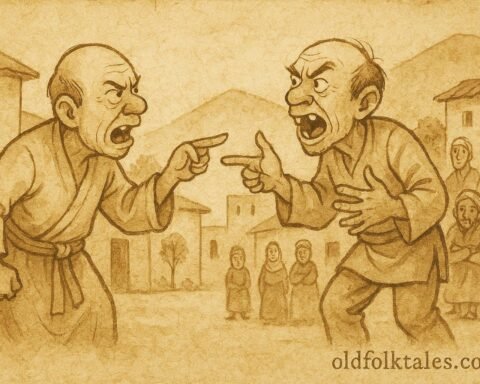
One morning, Karim went to the market to sell his goods, wool, dates, and fine leather straps. The market was crowded with sellers shouting their prices and buyers haggling for bargains. As Karim arranged his wares, a rude stranger approached, a wealthy merchant from another town. Seeing Karim’s proud moustache, the merchant sneered and said loudly, “Ah, friend! That moustache of yours looks heavier than your wisdom!”
The laughter that followed burned Karim like fire. Insults to one’s moustache were grave, almost sacred affronts in his culture. With a red face, Karim shouted, “You insult my moustache, you insult my honour!” He drew closer, trembling with rage. But the merchant only smirked and walked away, leaving Karim humiliated before his fellow villagers.
That night, Karim could not sleep. He sat before his mirror, staring at his moustache under the flicker of an oil lamp. “What is a man,” he thought, “if others mock his honour?” The next morning, he swore to regain his dignity. He went to the merchant’s home, demanding an apology. The merchant laughed again and said, “If you want your honour back, prove you are a man of courage. Spend one night in the haunted ruins by the date grove.”
Everyone in the village knew the story, the ruins were said to be haunted by jinn. Few dared to approach them after sunset. Yet Karim, burning with wounded pride, accepted the challenge.
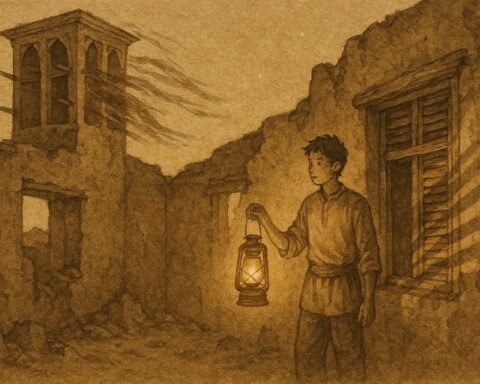
As dusk fell, he entered the ruins, carrying only a lamp and a small dagger. The walls were crumbling, the air thick with the smell of dust and silence. Hours passed, and nothing stirred. But just as the moon rose high, a cold wind swept through the place, and a whisper echoed, “Who dares disturb my home?”
Karim’s lamp flickered. A shadow appeared, tall, smoky, and shifting like mist. Karim’s heart pounded, but he stood firm. “I am Karim, son of Hassan,” he said. “I have come to prove that a man’s honour lies in his courage, not in fear!”
The shadow paused, then spoke again. “Courage, you say? Then face the truth: your honour is not in your moustache, but in your deeds.” With that, the wind stilled. When dawn came, Karim walked out of the ruins unharmed. The villagers gasped when they saw him alive.
When the merchant heard that Karim had spent the night in the haunted ruins, his arrogance faded. He offered Karim gold to forgive the insult. But Karim refused, saying, “I need no gold. My honour has been tested and proven.” The merchant bowed his head in respect, and the two men reconciled.
From that day forward, Karim’s moustache was no longer a symbol of vanity, but of integrity, a reminder that honour is something one upholds through action, not appearance. He treated others with humility and fairness, and his name became a proverb among the people: “Be like Karim, whose moustache spoke of deeds, not words.”
Moral Lesson
This Iraqi folktale teaches that true honour is not found in outward symbols like wealth or appearance, but in courage, truth, and self-respect. Pride can mislead, but integrity earns lasting respect.
Knowledge Check
1. What does the moustache symbolize in this Iraqi folktale?
It symbolizes a man’s dignity, honour, and social standing within the community.
2. Why was Karim insulted by the merchant’s words?
Because mocking his moustache meant mocking his honour, a grave insult in Iraqi culture.
3. What test of courage did Karim face to restore his honour?
He was challenged to spend a night alone in haunted ruins believed to be inhabited by jinn.
4. What realization did Karim gain after his trial?
He learned that true honour lies in one’s actions and character, not in pride or outward symbols.
5. How did the story resolve between Karim and the merchant?
The merchant admitted his mistake and sought forgiveness after witnessing Karim’s bravery.
6. What cultural value does this folktale reflect in Iraqi society?
It emphasizes personal integrity, courage, and the importance of maintaining honour through moral deeds.
Source & Origin
Source: From Folktales from Iraq by C. G. Campbell.
Origin: Collected from oral tales among the Shia tribes of southern Iraq, mid-20th century.