In a village where children’s laughter filled the air and families gathered beneath fruit laden trees, there lived a couple who longed for a child with an ache that grew deeper with each passing year. Pak Ahmad and Mak Fatimah had been married for many years, and though their home was comfortable and their fields productive, an emptiness haunted their lives. They watched neighbors bouncing grandchildren on their knees, saw young parents teaching their sons to fish and their daughters to weave, and felt the weight of their childlessness like a stone upon their hearts.
Every night, Mak Fatimah would pray with tears streaming down her face, asking for the blessing of a child. “Any child,” she would whisper into the darkness. “I do not ask for beauty or strength. I only ask for someone to love, someone to call my own.”
Click to read all East Asian Folktales — including beloved stories from China, Japan, Korea, and Mongolia.
Pak Ahmad, though quieter in his grief, shared his wife’s yearning. He would tend his garden with extra care, imagining a small child toddling between the vegetable rows. He would repair the house with meticulous attention, dreaming of a son or daughter who would one day inherit it.
The village bomoh, a wise healer who understood both herbs and spirits, had told them that sometimes prayers are answered in unexpected ways. “The divine listens,” she had said, her ancient eyes twinkling with mysterious knowledge, “but the form of the blessing may surprise you. Will you accept what is given with gratitude, regardless of its appearance?”
Both Pak Ahmad and Mak Fatimah had nodded emphatically. “Any child would be a blessing,” they had declared.
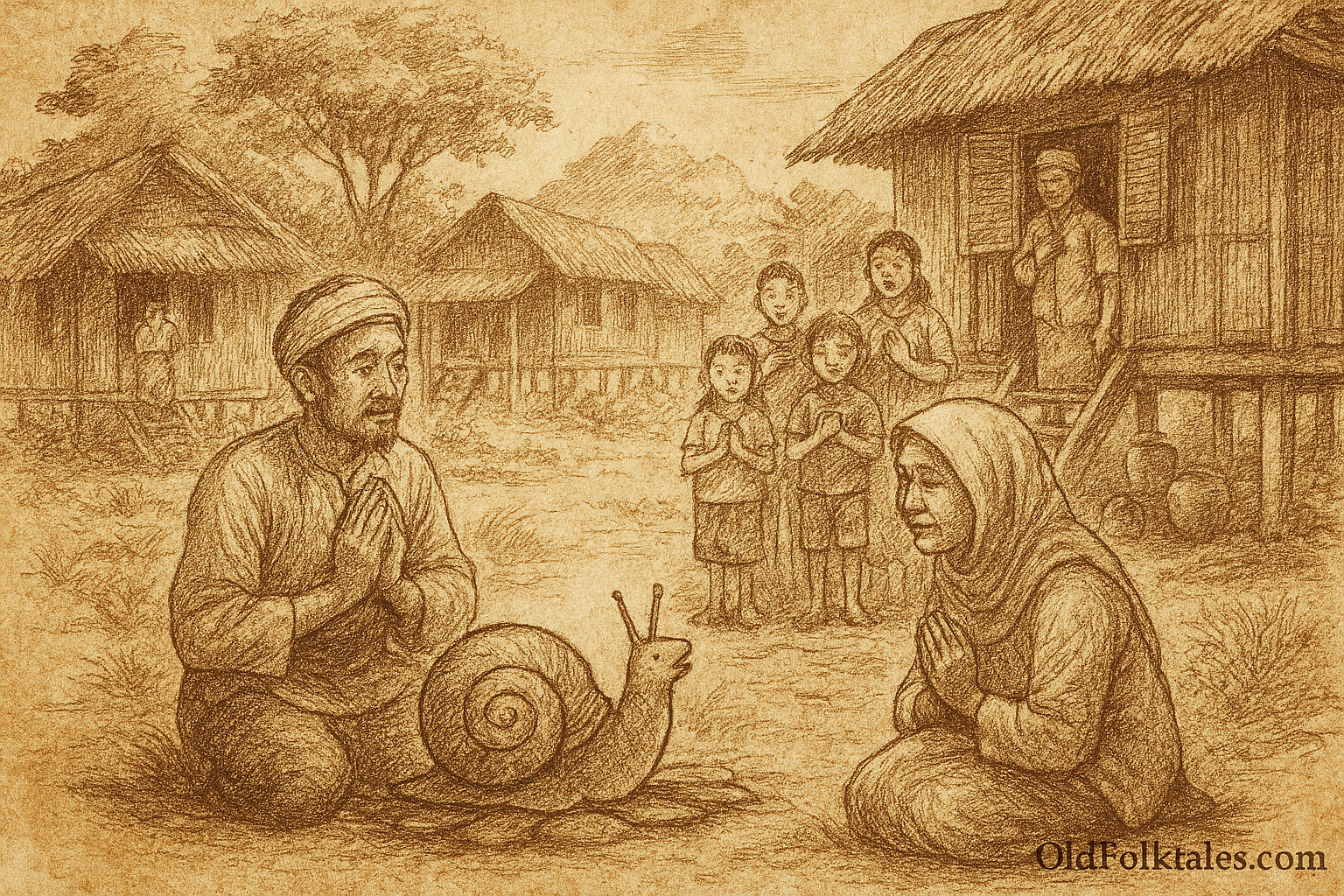
One morning, Mak Fatimah woke to find something extraordinary in the corner of their bedroom. There, nestled in a fold of her sarong, was a perfect snail. But this was no ordinary garden snail. It was larger, with a shell that gleamed with an iridescent sheen, and when Mak Fatimah leaned closer, she heard the tiniest voice say, “Mama.”
Her hands flew to her mouth, stifling a cry of astonishment. The snail spoke again, clearer this time: “Mama, I am here. Your prayers have been answered.”
Mak Fatimah’s eyes filled with tears, but whether they were tears of joy or confusion, she could not say. She called for Pak Ahmad, who came running. Together they stared at the miraculous snail child, their hearts torn between gratitude for answered prayers and bewilderment at the form those answers had taken.
“This is our son,” Mak Fatimah finally declared, her voice firm despite her trembling. “He is the child we asked for, and we will love him as we would any child.”
They named him Anak Siput, which simply meant “Snail Child,” and they cared for him with all the devotion they had stored up through years of waiting. They built him a special cushioned bed, spoke to him with tenderness, and told him stories as if he were any normal baby. And Anak Siput, despite his unusual form, showed remarkable intelligence and kindness from the very beginning.
But the village was less accepting.
When word spread that Pak Ahmad and Mak Fatimah’s long awaited child had arrived in the form of a snail, the gossip was merciless. Neighbors whispered behind raised hands, children giggled and pointed, and some even suggested that the couple had been cursed rather than blessed.
“What use is a child who moves slower than a shadow?” some mocked.
“How can a snail help in the fields or bring honor to a family?” others sneered.
The cruelest were those who had once pitied the childless couple. “Better to have no child than to have one so useless and strange,” they declared.
Pak Ahmad and Mak Fatimah endured this ridicule with quiet dignity, though each cruel word pierced their hearts. Anak Siput himself heard all the mockery. Despite his small size and slow movement, he possessed sharp intelligence and deep feelings. The words hurt, but he never complained to his parents, not wanting to add to their burden.
Instead, Anak Siput devoted himself to learning everything he could. Though he could not run or play like other children, he could listen and observe. He absorbed knowledge about farming from watching his father work, learned about healing herbs from conversations he overheard, and understood human nature from the way people treated him versus how they behaved when they thought no one noticed.
Years passed, and Anak Siput grew in wisdom if not in conventional form. His parents aged, their backs becoming bent from years of labor and hearts heavy from years of defending their unusual son. Yet they never once regretted accepting the gift they had been given.
Then came the year of the great drought.
The rains failed to arrive when expected. The rice paddies cracked and hardened, vegetable gardens withered, and the village well dropped to alarming levels. Desperation gripped the community. The village headman called meetings where farmers argued about water distribution, and tempers flared as resources dwindled.
It was during one of these heated meetings that Anak Siput, carried carefully by his father, spoke up. His voice, though small, carried clearly in the tense silence.
“Honorable elders and neighbors,” he said, “I know where water can be found.”
The crowd erupted in scornful laughter. “The snail thinks he can solve our problems!” someone shouted. “What does a creature who lives in dampness know about finding water in a drought?”
But the headman, desperate and wise enough to listen to any suggestion, raised his hand for silence. “Speak, Anak Siput. What do you know?”
“I have spent my life close to the ground,” Anak Siput explained patiently. “I notice things that those who stand tall might miss. There is a place in the forest, beyond the bamboo grove, where the earth remains damp even now. If you dig there, you will find an underground spring that can sustain our village.”
Some scoffed, but others, remembering the bomoh’s words about unexpected blessings, agreed to investigate. A group of men followed Anak Siput’s directions to the spot he had described. To their amazement, they found exactly what he had promised: cool, damp earth. When they dug, fresh water bubbled up, clear and abundant.
The discovery saved the village. Water was carefully channeled to the most critical crops, and the community survived the drought. Anak Siput’s contribution could not be denied or dismissed.
But this was only the beginning of his service to the village. In the months that followed, Anak Siput’s keen observations and patient wisdom solved other problems. He identified the cause of a rice blight that had puzzled farmers, suggested a solution to a property dispute that had divided families, and even helped the bomoh locate a rare medicinal plant by remembering where he had seen it years before.
Gradually, the villagers’ mockery turned to respect, then to admiration. People began seeking Anak Siput’s advice on matters both practical and personal. His parents, once pitied and ridiculed, were now honored as the mother and father of the village’s wisest resident.
One evening, as the whole village gathered to celebrate the successful harvest made possible by the water source Anak Siput had found, something miraculous occurred. As Anak Siput sat in the place of honor, surrounded by grateful neighbors who had once scorned him, a brilliant light began to emanate from his shell.
The crowd gasped and stepped back as the light grew brighter and brighter, filling the entire gathering space with radiance. When the light finally faded, where the snail had been sitting now stood a handsome young man. He had gentle eyes that reflected the wisdom of years spent observing the world from a humble position, and his face showed the kindness that comes from having experienced both cruelty and compassion.
“I am still Anak Siput,” he said, his voice now full and strong. “But my true form can now be revealed because you have learned to see beyond appearances. The test was never mine alone. It was also yours, to discover whether you could recognize worth that did not conform to your expectations.”
Pak Ahmad and Mak Fatimah wept with joy, embracing the son they had always loved, now transformed in body to match the beauty of his spirit. The villagers who had once mocked felt shame, but Anak Siput bore no grudge.
“You have learned,” he said simply. “And that is what matters.”
From that day forward, Anak Siput remained in human form, serving his village with the same dedication he had always shown. He eventually became headman, known far and wide for his fair judgment and kind heart. He married and raised children of his own, teaching them never to judge others by appearance alone.
His parents lived to old age, surrounded by grandchildren and honored by all. And the story of Anak Siput was told and retold, a reminder that the divine often answers prayers in ways that test our capacity to love unconditionally and to recognize true worth beneath unexpected exteriors.
Click to read all Southeast Asian Folktales — featuring legends from Thailand, Indonesia, Vietnam, and the Philippines.
The Moral Lesson
The legend of Anak Siput teaches us that true value and capability are not determined by outward appearance or physical form. Judging others based on superficial characteristics blinds us to their genuine worth and robs us of wisdom and help they might offer. The story emphasizes that patience, kindness, and intelligence are far more valuable than conventional beauty or strength. It warns against the cruelty of mockery and the foolishness of dismissing those who seem different or less capable. Most importantly, the tale reminds us that answered prayers sometimes come in unexpected forms, and accepting blessings with gratitude regardless of their appearance demonstrates true faith and wisdom. Those who can see beyond the surface to recognize inner worth are the ones who truly understand value.
Knowledge Check
Q1: Who are Pak Ahmad and Mak Fatimah in the Anak Siput story? A: Pak Ahmad and Mak Fatimah are a childless couple who pray for years to have a child. When their prayers are answered with a snail child, they accept this unusual blessing with love and devotion despite village ridicule. Their characters represent unconditional parental love and the ability to see worth beyond appearances, demonstrating that true acceptance requires looking past external form to embrace inner value.
Q2: What makes Anak Siput’s arrival miraculous in this Malaysian folk tale? A: Anak Siput is miraculous because he is born as a snail who can speak and think like a human, arriving as an answer to his parents’ desperate prayers for a child. His unusual form represents a test of whether his parents and community can accept blessings that come in unexpected packages and recognize worth that does not conform to conventional expectations of what a child should be.
Q3: How does the village initially react to Anak Siput? A: The village reacts with cruel mockery, ridicule, and dismissal, questioning his usefulness and suggesting his parents were cursed rather than blessed. Neighbors gossip, children laugh, and many declare it would be better to have no child than one so strange and seemingly useless. This collective cruelty represents how societies often reject those who are different without attempting to understand their potential value.
Q4: How does Anak Siput prove his worth to the village? A: Anak Siput proves his worth by using his unique perspective and keen observation skills to solve critical problems. Most importantly, he identifies an underground spring during a devastating drought, saving the village from disaster. He later helps with agricultural problems, resolves disputes, and locates medicinal plants, demonstrating that his different perspective and patient wisdom make him exceptionally valuable to the community.
Q5: What causes Anak Siput’s transformation into human form? A: Anak Siput transforms into a handsome young man after the village learns to recognize and honor his true worth beyond his appearance. The transformation occurs when the community’s attitude shifts from mockery to genuine respect and gratitude. This suggests that his snail form was a test of the community’s ability to see inner value, and once they passed this test by accepting him fully, his true form could be revealed.
Q6: What does this story teach about judging people by appearance in Malaysian culture? A: This Malaysian folk tale teaches that judging people by physical appearance or unconventional characteristics is both cruel and foolish, causing us to miss the valuable contributions different individuals can offer. It emphasizes traditional values of compassion, acceptance, and looking beyond the surface to recognize true worth. The story warns that communities that reject those who seem different may be rejecting their own salvation, as the one they mock might be the one who saves them.
Source: Adapted from Malaysian oral folklore traditions.
Cultural Origin: Malaysia, Southeast Asia.