In the ancient village of Nalpangan, nestled among the verdant mountains of the Philippines, there lived a maiden whose beauty was legendary throughout all the known world. Her name was Aponibolinayen, and she was so lovely that the very sight of her could make the sunshine dim and the rivers change their course. Her skin was like polished ivory, her hair flowed like black silk, and her eyes held depths that seemed to contain the mysteries of the heavens.
Aponibolinayen lived under the protection of her brother, Aponibalagen, a man of discernment and power. Many young men had come to him seeking his sister’s hand in marriage, bearing gifts and promises, but Aponibalagen had refused them all. He was waiting for a suitor who possessed not just wealth or good looks, but true power, someone worthy of his extraordinary sister.
Click to read all Southeast Asian Folktales — featuring legends from Thailand, Indonesia, Vietnam, and the Philippines.
The fame of Aponibolinayen’s beauty traveled far and wide, crossing mountains and valleys, until it reached the distant town of Adasen. There lived a man named Gawigawen, who was not only handsome but possessed great magical power. He had searched among all the pretty girls in the land but had never found one he wished to marry, until he heard tales of Aponibolinayen. The moment he learned of her, his heart was set. She would be his wife.
Gawigawen turned to his mother, Dinawagen, and begged her to help him win the beautiful maiden. Understanding her son’s determination, Dinawagen took her magical hat that shimmered like captured sunlight and set out immediately for Nalpangan. When she arrived, she was warmly greeted by Ebang, Aponibolinayen’s mother, who began preparing a feast to honor her guest.
Ebang placed a pot over the fire, and when the water boiled, she broke up a stick and threw the pieces into the bubbling water. Miraculously, they transformed into fresh fish. Then she brought basi, the traditional rice wine, in a large jar so ancient that Dinawagen counted nine notches on its rim, it had been passed down through nine generations, each notch representing an ancestor who had drunk from it.
As they ate and drank together, Dinawagen explained the purpose of her visit. She spoke of her son’s wishes and asked if Aponibalagen would consent to the marriage. Aponibalagen, who had already heard tales of Gawigawen’s great power, immediately agreed. This was the suitor he had been waiting for. Dinawagen departed joyfully, leaving behind a golden cup as an engagement present.
When Dinawagen returned home and told her son of her success, Gawigawen’s happiness knew no bounds. He invited all the people of his town to accompany him to Nalpangan to negotiate the bride price. The discussions were long and intense, for the people of Nalpangan knew the value of their most precious daughter. Finally, it was agreed that Gawigawen must fill the spirit house eighteen times with valuable goods, gold, beads, jars, and treasured items.
When this enormous bride price was paid, the celebration began. The people gathered in the yard, dancing and beating copper gongs that rang out across the hills. Pretty girls adorned themselves in their finest clothes and danced with grace and skill. One girl wore large ceremonial jars around her neck, and as she moved, the jars sang out, “Kitol, kitol, kanitol; inka, inka, inkatol.”
But when Aponibolinayen descended from the house to dance, an extraordinary thing happened. The sunshine itself seemed to vanish, overwhelmed by her radiance. As she moved gracefully across the yard, the river rose up and flowed into the town, and striped fish swam after her, nibbling playfully at her heels. Such was her supernatural beauty that even nature itself responded to her presence.
The wedding festivities lasted for three months, three months of feasting, dancing, and celebration. Then, one morning at dawn, the procession began to take Aponibolinayen to her new home in Adasen. The trail between the two towns had been transformed by magic: grass and trees glittered with bright lights as if decorated with stars, and the waters of streams sparkled so brilliantly they dazzled the eyes as Aponibolinayen waded through them.
When they reached Gawigawen’s spring, they found it had become more beautiful than ever. Each grain of sand at the bottom had transformed into a precious bead, and the stone where women set their water jars had become a large decorative dish. Aponibalagen, wanting to create something special for his sister, commanded that an old man be brought to him. In an act of powerful magic, he cut off the old man’s head and buried it in the ground, and immediately sparkling water bubbled up, forming a new spring. The body became a shady tree under which Aponibolinayen could rest, and each drop of blood that touched the earth transformed into valuable beads. Even the path from the spring to the house was lined with beautiful plates. Everything was made magnificent for the bride.
But throughout all these celebrations and transformations, Aponibolinayen had kept her face covered. She had never looked at her husband, for a jealous girl, envious of the bride’s beauty and position, had whispered cruel lies, telling Aponibolinayen that Gawigawen had three noses. Afraid and disgusted by this false image, the bride could not bring herself to look upon him.
After her family and friends had returned to Nalpangan, Aponibolinayen grew profoundly unhappy. When her mother-in-law asked her to cook, she had to feel her way around the kitchen, refusing to uncover her face. Her misery deepened until she could bear it no longer. She decided to run away.
One night, when the household was deep in sleep, Aponibolinayen used her own magical powers. She transformed herself into oil and slid silently through the gaps in the bamboo floor, escaping into the darkness without anyone seeing her.
She traveled through the night until she reached the middle of the jungle. There, a wild rooster spotted her and called out, asking where she was going.
“I am running away from my husband,” Aponibolinayen replied sadly. “He has three noses, and I cannot bear to live with him.”
The rooster shook his colorful head. “Oh, some crazy person must have told you that lie! Do not believe it. Gawigawen is a handsome man, I have seen him many times when he comes here to snare chickens.”
But Aponibolinayen would not listen. She continued through the jungle until she came to a large tree where a monkey sat among the branches. He too asked about her journey.
“I am fleeing from my husband,” she said again. “He has three noses.”
“Do not believe such nonsense!” the monkey exclaimed. “Someone who wanted to marry him herself must have told you that. Gawigawen is truly handsome.”
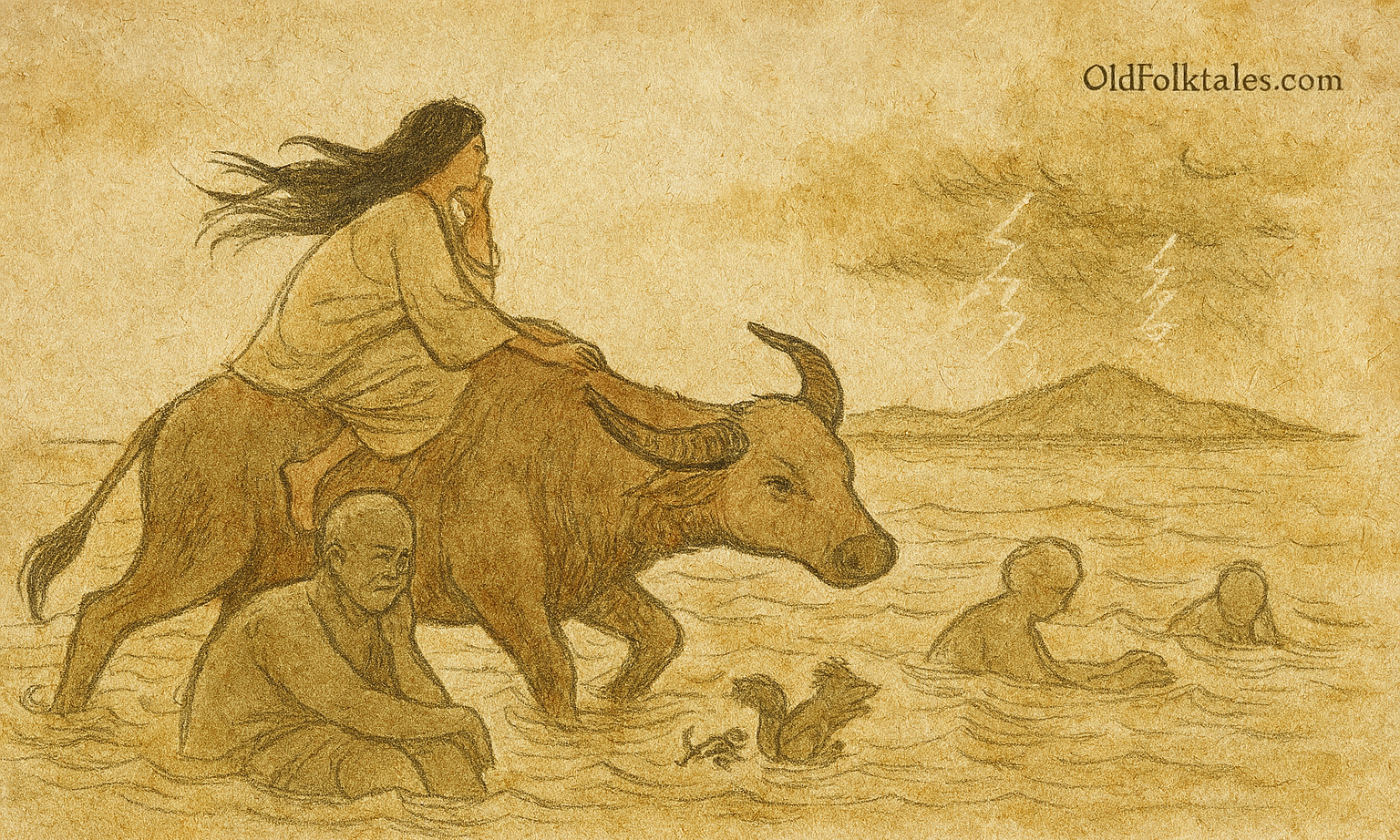
Still, Aponibolinayen refused to believe them and pressed onward until she reached the great ocean. Unable to go any farther, she sat down on the shore, pondering what to do next. As she rested, a carabao, a water buffalo, came ambling along. Thinking she might ride for a while, Aponibolinayen climbed onto its broad back.
No sooner had she settled herself than the carabao plunged into the waves and began swimming. On and on it swam, carrying her across the entire ocean until they reached the far shore, a land she had never seen before.
There, they came upon a magnificent orange tree heavy with golden fruit. The carabao told her to eat and rest while he grazed nearby. But as soon as she climbed into the tree, the carabao ran straight to his master, Kadayadawan, and told him about the beautiful girl.
Kadayadawan was immediately intrigued. He quickly combed and oiled his hair, put on his finest striped coat and belt, and hurried with the carabao to the orange tree. Aponibolinayen, looking down from the branches, was surprised to see a man approaching with her friend the carabao. But as they drew near and began talking, she found Kadayadawan pleasant and charming.
Before long, Kadayadawan had persuaded her to become his wife. He took her to his home, and from that night forward, his house appeared to be ablaze with light, not from fire, but from the radiant beauty of his bride.
After some time had passed, Kadayadawan and Aponibolinayen decided to make a ceremony for the spirits. They called upon magic betel-nuts, oiled them with sacred oil, and commanded them: “Go to all the towns and invite our relatives to this ceremony. If they refuse to come, grow on their knees until they agree to attend.”
The betel-nuts scattered in all directions. One traveled all the way to Nalpangan and found Aponibalagen. “Kadayadawan is making a ceremony for the spirits,” it announced. “You are summoned to attend.”
“We cannot come,” Aponibalagen replied. “We are searching for my sister who is lost.”
“You must come,” the betel-nut insisted, “or I shall grow on your knee.”
“Then grow on my pig,” Aponibalagen answered. Immediately, the betel-nut leaped onto the pig’s back and grew into a tall, heavy tree. The poor pig squealed under the weight, unable to move.
Seeing he had no choice, Aponibalagen relented. “Get off my pig, and we will go.”
The magical nut released the pig, and the people of Nalpangan began their journey. When they reached the river that separated the lands, they found Gawigawen already there, also forced to attend by the magical nuts. Kadayadawan, seeing the gathering crowd, sent more betel-nuts to carry everyone safely across the water.
The ceremony began with dancing and music. As Gawigawen danced with one of the women, he suddenly recognized Aponibolinayen. In a swift movement, he seized her and tucked her into his belt. Kadayadawan, witnessing this insult to his hospitality and the theft of his wife, was consumed with rage. He threw his spear with such force that it killed Gawigawen instantly.
Aponibolinayen escaped and ran into the house, trembling with shock. But Kadayadawan, though angry, was also a man of power and honor. He used his magic to bring Gawigawen back to life, then demanded to know why his guest had seized his wife.
Gawigawen explained that Aponibolinayen was actually his own wife who had been lost. The assembled people were astonished, they had not recognized her at first.
A long discussion followed about how to resolve this complicated situation and restore peace between the two powerful men. Finally, it was decided that Kadayadawan must pay both Aponibalagen and Gawigawen the full bride price that had originally been demanded for the beautiful maiden.
Once this payment was made, harmony was restored. Aponibolinayen, who had finally seen Gawigawen’s true face and realized he was indeed handsome with only one nose, understood how foolish she had been to believe the jealous girl’s lies. In recognition of Kadayadawan’s honor and generosity, the guardian spirit blessed them all with a golden house, where they could live in peace and prosperity.
Journey through enchanted forests and islands in our Southeast Asian Folktales collection.
The Moral of the Story
The tale of Aponibolinayen teaches us the dangers of believing lies and acting without seeking the truth. Had the beautiful maiden simply looked at her husband with her own eyes instead of believing jealous gossip, she would have avoided much suffering and complication. The story also illustrates that hasty decisions made in fear or pride can lead us far from where we belong. Yet it ultimately shows that truth will prevail, and that honor and proper resolution can restore harmony even after great conflict. The importance of family ties, the power of magical traditions, and the value of honest communication are all woven throughout this Philippine legend.
Knowledge Check
Q1: Who is Aponibolinayen in this Philippine folktale?
A1: Aponibolinayen is the most beautiful maiden in all the world, from the village of Nalpangan in the Philippines. Her beauty is so extraordinary that when she dances, the sunshine vanishes and rivers flow into towns. She is protected by her brother Aponibalagen, who seeks a powerful husband for her.
Q2: Why does Aponibolinayen run away from her husband Gawigawen?
A2: Aponibolinayen flees because a jealous girl lied to her, claiming that Gawigawen has three noses. The bride keeps her face covered and never looks at her husband, believing this false information. Her fear and disgust drive her to escape using magical powers.
Q3: What role do the magic betel-nuts play in this Philippine legend?
A3: The magic betel-nuts serve as supernatural messengers that Kadayadawan uses to summon relatives to his ceremony. They have the power to compel attendance, if someone refuses, the nuts will grow on their knees (or in Aponibalagen’s case, on his pig) until they agree to come.
Q4: How is the conflict between Kadayadawan and Gawigawen resolved?
A4: After Kadayadawan kills Gawigawen for seizing Aponibolinayen, he brings him back to life and learns she is actually Gawigawen’s lost wife. To restore peace, it is decided that Kadayadawan must pay both Aponibalagen and Gawigawen the full bride price originally demanded for Aponibolinayen.
Q5: What magical transformations occur in the story of Aponibolinayen?
A5: Many magical transformations occur: sticks become fish when boiled, Aponibolinayen transforms into oil to escape, sand grains become beads, an old man’s head becomes a spring and his body a tree, blood drops become valuable beads, and betel-nuts grow into trees to compel obedience.
Q6: What cultural elements are present in this Philippine folktale?
A6: The story features Filipino cultural elements including bride price negotiations, spirit houses, basi (rice wine), copper gongs, ancestral jars passed through generations, ceremonies for spirits, betel-nuts used in rituals, and the carabao (water buffalo) as an important animal in Philippine culture.
Source: Philippine folktale, Philippines