In the days when the land was younger and the spirits walked more freely among mortals, there lived a fisherman named Pak Hassan in a coastal village where the sea met the jungle. He was neither the best nor the worst of men, neither particularly kind nor overtly cruel. He made his living as his father and grandfather had before him, casting nets into the abundant waters and selling his catch at the morning market.
Pak Hassan’s wife, Mak Salmah, was known throughout the village for her gentle nature and her skill in the kitchen. Each morning before dawn, she would wake to prepare her husband’s meal for the long day ahead. She would cook rice in their clay pot over the fire, carefully measuring each grain, for in their household as in all traditional homes, rice was considered sacred. It was not merely food but a blessing, a gift from the earth that sustained life itself.
Click to read all East Asian Folktales — including beloved stories from China, Japan, Korea, and Mongolia.
The village elders often reminded the younger generation of rice’s spiritual importance. “Every grain of rice,” they would say, their weathered faces serious in the firelight, “contains the sweat of the farmer, the tears of the sky, and the breath of the divine. To waste rice is to dishonor all three.”
But Pak Hassan, like many who have never known true hunger, had grown complacent. He took his daily rice for granted, seeing it as nothing more than fuel for his body, no different from the water he drank or the air he breathed.
One morning, as the sky blushed pink with the approaching sunrise, Pak Hassan prepared to launch his boat for the day’s fishing. Mak Salmah handed him his provisions: a bundle wrapped in banana leaves containing rice and salted fish, a bamboo container of water, and a small packet of betel nuts for chewing. She had risen extra early that morning, cooking more rice than usual because she had dreamed of abundant fish and wanted her husband to have plenty of energy.
“May your nets be full today,” she said softly, touching her hand to her heart in blessing.
Pak Hassan grunted his acknowledgment, already thinking of the fishing grounds, and pushed his boat into the gentle morning waves.
The day proved as bountiful as Mak Salmah had dreamed. Pak Hassan’s nets bulged with fish: silver scaled tenggiri, fat kembung, and prawns that snapped and jumped in his basket. By midday, he had caught more than enough to sell well at market and feed his family for days. Satisfied and somewhat drowsy in the afternoon heat, he decided to eat his meal before heading back to shore.
He unwrapped the banana leaf package and found the rice still warm, fragrant with the aroma of coconut oil and pandan leaves. Mak Salmah had indeed cooked generously. Pak Hassan ate heartily, stuffing mouthfuls of rice and fish into his mouth as he bobbed in his boat, barely tasting the food in his haste.
When his belly was full, he looked down at what remained. There was still a substantial amount of rice left, nearly half of what his wife had prepared. In the old days, Pak Hassan would have carefully wrapped the leftover rice to bring home, where it could be fried for the next morning’s breakfast or mixed into porridge for the children. But today, flush with his successful catch and lazy in the warm sun, he looked at the rice and felt only annoyance at having to carry it back.
“Why should I bother?” he muttered to himself. “The sea will take it, and the fish will eat it. Nothing is wasted in nature.”
With a careless gesture, he tipped the banana leaf over the side of his boat, dumping the remaining rice into the clear blue water. The white grains scattered across the surface, floating for a moment before beginning to sink into the depths.
For several heartbeats, nothing happened. The sea remained calm, the sun continued its arc across the sky, and Pak Hassan reached for his paddle, ready to head home.
Then the rice began to cry.
At first, Pak Hassan thought he was imagining it, that the sound was merely seabirds or the creaking of his boat. But the sound grew louder, more distinct. It was unmistakably the sound of weeping, of countless small voices raised in sorrow and anguish. The very grains of rice he had discarded were crying out, their voices joining in a chorus of grief that seemed to pierce the air itself.
“Why do you waste us?” the voices wailed. “We who were planted with hope, grown with care, harvested with gratitude, and cooked with love. Why do you throw us away as if we have no value?”
Pak Hassan’s blood turned to ice in his veins. He stared at the water where the rice was sinking, his hands frozen on the paddle. The voices grew louder, and now they were not weeping but calling out, summoning, demanding justice for this terrible disrespect.
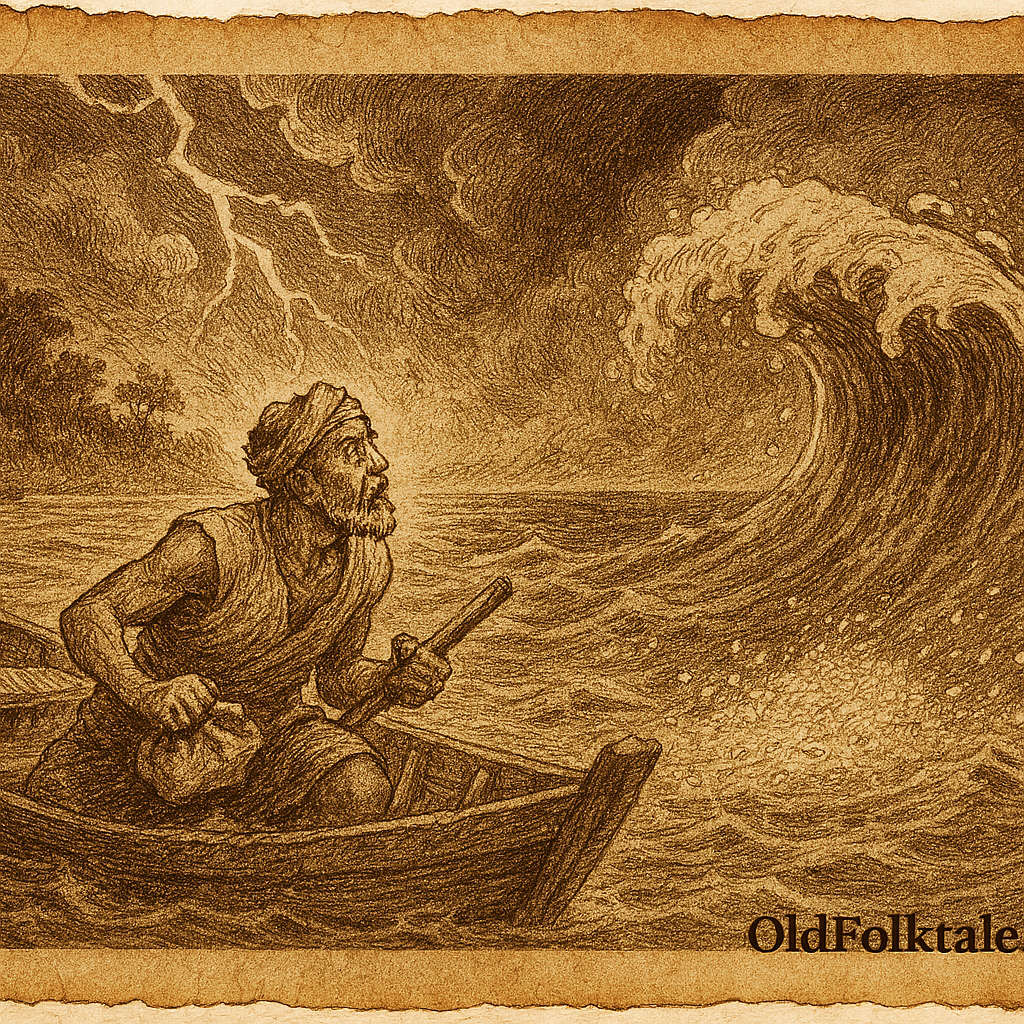
The sky, which moments before had been clear and bright, suddenly darkened. Clouds gathered with unnatural speed, swirling overhead like a great funnel. The calm sea began to churn, waves rising higher and higher. Thunder rolled across the heavens, and lightning split the sky with jagged brilliance.
Pak Hassan tried to paddle toward shore, his heart hammering with terror, but his boat seemed frozen in place. The water around him began to glow with an eerie light, and from the depths emerged beings of light and shadow, spirits of the earth and water summoned by the crying rice.
“You have shown great disrespect,” a voice boomed from everywhere and nowhere, resonating through Pak Hassan’s very bones. “Food is sacred. Rice is life. To waste it carelessly is to mock the farmers who planted it, the earth that nurtured it, and the divine forces that blessed its growth. For this transgression, the land itself must be reshaped as a reminder to all who come after.”
Before Pak Hassan’s horrified eyes, the shore began to crack and split. The earth groaned and shifted, rocks tumbling and trees swaying as if caught in an earthquake. A great fissure opened in the land, running from the spot where he floated all the way inland, cutting through forest and field like a knife through flesh.
Water from the sea began rushing into this new channel, following the path of the crack, carving it deeper and wider. The ground continued to reshape itself with tremendous force, the supernatural powers molding the landscape as a potter shapes clay. What had been solid land became a flowing waterway, a river that carved its path through the territory as if it had always been there.
The storm raged for what felt like hours but might have been mere minutes. When finally the wind died and the clouds dispersed, Pak Hassan found himself floating not in the open sea but at the mouth of a newly formed river. His boat was beached on the muddy bank, and he collapsed onto the solid ground, trembling and weeping with terror and remorse.
When he finally gathered the courage to look up, he saw the transformation that had occurred. Where there had been continuous coastline, there was now a magnificent river cutting inland, its waters flowing with purpose and power. The banks were raw and new, but already the river seemed ancient, as if it had been carved by centuries rather than moments.
Pak Hassan stumbled back to his village, leaving his boat and his catch behind. He found the entire community gathered, staring in awe and fear at the new river that had appeared from nowhere. Some claimed to have heard the crying of rice, others spoke of seeing spirits and lights, but all agreed that something momentous and terrible had occurred.
With shame burning his face, Pak Hassan confessed what he had done. He told them of the wasted rice, the crying voices, and the supernatural punishment that had reshaped the very land. The village elders listened gravely, nodding as if they had expected such a tale.
“This river,” the oldest among them declared, “shall be called Sungai Siamas, and it will stand forever as a reminder of the sacredness of food and the consequences of wastefulness. Let no one who sees it ever forget that every grain of rice is precious, that gratitude must accompany abundance, and that disrespect for the gifts of the earth will not go unanswered.”
From that day forward, Pak Hassan became the most careful and grateful of men. He never wasted a single grain of rice again, and he taught his children and his children’s children to treat food with the reverence it deserved. He would often sit by the banks of Sungai Siamas, the river that his carelessness had created, and remember the lesson that had cost the land itself so dearly.
The river remained, flowing strong and clear, a permanent monument to the importance of gratitude, the sacredness of sustenance, and the balance that must be maintained between humans and the natural and spiritual worlds. And in the villages along its banks, parents would point to the water and tell their children the story of the crying rice, ensuring that the lesson would never be forgotten.
Click to read all Southeast Asian Folktales — featuring legends from Thailand, Indonesia, Vietnam, and the Philippines.
The Moral Lesson
The legend of Sungai Siamas teaches us that food, particularly rice, carries profound spiritual and cultural value that must be honored through gratitude and careful use. Wastefulness is not merely practical foolishness but a spiritual transgression that disrespects the labor of farmers, the generosity of the earth, and the divine forces that provide abundance. The story emphasizes that our actions toward even small things like grains of rice reflect our character and our relationship with the natural world. When we take blessings for granted and treat gifts carelessly, we invite consequences that can reshape our world in ways we never intended. True wisdom lies in maintaining balance through gratitude, respect, and mindful consumption.
Knowledge Check
Q1: Who is Pak Hassan in the Siamas River origin story? A: Pak Hassan is a fisherman whose careless act of throwing leftover rice into the sea triggers the supernatural creation of the Siamas River. He represents people who take blessings for granted and fail to recognize the sacred value of basic sustenance. His character demonstrates how individual disrespect for food can have consequences that affect entire communities and landscapes.
Q2: Why is rice considered sacred in this Malaysian folk tale? A: Rice is considered sacred because it contains “the sweat of the farmer, the tears of the sky, and the breath of the divine.” It represents not just physical sustenance but the interconnection of human labor, natural processes, and spiritual blessing. In traditional Malaysian and Southeast Asian cultures, rice is life itself, and wasting it is seen as dishonoring all the forces that brought it into being.
Q3: What happens when Pak Hassan throws the rice into the water? A: When the rice is thrown into the water, the grains begin to cry out in sorrow and anguish, their voices calling for justice. This supernatural response summons spirits of earth and water who reshape the land as punishment, creating a great fissure that becomes the Siamas River. The crying rice represents the spiritual essence of food speaking against its disrespectful treatment.
Q4: What do the supernatural forces do in response to the wasted rice? A: The supernatural forces gather storm clouds, churn the sea, and physically reshape the landscape by splitting the earth and creating a new river channel. They carve the Siamas River into existence as both punishment for Pak Hassan’s disrespect and as a permanent reminder to future generations about the sacredness of food and the consequences of wastefulness.
Q5: What is the meaning of the name Sungai Siamas? A: Sungai Siamas means “Siamas River” in Malay, with “sungai” meaning river. The river serves as a permanent geographical monument to the incident of wasted rice, standing as an eternal reminder of the spiritual importance of food and the need for gratitude. The name itself carries the weight of the moral lesson embedded in the landscape.
Q6: What cultural values does this Malaysian legend teach? A: This legend teaches traditional Southeast Asian values including deep respect for food (especially rice), gratitude for abundance, mindfulness in consumption, and recognition of the spiritual dimension of everyday sustenance. It emphasizes that wastefulness is a moral failing, that food connects us to divine and earthly forces, and that maintaining proper respect for natural gifts is essential for harmony between humans and the spiritual world.
Source: Adapted from Malaysian oral folklore traditions
Cultural Origin: Malaysia, Southeast Asia.