In a small Syrian village nestled between olive groves and desert winds lived a poor man named Atiyah. His name meant “Gift of God,” yet all his life he seemed to receive little from fate. His home was a single mud-brick room, his belongings could be counted on one hand, and his meals were whatever he could scrape from a day’s labor. Still, Atiyah was known for something far greater than wealth: he carried a gentle smile, a generous heart, and an unwavering belief that God never forgot anyone.
Every morning before sunrise, Atiyah walked to the fields to work for farmers who paid him just enough to survive. He never complained. If a neighbor needed help gathering firewood, he set aside his exhaustion and lent his hands. If a family was hungry, he invited them to share whatever simple dish he had scraped together. Many said he was too generous for a man so poor, but Atiyah believed that blessings multiplied when shared.
One evening, as the call to prayer faded and the cool desert air settled over the village, Atiyah heard a soft knock at his door. When he opened it, he found an elderly traveler leaning on a wooden staff. Dust covered the man’s robe, and his eyes carried the weariness of a long journey.
“My son,” the traveler said, “I have walked far and seek only shelter for the night.”
Atiyah did not hesitate. Though he had no guest room, no feast to offer, he welcomed the stranger warmly. He gave him the only rug he owned, even insisting the traveler take the softer corner. For dinner, Atiyah cooked the last handful of rice left in his jar. He ate only a small portion so the stranger could have enough.
By morning, the traveler looked rested and bright-eyed. As they stepped outside into the golden light, he turned to Atiyah and said, “May God reward your open heart.” Then he lifted his hand and added, “From this moment, whatever you touch with sincerity will multiply.”
Before Atiyah could ask what he meant, the traveler vanished, leaving only a swirl of dust glowing in the rising sun.
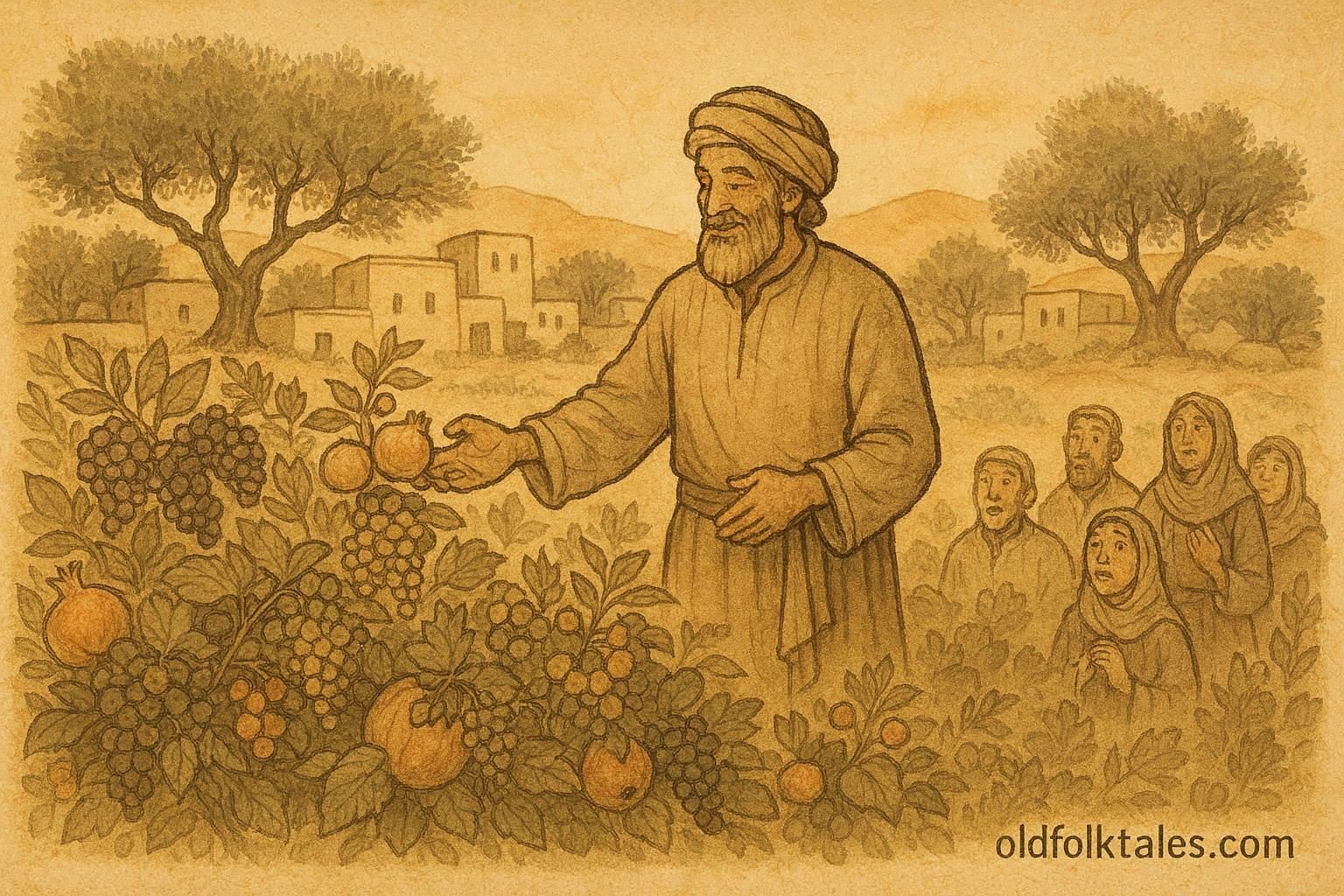
Unsure whether he had witnessed a miracle or a dream, Atiyah went about his day. But when he reached his small garden and touched a single tomato plant, the soil stirred. Shoots sprang upward, the plant doubled in size, then doubled again until it towered over the humble plot, heavy with ripe fruit. Atiyah fell to the ground in astonishment. The blessing was real.
News spread quickly through the village. Some rejoiced for him; others watched with envy. Atiyah, overwhelmed by the sudden abundance, began sharing the multiplied produce with neighbors. Each time he touched a basket to give it away, more fruits appeared. Before long, he no longer needed to work in the fields—he spent his days distributing food to families who had long struggled.
But blessings test the heart, and not all trials come from poverty. Soon, people he had never met arrived at his door asking for gifts. Distant relatives claimed rights to his fortune. Others tried to trick him, hoping to gain something without effort. A few even whispered that no poor man should possess such a miracle.
Atiyah’s days grew heavy. He found himself torn between helping others and protecting the blessing. Villagers who once admired him now demanded more than he could give, and some began to resent him. The more he tried to please everyone, the more they argued, pushing him to exhaustion and doubt.
One evening, he stood alone in his overflowing garden, the air thick with the scent of ripe fruit. “Is this blessing truly a gift,” he wondered aloud, “if it turns hearts hard and sets neighbor against neighbor?”
That night, he dreamt of the traveler again. The old man stood beneath an olive tree and said, “A gift from God tests not your wealth but your wisdom. What you give freely is blessed; what you hold out of fear becomes a burden.”
When Atiyah awoke, his heart felt lighter. He realized the blessing had never meant to make him rich, it was meant to teach him, and his community, the true meaning of generosity.
So he gathered the village elders and proposed a solution: instead of individuals demanding gifts, the entire harvest would be shared communally. Everything multiplied through his touch would go into a common storehouse, where families could take what they needed. He would not be the owner of the blessing, he would be its caretaker.
The village agreed, and peace returned. Elders oversaw the storehouse. Neighbors worked together to distribute food. No one fought or envied anymore. The blessing, once a source of tension, became the heart of unity.
As for Atiyah, he returned to a simple life, grateful not for the wealth but for the harmony restored. His name, “Gift of God,” finally matched his fate, not because of riches, but because he had used his blessing wisely and shared it with pure intention.
Moral Lesson
True blessings reveal the character of the one who receives them. Wealth and abundance mean little unless they are shared with humility, wisdom, and gratitude.
Knowledge Check
1. Who is Atiyah in the Syrian folktale “Atiyah, the Gift of God”?
Atiyah is a poor yet generous man whose kindness earns him a divine blessing that tests his character.
2. What blessing does Atiyah receive in the story?
He is granted the miraculous ability to make anything he touches multiply when he intends it sincerely.
3. What is the main conflict caused by the blessing?
The blessing brings envy, pressure, and conflict among villagers who demand more than Atiyah can give.
4. How does Atiyah resolve the community tension?
He creates a communal storehouse so the blessing benefits everyone fairly.
5. What cultural theme does the folktale highlight?
The tale reflects Middle Eastern values of hospitality, generosity, and communal harmony.
6. What is the central moral of “Atiyah, the Gift of God”?
Blessings must be used with wisdom and humility, or they become burdens rather than gifts.
Source
Adapted from the Syrian folktale “Atiyah, the Gift of God,” referenced in Arab Folktales by Inea Bushnaq.