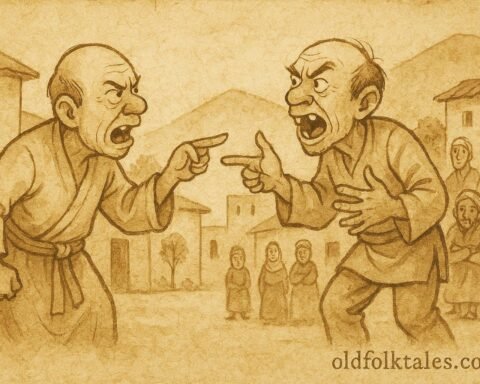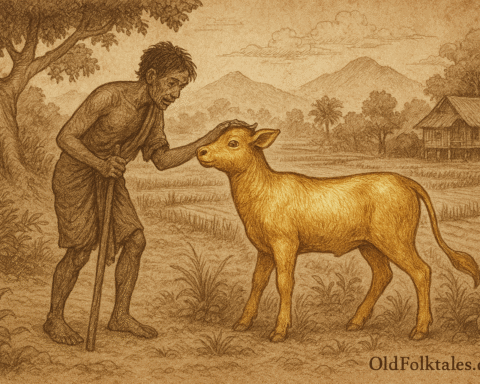
Deep in the lush rainforests of Temburong, where ancient trees stretched toward the heavens and rivers flowed clear and cold through valleys untouched by time, there stood a longhouse village inhabited by the Murut people. The longhouse was a magnificent structure built on sturdy wooden stilts, its roof thatched with dried palm fronds that rustled softly in the breeze. Dozens of families lived under this single roof, their individual quarters connected by a long communal corridor that served as the heart of village life.
The village was led by a respected chief named Senawat, a man known for his wisdom in settling disputes and his skill in leading hunting parties. Under his guidance, the Murut villagers lived as their ancestors had for generations, hunting wild boar and deer in the forest, cultivating rice and tapioca in cleared fields along the riverbank, and fishing in the abundant waters that sustained them. Life followed the rhythms of the seasons and the cycles of planting and harvest.
Click to read all Southeast Asian Folktales — featuring legends from Thailand, Indonesia, Vietnam, and the Philippines.
The longhouse buzzed with daily activity. In the mornings, the men would gather their blowpipes, poison darts, and hunting spears before disappearing into the jungle. Women worked the fields, their backs bent under the tropical sun as they tended crops and gathered wild vegetables. Children played along the wooden platforms, their laughter echoing through the trees. In the evenings, families would gather to share meals of rice, fish curry, and wild ferns, their conversations mixing with the sounds of the jungle at dusk.
One particular evening, as the sun began its descent behind the mountains and painted the sky in shades of orange and purple, a group of young boys returned from their work helping in the fields. They were hot, sweaty, and eager to cool off in the river. With whoops of excitement, they ran down to the water’s edge, shedding their simple clothes and splashing into the cool current.
As they swam and played, one of the boys noticed a small frog sitting on a rock near the shore. It was a harmless creature, green and glistening, its throat pulsing gently as it rested. But the boy, bored and looking for entertainment, had a cruel idea.
“Look at this frog!” he called to his companions. “Let’s make it jump!”
The boys clambered out of the water and surrounded the frightened amphibian. They poked it with sticks, splashed water at it, and blocked its escape routes, forcing it to hop frantically toward the longhouse. The frog’s eyes bulged with terror as it leaped desperately, trying to find safety, but the boys pursued it relentlessly, laughing at its panic.
“Jump! Jump higher!” they taunted, finding amusement in the creature’s distress.
As the commotion drew closer to the longhouse, women who had just returned from the fields, their bodies aching from a long day’s labor, looked down from the platform. Instead of scolding the boys for their cruelty, they found the scene amusing. After such exhausting work, the sight of the frog hopping clumsily and the boys chasing it brought smiles to their tired faces. Soon, their smiles turned to laughter.
“Look how it jumps!” one woman called out, chuckling. “Like it’s dancing!”
Others joined in the laughter, pointing and commenting. Not a single adult thought to stop the boys’ cruel game or to show mercy to the terrified creature. The frog represented nothing to them, just an insignificant animal, something to provide a moment’s entertainment after a hard day.
At that moment, another creature appeared, a squirrel that had been fleeing through the trees, injured and bleeding from a hunter’s missed shot. The small animal, disoriented by pain and fear, ran blindly across the ground. In its panic, it failed to see the hopping frog, and the two creatures collided in an awkward, tumbling heap.
This collision struck the villagers as even more hilarious. The laughter grew louder and more heartless. Men emerging from the jungle joined in, slapping their thighs and wiping tears of mirth from their eyes. Children mimicked the collision, bumping into each other and falling down dramatically, which only made the adults laugh harder.
“Did you see that?” they exclaimed. “The frog and squirrel crashed right into each other!”
The entire village seemed to share in this moment of cruel amusement. No one thought of the fear and pain the animals were experiencing. No one considered showing compassion to Allah’s creatures. They simply laughed, finding entertainment in the suffering of beings weaker than themselves.
But the frog and the squirrel, terrified and in pain, did what all of Allah’s creatures do when faced with injustice—they prayed. In their own way, they called out to their Creator, asking for deliverance from the cruelty of these humans who had forgotten mercy and kindness.
And Allah, who hears the prayers of all His creatures, listened.
The sky, which had been clear and beautiful just moments before, suddenly darkened as if a curtain had been drawn across the sun. Black clouds gathered with unnatural speed, roiling and churning like boiling water. The air grew thick and oppressive, making it hard to breathe. The laughter died in the villagers’ throats as they looked up in growing fear.
The wind rose not the gentle breeze they were accustomed to, but a howling gale that tore at the longhouse’s roof and bent the jungle trees like grass. Thunder crashed so loudly that it felt like the earth itself was splitting apart. Lightning began to fall, not as single bolts but as a terrible barrage, striking the ground again and again with blinding white fire.
“Get inside! Everyone inside!” Chief Senawat shouted, but his voice was lost in the roar of the storm.
Rain poured down in torrents so heavy that it was impossible to see more than an arm’s length ahead. The villagers scrambled for shelter, abandoning any thought of helping one another in their panic. It was each person for themselves as they fought against the wind and rain, trying to reach the safety of their quarters.
The longhouse shook violently on its stilts, the wooden structure groaning and creaking under the assault. Lightning struck closer and closer, hitting trees, exploding bamboo, setting small fires that were immediately extinguished by the deluge. The villagers huddled inside, their faces pale with terror, clutching their children and praying for mercy.
“What have we done?” some whispered. “Why is this happening?”
But there was no time for answers. The storm intensified beyond anything they had ever experienced. Thunder and lightning came simultaneously now, the sound and light overwhelming the senses. The children screamed. The adults cried out to Allah for forgiveness, suddenly remembering the divine power they had forgotten in their moment of cruel laughter.
Then came the final bolt, a massive strike of lightning that hit the ground directly beneath the longhouse with such tremendous force that it lifted the entire structure into the air. For a moment that seemed frozen in time, the longhouse hung suspended, its inhabitants still trapped inside, their cries of terror echoing through the storm.
When the lightning faded and the longhouse crashed back down, silence fell. The storm began to subside as quickly as it had appeared. The wind died away. The rain slowed to a drizzle, then stopped. The clouds parted, revealing stars in the night sky.
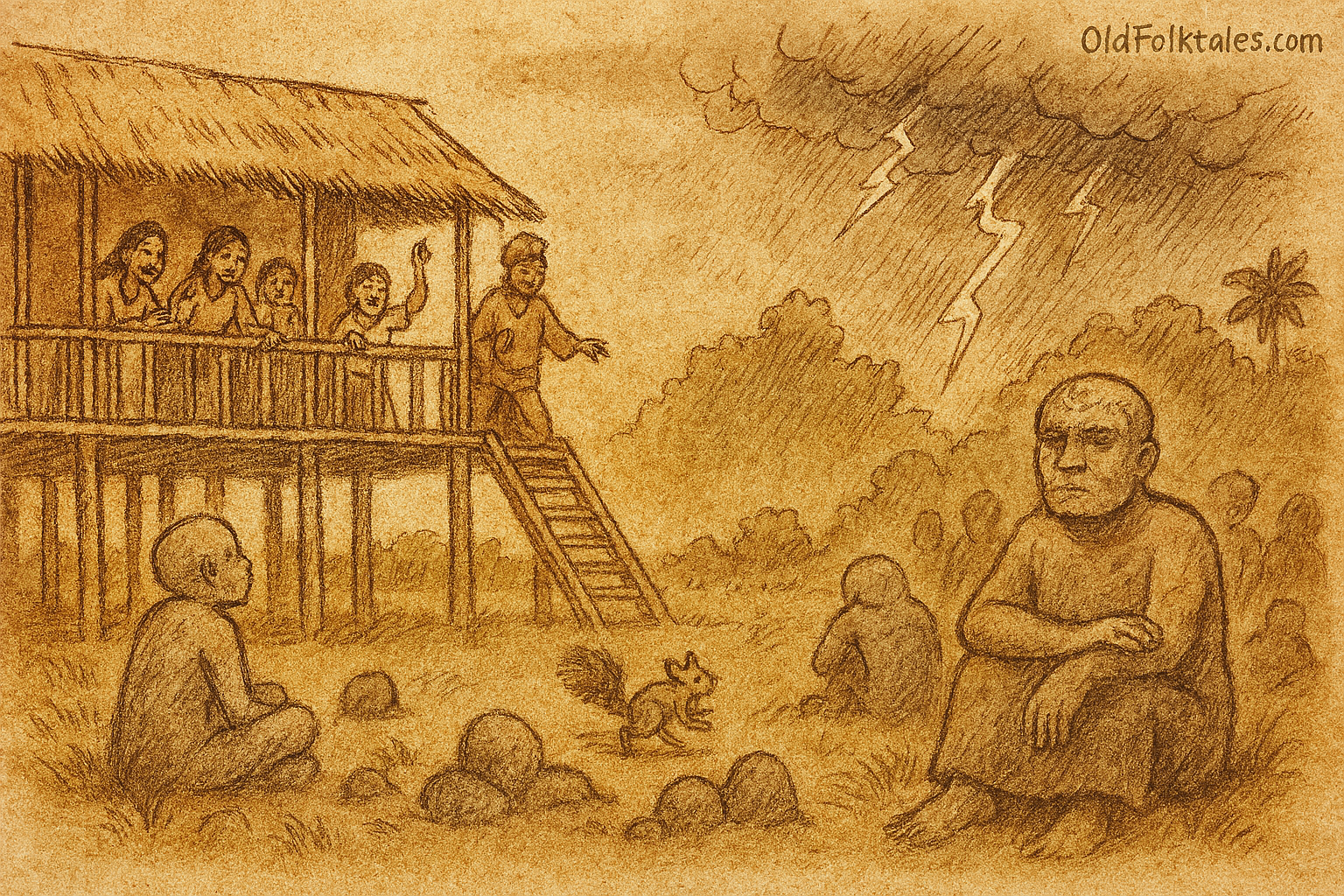
But where the vibrant village had stood just minutes before, there was now only silence and stillness. The longhouse remained, but it was empty of life. In the clearing around it, scattered across the ground, were dozens of stones and boulders of various sizes, some small like children, some larger like adults, their shapes vaguely human if one looked closely.
The villagers had been turned to stone, frozen in their final moments of terror and regret. Their bodies had hardened into rock, their cries muffled forever, their laughter silenced for eternity. Even the frog and the squirrel, whose prayers had brought down this divine punishment, had perished in the storm they had called forth, not realizing they would be caught up in its fury.
Chief Senawat stood among them, now just another boulder, his authority and wisdom reduced to cold, silent stone. Mothers who had laughed at the animals’ suffering were frozen forever, their children beside them. The boys who had tormented the frog would never swim in the river again, never grow to adulthood, never have the chance to learn compassion.
The place became known as Batu Senawat, the Stones of Senawat named after the village chief whose people had forgotten that all of Allah’s creatures deserve respect and mercy. The site lies three kilometers along the path toward Kampong Selapon, and to this day, locals avoid it, especially after dark. The scattered rocks and small boulders that dot the clearing serve as a haunting reminder that these stones were once living, breathing human beings who laughed when they should have shown kindness.
Elders from nearby villages would bring their children to see Batu Senawat and tell them the story. “See these stones?” they would say. “Once they were people like us. But they forgot that we are not the only creatures of Allah, and that cruelty even to the smallest frog or squirrel does not go unpunished.”
The tale of Batu Senawat spread throughout Brunei and became a warning passed down through generations. Parents told their children not to laugh at the suffering of animals, not to find entertainment in cruelty, and always to remember that Allah watches over all His creation, not just humans. For in the faith of the Murut and the Malay people, it is believed that animals have a special place in Allah’s sight their prayers are pure, uncorrupted by greed or ego, and therefore more readily heard.
The stones of Batu Senawat remain to this day, a testament to a moment when laughter turned to lightning, and a village learned too late that mercy is not optional, it is divine law.
Journey through enchanted forests and islands in our Southeast Asian Folktales collection.
The Moral of the Story
The legend of Batu Senawat teaches us that all of Allah’s creatures deserve respect, compassion, and protection from cruelty. The villagers’ sin was not simply laughing, but finding entertainment in the suffering of defenseless animals. Their cruelty revealed hearts that had forgotten mercy and compassion, essential qualities in Islam and in humanity. The story reminds us that how we treat the weakest and most vulnerable beings reflects our true character and our relationship with the Creator. Animals, in Islamic and Malay belief, have souls and their own connection to Allah; their prayers are pure and therefore powerful. The tragedy of Batu Senawat warns that cruelty to any of Allah’s creation no matter how small or seemingly insignificant brings divine punishment, and that we must always remember mercy and kindness in our daily lives.
Knowledge Check
Q1: Who were the people of Batu Senawat in this Bruneian folktale?
A1: The people of Batu Senawat were members of the Murut tribe who lived in a longhouse village in Temburong, Brunei. They were led by Chief Senawat and made their living through hunting, farming, and fishing in the rainforest.
Q2: What cruel act led to the divine punishment in the Batu Senawat legend?
A2: A group of boys cruelly tormented a frightened frog, forcing it to jump and hop for their entertainment. When an injured squirrel collided with the frog, the entire village including adults, laughed at the animals’ suffering instead of showing mercy or stopping the cruelty.
Q3: How were the villagers of Batu Senawat punished?
A3: Allah answered the prayers of the tormented animals by sending a supernatural storm with devastating lightning and thunder. The lightning struck so powerfully that it lifted the longhouse into the air, and when the storm ended, all the villagers had been turned to stone.
Q4: What is the significance of animals in this Temburong folktale?
A4: In Malay and Islamic belief, animals have a pure connection to Allah uncorrupted by human sins like greed. Their prayers are considered more readily heard by the Creator. The frog and squirrel’s prayers for justice were answered, though they too perished in the storm.
Q5: Where is Batu Senawat located and what can be seen there today?
A5: Batu Senawat is located in Temburong, Brunei, three kilometers along the path toward Kampong Selapon. Today, scattered rocks and boulders of various sizes can be seen there, the petrified remains of the villagers who were turned to stone as divine punishment.
Q6: What does the Batu Senawat legend teach about compassion in Islamic culture?
A6: The legend emphasizes that in Islamic and Malay culture, showing mercy and compassion to all of Allah’s creatures, even small animals, is a religious and moral obligation. Cruelty to animals is a serious sin that reflects a heart that has forgotten Allah’s teachings about kindness and mercy.
Source: Bruneian folktale from Temburong, Brunei Darussalam