In the heart of Singapore, long before the towering skyscrapers and endless concrete transformed the island, there stretched a vast ancient forest that covered the hills known as Bukit Brown. This was no ordinary woodland but a place where the boundary between the living world and the realm of spirits grew thin as silk. The trees were old beyond counting, their roots drinking from soil enriched by generations, their canopy so dense that even at noon the forest floor remained wrapped in perpetual twilight.
The early Chinese settlers who came to Singapore in the nineteenth century recognized Bukit Brown as a sacred space, a place where the ancestors should rest and where the spirits of the land held dominion. They established a cemetery there, one that would eventually hold thousands upon thousands of graves, creating a city of the dead that mirrored the growing city of the living nearby. The forest and the cemetery became inseparable, trees growing among tombs, roots entwining with burial grounds, nature and death and memory all woven together into something that felt both peaceful and profoundly unsettling.
Click to read all East Asian Folktales — including beloved stories from China, Japan, Korea, and Mongolia.
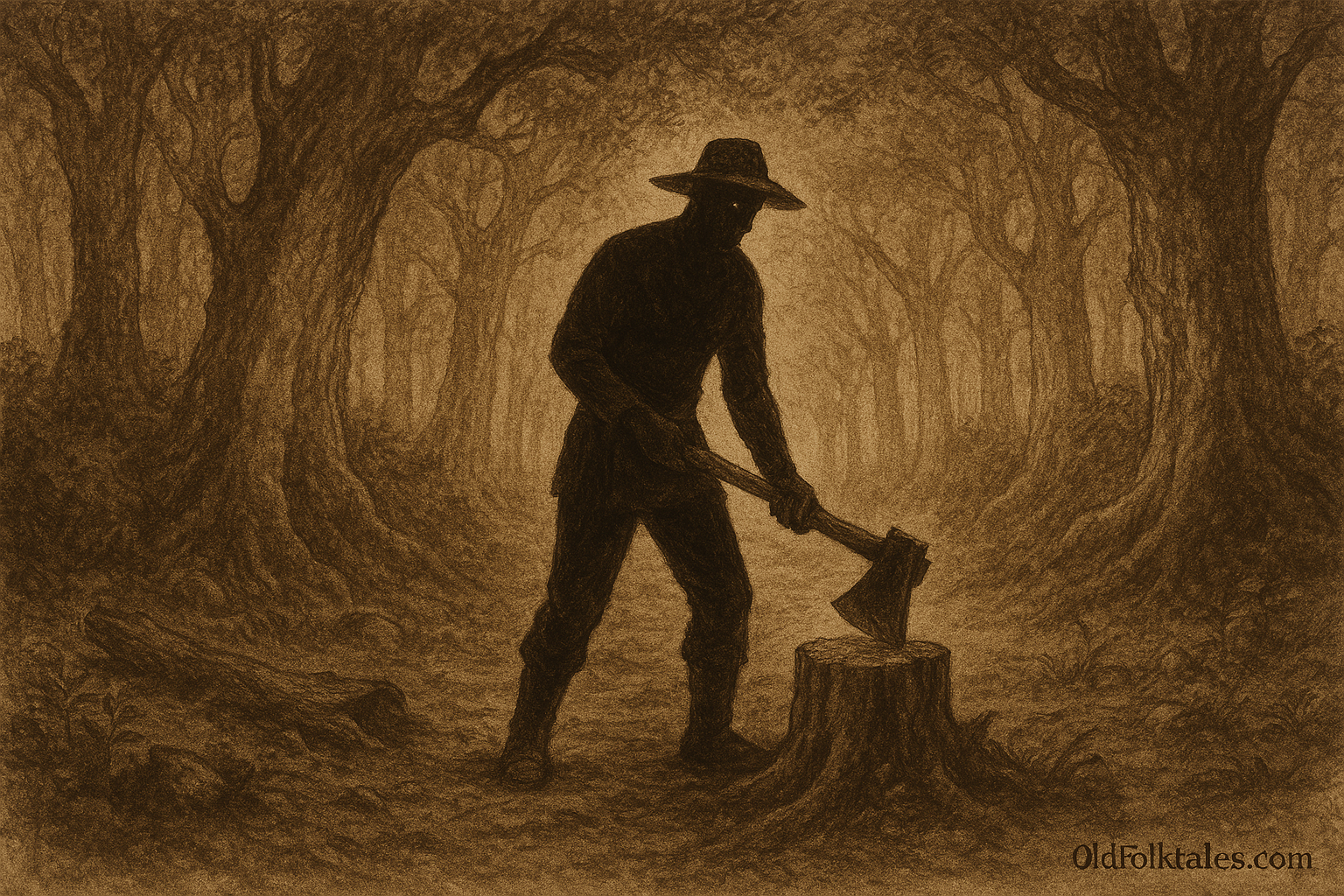
Among the spirits said to dwell in Bukit Brown, none was more frequently encountered than the Black Woodcutter. The Chinese families who tended their ancestral graves and the travelers who ventured through the cemetery trails all knew his legend. He was described as a tall figure, taller than any ordinary man, with skin the color of soot or charcoal, as if he had been carved from shadow itself. Some said his skin was actually black as night, absorbing light rather than reflecting it. Others insisted it merely appeared dark because he existed partially in the spirit realm, his form never quite solid enough to catch the sun properly.
The Black Woodcutter was always doing the same thing: chopping wood. But here was the mystery that gave him his supernatural character. No one ever saw the wood he chopped. No fallen logs appeared where he worked, no chips of bark scattered on the ground, no stumps remained as evidence of his labor. He swung his axe through empty air, the blade passing through invisible timber, and yet the sound was unmistakable: the rhythmic thunk of metal biting into wood, steady and purposeful, echoing through the forest with a resonance that seemed to come from everywhere and nowhere at once.
Those who encountered the Black Woodcutter reported similar experiences. They would be walking through Bukit Brown, perhaps visiting family graves or taking one of the paths that wound through the cemetery, when they would realize they were lost. The trails in Bukit Brown were notoriously confusing, identical-looking paths branching and reconnecting in ways that defeated memory and sense of direction. The dense canopy blocked out sun and stars, making navigation by celestial markers impossible. The graves themselves, while each unique to families who tended them, could all begin to look the same to a panicked, disoriented visitor: stone and marble, inscriptions in Chinese characters, offerings left by the living for the dead.
In that moment of realization that they were lost, travelers would hear it: the sound of chopping. Thunk. Thunk. Thunk. A steady rhythm cutting through the oppressive silence of the cemetery forest. Some would freeze in fear, knowing they were hearing something that should not exist. Others, driven by desperation or hope or simple curiosity, would move toward the sound.
They never saw him clearly. The Black Woodcutter remained always at the edge of vision, a tall dark form among the shadows, his axe rising and falling with mechanical precision. If travelers tried to approach him directly, he would seem to recede, always staying just far enough away that his features remained indistinct. But if they simply followed the sound of his chopping, maintaining a respectful distance and not attempting to confront or question, something miraculous would happen.
The path would appear. Not a new path, but one they had somehow missed before, suddenly obvious, leading clearly toward the cemetery entrance or back to familiar landmarks. The Black Woodcutter’s rhythmic chopping would guide them, the sound moving through the forest just ahead, always just out of sight but perfectly audible. Travelers who trusted the sound and followed without question would find themselves safely back on track, their way clear, their panic subsiding into grateful relief.
But the Black Woodcutter’s guidance came with unspoken rules that the early Chinese settlers learned through experience and passed down through stories told in clan association meetings and around family altars. The spirit demanded respect. Those who approached him with mockery or disbelief, who shouted challenges or tried to prove he was not real, found themselves plunged into deeper confusion. The chopping sound would fracture and multiply, coming from multiple directions at once, leading them in circles until exhaustion and terror forced them to collapse among the graves. Some stayed lost for days, emerging only when search parties found them, their hair turned white with shock, unable to speak clearly about what they had experienced.
The settlers understood that the Black Woodcutter was a guardian spirit, one of those beings who had claimed Bukit Brown as his territory long before humans arrived, or perhaps a soul who had become so attached to the forest that death could not separate him from his eternal labor. His invisible woodcutting was not meaningless but purposeful: he was maintaining the forest, tending to it in ways that transcended physical reality, chopping away spiritual overgrowth, clearing paths in dimensions humans could not perceive.
Families who regularly visited Bukit Brown to tend ancestral graves developed rituals around the Black Woodcutter. Before entering the cemetery, they would burn a stick of incense and offer a brief prayer acknowledging his presence and asking for safe passage. They taught their children to listen for the chopping sound not with fear but with respect, explaining that the spirit protected those who honored him and the space he guarded. They left small offerings sometimes near the forest’s edge: a cup of tea, a few pieces of fruit, tokens of gratitude for a guardian who asked for nothing but continued his vigil regardless of recognition.
As Singapore grew and changed, as the forest shrank and modern development crept ever closer to Bukit Brown, the stories of the Black Woodcutter persisted. Even into the twentieth century, people reported hearing the phantom chopping, especially in the older, more densely forested sections of the cemetery. The sound remained unchanged: steady, purposeful, impossible yet undeniable, echoing through trees that remembered when the island was nothing but jungle and spirits walked more freely than they do today.
The Black Woodcutter became a symbol of continuity for Singapore’s Chinese community, a reminder that beneath the modern city, ancient forces still operated according to their own logic. He represented the idea that some guardians never leave their posts, that some spirits remain faithful to their duties across generations and centuries, and that respect for the unseen world brings practical benefits even in an age that claims not to believe in such things.
To this day, those who visit Bukit Brown, whether to pay respects to ancestors or to walk among the historical graves, speak of occasionally hearing sounds that have no visible source: rhythmic chopping that seems to move through the trees, a steady beat that feels both comforting and otherworldly. The Black Woodcutter continues his endless labor, chopping invisible wood in a forest that exists in two worlds at once, guiding those who lose their way back to the path, asking nothing in return except the respect that any guardian deserves, eternally faithful to his role as protector of Bukit Brown’s ancient, sacred ground.
Click to read all Southeast Asian Folktales — featuring legends from Thailand, Indonesia, Vietnam, and the Philippines.
The Moral Lesson
The legend of the Black Woodcutter teaches that unseen guardians exist in places of significance and that respecting these presences brings protection while mockery brings confusion and harm. The spirit’s consistent aid to lost travelers demonstrates that help often comes from sources we cannot fully understand or see, and that trusting in guidance from the spiritual realm requires humility and respect. This Singaporean tale reminds us that ancient forces persist beneath modern surfaces, that some duties transcend death and time, and that maintaining proper relationships with the guardians of sacred spaces ensures safe passage through both physical and spiritual landscapes.
Knowledge Check
Q1: Who is the Black Woodcutter of Bukit Brown in Singapore folklore?
A1: The Black Woodcutter is a guardian spirit of the ancient forest around Bukit Brown cemetery in Singapore, known among early Chinese settlers. He appears as an unusually tall figure with soot-colored or shadow-black skin, perpetually chopping invisible wood with an axe that passes through empty air yet produces clear, rhythmic chopping sounds. He serves as a protective spirit who guides lost travelers back to safe paths through the confusing cemetery trails, representing one of Singapore’s most enduring supernatural legends from the Chinese community’s oral tradition.
Q2: What is Bukit Brown and why was it significant to early Chinese settlers in Singapore?
A2: Bukit Brown was a vast ancient forest area in Singapore that Chinese settlers in the nineteenth century recognized as sacred space where the boundary between living and spirit worlds was thin. They established a massive cemetery there, creating a necropolis that held thousands of graves among the dense woodland. The site became a place where nature, death, and ancestral memory intertwined, serving as both a resting place for the dead and a spiritual landscape where guardian spirits like the Black Woodcutter maintained watch over the sacred ground.
Q3: What happens when travelers become lost in Bukit Brown according to this Singaporean legend?
A3: When travelers realize they are lost in Bukit Brown’s confusing maze of cemetery trails, they hear the Black Woodcutter’s rhythmic chopping sound echoing through the forest. If they follow the sound respectfully without trying to confront the spirit directly, it guides them toward clear paths leading back to the cemetery entrance or familiar landmarks. The chopping moves through the forest just ahead of them, always audible but the spirit himself remaining at the edge of vision, leading them to safety if they trust the guidance and maintain proper respect.
Q4: What are the consequences of disrespecting the Black Woodcutter in this Chinese Singaporean tale?
A4: Those who approach the Black Woodcutter with mockery, disbelief, or aggressive challenges experience his displeasure through intensified disorientation. The chopping sound fractures and multiplies, coming from multiple directions simultaneously, leading disrespectful travelers in exhausting circles among the graves. Some remain lost for days until search parties find them, emerging with hair turned white from shock and unable to speak clearly about their experiences. This punishment demonstrates that the spirit demands respect and that mockery of spiritual guardians brings tangible negative consequences.
Q5: What does the Black Woodcutter’s invisible woodcutting symbolize in Singapore Chinese tradition?
A5: The invisible woodcutting symbolizes spiritual labor and guardianship that operates beyond physical perception. The Black Woodcutter is understood to be maintaining the forest and clearing spiritual overgrowth in dimensions humans cannot perceive, tending to the sacred space in ways that transcend material reality. His endless, purposeful labor represents eternal vigilance and duty that continues regardless of recognition or reward, embodying the concept that some guardians remain faithful to their responsibilities across centuries, operating according to spiritual logic rather than physical laws.
Q6: What rituals did Chinese families develop around the Black Woodcutter and what do they reveal about Singaporean Chinese attitudes toward spirits?
A6: Chinese families visiting Bukit Brown developed rituals of acknowledging the Black Woodcutter before entering the cemetery, burning incense and offering prayers asking for safe passage. They left small offerings like tea and fruit as gratitude tokens and taught children to listen for the chopping with respect rather than fear. These practices reveal that Singaporean Chinese culture views spirits as real presences requiring proper acknowledgment, that maintaining respectful relationships with guardian entities brings practical protection, and that spiritual literacy, teaching the young about unseen guardians, is an important form of cultural transmission ensuring safety and continuity across generations.
Source: Adapted from Singapore Chinese Clan Associations Oral Archives, Bukit Brown folk narratives
Cultural Origin: Bukit Brown area, Singapore