In the days when Brunei’s ports bustled with traders from distant lands and the Sultan’s authority stretched across the waters like a protective canopy, there existed a position of great responsibility and trust known as the Shahbandar. This harbor master held power over all maritime trade, ensuring fair commerce, collecting the Sultan’s duties, and protecting both foreign merchants and local traders from exploitation. It was a position that required not just administrative skill but unwavering integrity, for the temptations to abuse such authority were immense.
The Shahbandar of our tale was a man named Datu Mansur, appointed to his post by the Sultan himself after years of apparently faithful service. He came from a good family, spoke eloquently of justice and fairness, and initially seemed the perfect choice for such an important role. His settlement, built on a strategic rise overlooking the harbor, became the center of all trade activity. Merchants would bring their goods there to be assessed, duties to be calculated, and disputes to be resolved.
Click to read all East Asian Folktales — including beloved stories from China, Japan, Korea, and Mongolia.
But as the saying goes, power reveals character rather than creating it, and Datu Mansur’s true nature soon emerged once he held authority over the merchants’ fortunes.
It began subtly, as corruption often does. A small “extra fee” here for faster processing, a minor adjustment there in the value of goods to increase taxes owed. Merchants who complained found their ships delayed for “additional inspection” or their goods deemed suspicious and confiscated. Those who paid Datu Mansur’s demanded bribes found their business sailing smoothly, while those who refused met obstacle after obstacle.
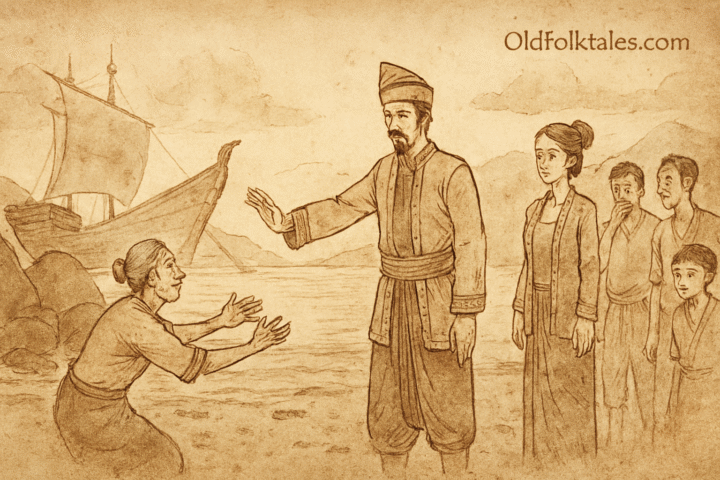
Local villagers who brought fish or forest products to trade were treated even worse. Datu Mansur would use his position to purchase their goods at unfairly low prices, threatening to ban them from the trading post entirely if they refused. Widows and orphans who depended on trade for survival were shown no mercy. When they came seeking fair payment for their labor, Datu Mansur would laugh in their faces.
“You should be grateful I buy from you at all,” he would sneer. “Without my generosity, you would have nothing.”
But it was not generosity, it was exploitation wearing the mask of authority. Datu Mansur grew wealthy while those he was meant to protect grew poorer. His house on the hill expanded with rooms filled with luxury goods, while villagers went hungry. He wore silk while children wore rags. He feasted while families rationed rice.
The people began to complain, but carefully, for Datu Mansur had cultivated relationships with other officials who benefited from his corruption. When delegations approached these officials with grievances, they were dismissed or threatened. The system that should have provided justice had become corrupted by those who profited from injustice.
Foreign merchants, though also suffering under Datu Mansur’s schemes, were in a better position to voice complaints. Several sent reports to their home governments about the Bruneian Shahbandar’s corruption. Word eventually reached the Sultan’s court, and an investigation was ordered.
When the Sultan’s representatives arrived to examine the accusations, Datu Mansur put on a magnificent performance. He produced doctored records showing fair dealings, brought forward false witnesses who praised his integrity, and presented gifts to the investigators. The officials, either convinced or bribed, reported back to the Sultan that the accusations were unfounded, mere complaints from greedy merchants who resented paying fair taxes.
The people were devastated. They had placed their hope in the Sultan’s justice, believing that once the truth was known, their suffering would end. But the investigators had been deceived or bought, and Datu Mansur emerged from the inquiry more arrogant than ever.
“You see?” he proclaimed to the assembled villagers. “Your complaints mean nothing. The Sultan himself has confirmed my righteousness. Now get back to work, and be grateful for my continued tolerance of your presence.”
But there were powers watching that neither corrupt officials nor deceived investigators could influence. The spirits that dwelled in Brunei’s waters and forests, the unseen guardians that maintained the balance between justice and chaos, were not so easily fooled.
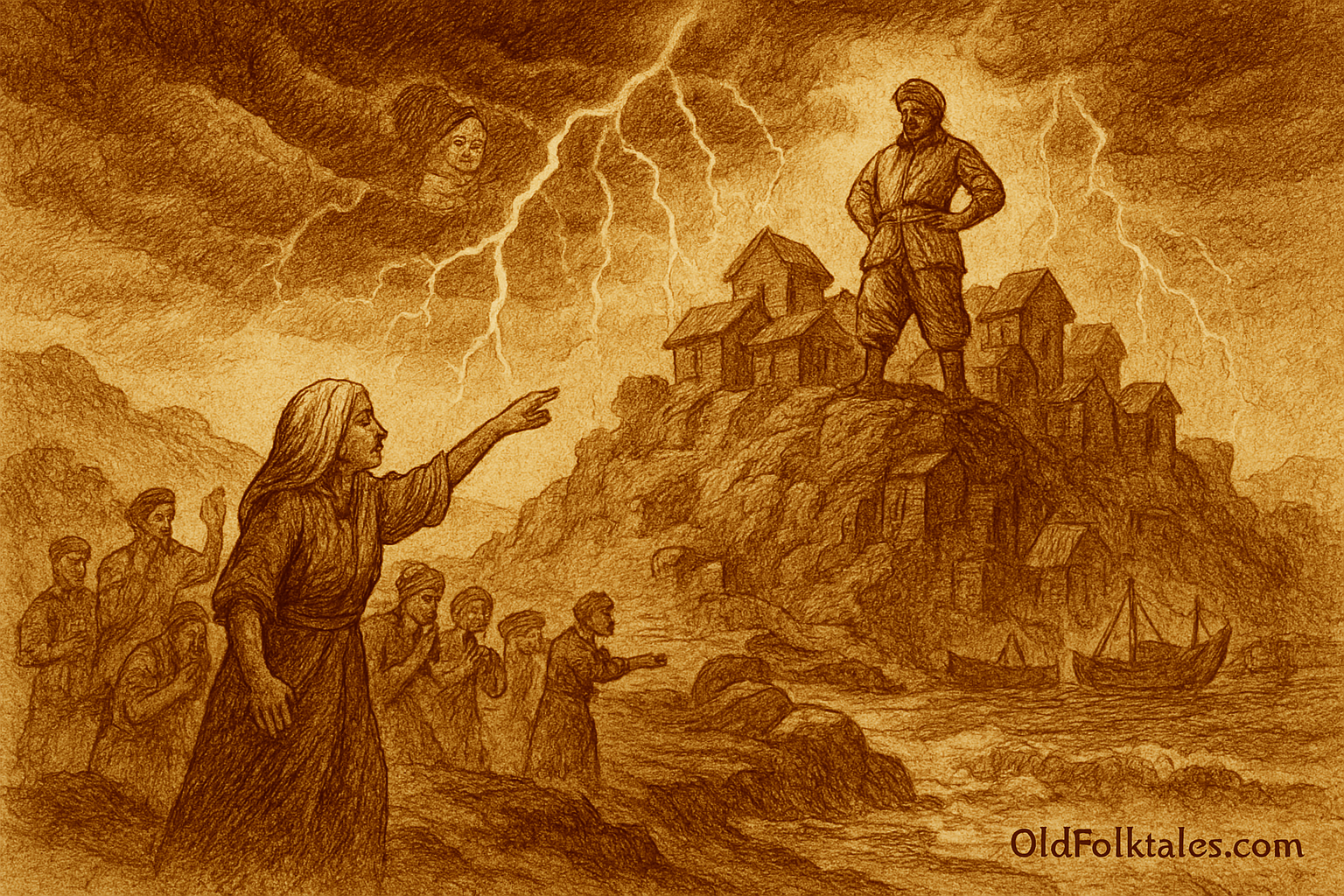
An elderly bomoh woman named Nenek Fatimah, who served as spiritual advisor to the village, began having disturbing dreams. In her visions, she saw dark clouds gathering over Datu Mansur’s settlement, saw the earth itself rejecting his presence, saw supernatural forces mobilizing to correct what human authorities had failed to address.
She went to Datu Mansur’s grand house on the hill and requested an audience. Though he viewed her as merely a superstitious old woman, he agreed to see her, amused by the idea that she might try to threaten him with spiritual warnings.
“Datu Mansur,” Nenek Fatimah said, her voice grave with urgency, “I come not as your enemy but as a warner. The spirits speak of your corruption. They show me visions of divine punishment approaching. You have been given authority and used it to crush rather than protect. You have been given wealth and used it to flaunt rather than share. Change your ways now, before it is too late.”
Datu Mansur threw back his head and laughed. “Old woman, your spirits have no power over me. I have the Sultan’s approval, wealth beyond measure, and authority that none can challenge. Your village superstitions mean nothing in the real world of trade and power.”
“The world you speak of is small and temporary,” Nenek Fatimah replied sadly. “The world the spirits inhabit is vast and eternal. I have warned you as my conscience demands. What happens next is on your own head.”
She left, and Datu Mansur returned to his corrupt practices with even more brazenness, emboldened by what he saw as his untouchable position.
The reckoning came on a day that had started like any other. The harbor was busy with ships, merchants haggling over prices, and Datu Mansur conducting his usual schemes. But around midday, the sky began to darken despite the weather having been clear. Clouds gathered with unnatural speed, swirling and roiling as if stirred by invisible hands.
The wind rose suddenly, not the normal tropical breeze but something that felt charged with purpose and anger. Animals began to behave strangely, dogs howling, birds fleeing inland in vast flocks, fish leaping from the water as if desperate to escape.
Nenek Fatimah stood on the shore, watching the settlement on the hill, her face set with sorrowful certainty. “It begins,” she whispered.
Thunder rolled across the sky, but it was unlike normal thunder. It sounded like voices, thousands of them, speaking words of judgment in a language beyond human comprehension. Lightning struck, not randomly but in deliberate patterns, circling Datu Mansur’s settlement on the hill like a fence of fire.
Datu Mansur ran from his house, finally feeling fear as he saw the supernatural forces arraying against him. “Stop!” he screamed at the sky. “I am the Shahbandar! I have authority here!”
But his authority meant nothing to the powers he had dismissed as superstition. The earth beneath the settlement began to tremble, then to shift. Datu Mansur and his household staff tried to flee, but their feet became rooted to the ground as surely as if they had taken root like trees.
The transformation happened swiftly. Flesh turned to stone, buildings merged with earth, and the entire settlement began to sink and rise simultaneously, the land reshaping itself with violent purpose. Datu Mansur’s last expression, frozen forever in stone, was one of finally understanding the magnitude of his error.
When the supernatural storm finally subsided, the harbor settlement was gone. In its place stood a hill, larger and more prominent than the rise that had been there before. The shape of the hill bore the rough suggestion of buildings and human forms, but all were now part of the landscape itself, transformed into permanent stone.
The people who had suffered under Datu Mansur’s corruption emerged from where they had sheltered during the supernatural event. They approached the new hill with a mixture of awe and satisfaction, seeing divine justice manifested in the physical world.
The Sultan, hearing of what had transpired, came to see for himself. Nenek Fatimah was brought before him to explain.
“This is the judgment of powers beyond human authority,” she told the ruler. “Datu Mansur was warned by mortals and spirits alike, but he believed his position made him untouchable. The hill that now stands here will remain for all time as a reminder that corruption, no matter how well protected by earthly systems, will eventually face divine reckoning.”
The Sultan decreed that the hill would be known as Bukit Shahbandar, the Hill of the Harbor Master, not to honor Datu Mansur but to preserve the lesson of his downfall. He established new systems of oversight to prevent such corruption, ensuring that trade officials would be regularly investigated and that complaints from common people would be heard and acted upon.
But most importantly, he required that all who took positions of authority visit Bukit Shahbandar and hear the story of what had happened there. “Let every official who is tempted to abuse their power,” the Sultan declared, “look upon this hill and remember that justice, though it may seem slow in coming, is ultimately inescapable.”
Generations passed, and Bukit Shahbandar remained, a permanent fixture in Brunei’s landscape and consciousness. Parents would take their children there and tell them the story of the corrupt Shahbandar who thought himself above accountability. Teachers would use it as an example when discussing ethics and governance. And those who held positions of power would look at it and feel the weight of their responsibility.
Some claimed that on certain nights, when the moon was hidden and the wind blew from the sea, you could hear sounds from the hill: not quite screams, but echoes of realization, the eternal moment when Datu Mansur finally understood that power without integrity is not strength but a pathway to destruction.
The hill stands still, silent testimony to the truth that corruption may flourish for a time, that unjust systems may protect wrongdoers, and that earthly authority may fail to punish abuse. But there are forces in the world that see all, judge fairly, and ultimately reshape reality itself to correct the imbalances that human weakness creates.
Click to read all Southeast Asian Folktales — featuring legends from Thailand, Indonesia, Vietnam, and the Philippines.
The Moral Lesson
The legend of Bukit Shahbandar teaches us that authority is a trust that must be exercised with integrity, not a license for personal enrichment at others’ expense. Corruption that exploits the vulnerable and abuses power may seem to prosper when protected by broken human systems, but divine justice operates on a higher level that cannot be bribed, deceived, or evaded. The story emphasizes that warnings ignored, whether from conscience, spiritual advisors, or the suffering of victims, lead to consequences far worse than the temporary discomfort of changing wrongful behavior.
Knowledge Check
Q1: Who is Datu Mansur in this Bruneian origin legend? A: Datu Mansur is a corrupt Shahbandar (harbor master) appointed by the Sultan to oversee maritime trade. He abuses his position by cheating merchants, exploiting villagers, demanding bribes, and using his authority to enrich himself while impoverishing those he was meant to protect. His character represents officials who betray public trust by using power for personal gain rather than service.
Q2: What is a Shahbandar and what responsibilities does this position carry? A: A Shahbandar is a harbor master in historical Brunei responsible for overseeing all maritime trade, ensuring fair commerce, collecting the Sultan’s duties, and protecting both foreign merchants and local traders from exploitation. The position requires integrity and fairness because it holds immense power over people’s livelihoods and economic well being, making it particularly vulnerable to corruption if held by unethical individuals.
Q3: How does Datu Mansur respond to warnings about his corruption? A: Datu Mansur dismisses all warnings with arrogance and contempt. When investigators come, he deceives them with false records and witnesses. When Nenek Fatimah brings spiritual warnings, he laughs and claims his earthly authority makes him untouchable. His refusal to heed multiple warnings demonstrates how power can blind people to accountability and make them believe they are above consequences.
Q4: What supernatural event creates Bukit Shahbandar? A: Supernatural forces manifested through an unnatural storm with purposeful thunder and lightning that circles the settlement. The earth trembles and reshapes itself, transforming Datu Mansur and his household into stone while the entire settlement is transformed into a hill. This divine intervention represents spiritual powers correcting injustice that human systems failed to address, creating a permanent monument to the consequences of corruption.
Q5: What role does Nenek Fatimah play in the story? A: Nenek Fatimah is an elderly spiritual advisor who receives visions warning of divine punishment approaching Datu Mansur. She attempts to warn him and give him opportunity to change, fulfilling her moral obligation despite knowing he will likely reject her counsel. Her character represents the importance of spiritual wisdom and the duty to warn others of consequences, even when those warnings will be dismissed.
Q6: What does this legend teach about corruption and accountability in Bruneian culture? A: This Bruneian legend teaches that corruption, especially abuse of public authority, will ultimately face divine judgment even when earthly systems fail to provide justice. It emphasizes that positions of power carry sacred responsibilities that transcend human oversight, and that spiritual forces maintain ultimate accountability for ethical conduct. The story reflects cultural beliefs that geographical features can embody moral lessons and that supernatural intervention corrects imbalances that human weakness creates or tolerates.
Source: Adapted from Bruneian oral folklore traditions.
Cultural Origin: Brunei Darussalam, Southeast Asia.