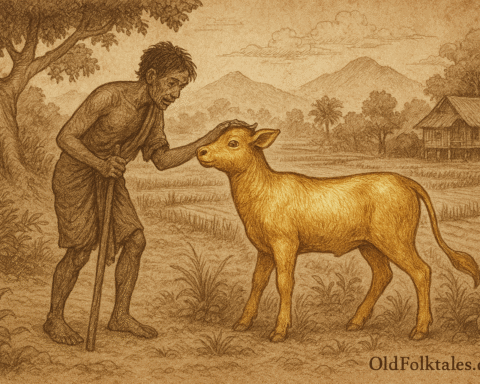
Across the wide Uzbek steppe, where yurts dot the grasslands and herds move with the rhythm of the seasons, there lived a poor shepherd whose only real treasure was a small calf named Buzaki Jingilapo. Though young in age and small in size, Jingilapo possessed something far rarer than strength—a sharp and playful mind. From the moment it learned to walk, the calf showed an uncanny awareness of people, animals, and danger, watching the world with bright, knowing eyes.
The shepherd cared for Jingilapo with affection, trusting the calf to graze freely near the village. Before long, word spread that this calf was unusually clever and strong for its age. Such talk reached the ears of a greedy merchant, a man who valued profit above fairness. Seeing an opportunity, the merchant decided to steal Jingilapo, fatten it quickly, and sell it for a fine sum.
Explore ancient tales from Thailand, Cambodia, and the Philippines in Southeast Asian Folktales.
One evening, the merchant crept toward the pasture, laying out grain and ropes, confident that a simple animal would fall easily into his trap. But Jingilapo was watching. Pretending innocence, the calf stepped close, then suddenly bolted, pulling the rope loose and tangling it around a fence post. The startled merchant fell hard into the dust as Jingilapo trotted away, tail flicking as if in laughter.
Humiliated but stubborn, the merchant tried again. This time, he disguised himself and attempted to lure the calf with sweet words and promises of shelter. Jingilapo listened patiently, then led the man on a winding path through thorny brush and uneven ground. By the time the merchant realized he had been fooled, his clothes were torn and his pride worse for wear. Jingilapo returned safely to the shepherd, untouched.
The calf’s cleverness did not end there. Villagers who boasted loudly or spoke falsehoods often found themselves the quiet targets of Jingilapo’s harmless tricks. A man who claimed he feared no animal was chased by the calf until he scrambled onto a cart. Another who bragged of his honesty found Jingilapo exposing his lies by leading others straight to the truth. Though embarrassed, the villagers could not help but laugh, recognizing the calf’s tricks as playful lessons rather than cruelty.
Despite its mischief, Jingilapo remained deeply loyal to its master. One night, sensing danger, the calf grew restless and refused to settle. Its persistent calls woke the shepherd just in time for him to spot wolves creeping toward the herd. Thanks to Jingilapo’s warning, the animals were driven to safety. On another occasion, Jingilapo led the shepherd to a hidden pasture, rich with grass, allowing the herd to grow strong and healthy.
In time, the shepherd’s fortunes improved. Though he remained humble, his animals thrived, and people spoke with respect of the man and his remarkable calf. The greedy merchant, having failed again and again, finally gave up his schemes, learning, too late, that cleverness cannot be stolen or trapped.
Thus, Buzaki Jingilapo became a familiar figure in steppe tales, remembered not for strength or size, but for wit, loyalty, and good-natured cunning. In laughter and storytelling, the calf lived on, reminding listeners that even the smallest among us can outthink the powerful.
Discover the wisdom of ancient India and the Silk Road in South & Central Asian Folktales.
Moral Lesson
This tale teaches that intelligence and loyalty are greater than greed and force. True cleverness protects the innocent, corrects arrogance, and rewards those who act with honesty and care.
Knowledge Check
1. Who is Buzaki Jingilapo?
A clever calf known for outsmarting humans and animals alike.
2. Who owns Jingilapo?
A poor but kind shepherd.
3. Why does the merchant target the calf?
He wants to steal it and profit from selling it.
4. How does Jingilapo defeat his enemies?
Through intelligence, trickery, and observation—not strength.
5. How does Jingilapo help the shepherd?
By warning of danger and leading him to good pastures.
6. What cultural value does the story emphasize?
The importance of wit, loyalty, and humor in Uzbek folk culture.
Source: Uzbek oral tradition, collected in regional folklore anthologies
Cultural Origin: Uzbekistan (Uzbek folk tale)