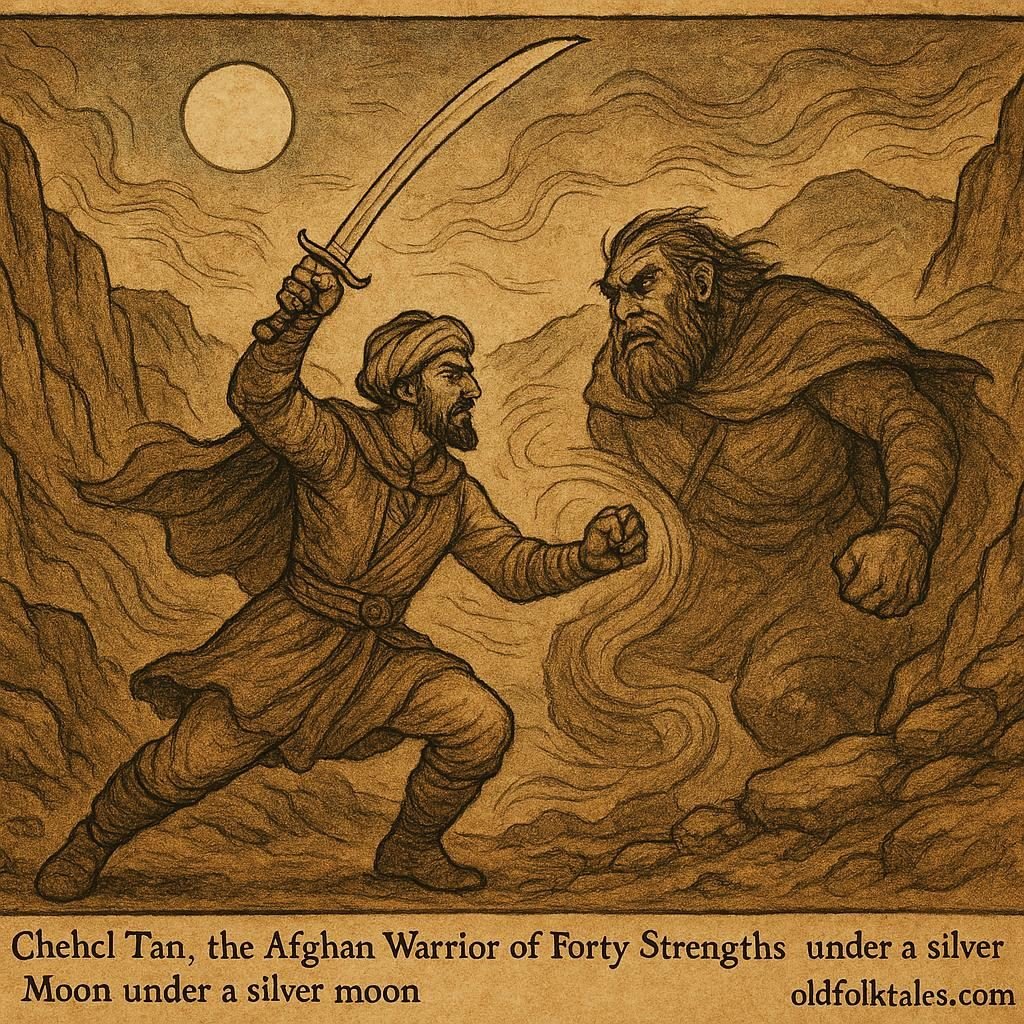
In the mountains of eastern Afghanistan, where the winds whisper through valleys of stone and the stars watch over lonely plains, people still speak of Chehcl Tan, the warrior whose might equaled that of forty men. Yet his greatest power was not his sword, it was his heart. His life became a lesson for all who sought to live with honour, courage, and compassion.
A Vow in the Ashes
Long ago, in a time of endless tribal feuds, a young man lived peacefully among the mountains. But one night, his village was raided and burned to the ground. When dawn broke, he stood alone among the ashes of his home, his family gone, his heart heavy with grief. Lifting his hands to the sky, he swore an oath before God:
“By blood and faith, I shall stand for justice, till the tyrant’s blade be broken, and the orphan smiles again.”
From that day, he became a wanderer, a defender of the weak, a warrior bound by righteousness. His deeds would soon earn him a name that echoed through the hills: Chehcl Tan, the Man of Forty Strengths.
Discover the wisdom of Persian poets and Arabian storytellers in Western Asian Folktales.
The Bandit of Kunar
His first test came in the rugged valleys of Kunar, where a feared bandit-chief terrorised travellers and plundered caravans that crossed the mountain roads. Determined to end the suffering, Chehcl Tan rode to the fortress alone and called out to the robber.
“I have come,” he declared, “to bring peace where fear has lived too long.”
The battle that followed raged until sunset. When victory was his, Chehcl Tan raised his sword, then lowered it.
“Live,” he told the bandit, “but live justly. Give your wealth to the poor, and redeem your name through mercy.”
The humbled bandit agreed, and from that day forward, the roads of Kunar were safe once more, not by the sword, but by forgiveness.
The Siege of the Forty Thieves
Soon another call for help reached Chehcl Tan. A fortress of thieves had enslaved an entire valley, taking food from the hungry and gold from the poor. Without hesitation, he went alone to confront them. The outlaws laughed, forty against one. But Chehcl Tan fought with the might of forty men. For three days and nights, steel rang against steel until the stronghold fell. When the villagers found him at dawn, he was kneeling in prayer among the fallen. From that day, they said the name “Chehcl Tan” not as a boast of power, but as a symbol of divine strength, the power that comes when justice is on one’s side.
The Saint’s Test
Chehcl Tan’s fame spread across the mountains, but his heart remained humble. One evening, as he rested near a desert shrine, a beggar approached and asked for alms. Without hesitation, Chehcl Tan gave him food, water, and even his sword.
“The just man’s weapon,” he said, “is mercy.”
The beggar’s form shimmered and changed, revealing a radiant saint. Smiling, the saint blessed him, saying, “Your heart is purer than your blade. Go forth, for strength without pride is beloved in the sight of God.” Then the saint vanished, leaving Chehcl Tan in awe beneath the stars.
The Princess and the Demon of the Pass
In time, Chehcl Tan’s name reached the palace of a powerful malek, whose daughter was famed for her wisdom and beauty. She had vowed to marry only a man whose courage and virtue surpassed all others. To test Chehcl Tan, the malek issued a deadly challenge: “Bring me the head of the Demon of the Pass,” he said, “and prove thy worth.”
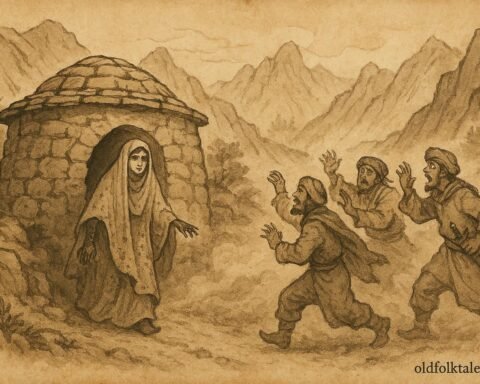
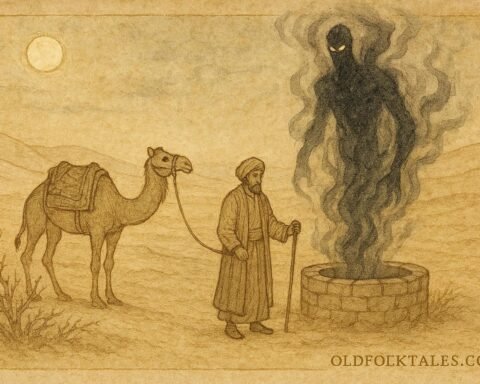
The demon was a monstrous being said to devour travellers at night in the mountain gorge. Chehcl Tan rode forth without fear. For hours he battled the creature amid thunder and wind, until at last, he drove his blade through its heart. The mountains trembled as the beast fell dead. Carrying the demon’s head, he returned victorious. But the malek, jealous and afraid that the hero’s fame might eclipse his own, betrayed him. Soldiers were sent to kill him in secret. Only the princess, torn between love and loyalty, risked her life to help him escape under the veil of darkness.
Exile and Sacrifice
Wounded and weary, Chehcl Tan fled into the desert. For days he wandered, his strength failing. One night, he saw fire on the horizon, a caravan under attack by raiders. Though his body was broken, his spirit rose once more. With a cry of faith, he drew his sword and charged into the fray, scattering the bandits and saving the travellers. When the last enemy fell, Chehcl Tan sank to the ground. The merchants gathered around him, and with tears, they buried him beneath a tamarisk tree, marking the grave with stones. Not long after, travellers passing through the desert saw soft lights hovering over his resting place, like stars guarding his spirit. From that time, people called him a martyr-saint, a man whose courage and mercy lived on beyond death.
Moral Lesson
The legend of Chehcl Tan teaches that true heroism is not in conquest but in compassion. Strength is hollow without justice, and courage is nothing without mercy. The greatest warrior is one whose power serves goodness, whose blade protects rather than destroys.
Knowledge Check (SEO-Optimized Q&A)
1. Who is Chehcl Tan in Afghan folklore?
Chehcl Tan is a legendary Afghan warrior celebrated for his immense strength, humility, and devotion to justice.
2. What does the name “Chehcl Tan” mean?
It means “Forty Bodies” or “The Man of Forty Strengths,” symbolising both physical power and spiritual might.
3. What moral lesson does the story teach?
That compassion, faith, and righteousness are greater than brute strength or worldly victory.
4. What trials did Chehcl Tan face?
He defeated a mountain bandit, fought forty thieves, passed a saint’s test of humility, and slew a demon haunting a mountain pass.
5. Why is Chehcl Tan regarded as a martyr-saint?
He gave his life defending the innocent, showing that sacrifice for justice brings eternal honour.
6. What Afghan cultural values are reflected in the tale?
The story embodies Afghan ideals of honour, generosity, humility, and spiritual courage.
Source: Charles Masson, Legends of the Afghan Countries, in Verse (London: J. Madden & J. Ollivier, 1848), pp. 18–30.
Region of origin: Eastern Afghanistan (likely Ghazni or Kandahar region).
Cultural type: Tribal chivalric folktale, part adventure, part moral epic.