
In the lush, verdant lands of the Bicol Region, where mountains meet the sea and rivers carve their way through fertile valleys, there once lived a maiden whose beauty surpassed that of the moon and stars. Her name was Daragang Magayon, which meant “Beautiful Maiden” in the ancient tongue, and she was the beloved daughter of Makusog, the powerful chieftain of the Rawis tribe.
Magayon’s beauty was legendary throughout the region. Her hair flowed like the darkest river at midnight, her eyes sparkled like dewdrops catching the first light of dawn, and her smile could make even the most troubled heart find peace. Suitors came from distant villages and kingdoms, bearing gifts of gold, pearls, and precious stones, all hoping to win her favor. Yet Magayon’s heart remained untouched, for she had not yet found love that stirred her soul.
Click to read all East Asian Folktales — including beloved stories from China, Japan, Korea, and Mongolia.
One fateful day, while bathing in the crystal-clear waters of the Yawa River, Magayon slipped on the smooth river stones and was swept away by the current. The waters pulled her under, and panic seized her heart as she struggled against the rushing stream. Just when she thought all was lost, strong arms lifted her from the water and carried her safely to shore.
Her rescuer was Panganoron, a brave and handsome warrior from the neighboring tribe of Karilaga. As their eyes met, something profound passed between them a recognition that transcended words, a connection as ancient as the mountains themselves. From that moment, their fates were entwined like vines climbing toward the sun.
Panganoron visited Magayon often, and their love blossomed like the sampaguita flowers that perfumed the evening air. They would walk together through the rice fields, share stories beneath the shade of acacia trees, and dream of a future together. Chieftain Makusog, seeing the genuine love between them and recognizing Panganoron’s noble character, blessed their union. The entire village rejoiced, and preparations began for a wedding celebration that would be remembered for generations.
But not all hearts were gladdened by this news. Pagtuga, a proud and powerful chieftain from a distant land, had long desired Magayon for himself. His pride wounded and his jealousy inflamed, he could not bear to see her marry another. Consumed by darkness, Pagtuga devised a treacherous plan.
Under the cover of night, Pagtuga and his warriors launched a surprise attack on the Rawis village. In the chaos and confusion, Pagtuga’s men seized Chieftain Makusog and took him captive. The next morning, Pagtuga sent word that he would release Makusog only if Magayon agreed to become his bride. The ultimatum was clear: her father’s life in exchange for her hand.
Magayon’s heart shattered like pottery thrown against stone. She loved her father deeply and could not bear the thought of his death, yet the idea of marrying Pagtuga, a man whose heart was filled with pride and cruelty, filled her with despair. After days of anguish, torn between filial duty and true love, she agreed to Pagtuga’s demands, sacrificing her own happiness to save her father.
The wedding day arrived under ominous gray skies. As Magayon stood beside Pagtuga, her eyes empty and her spirit broken, a battle cry suddenly pierced the air. Panganoron had gathered warriors from allied tribes and launched a desperate rescue. The wedding ground transformed into a battlefield, with warriors clashing in fierce combat, their weapons ringing out like thunder.
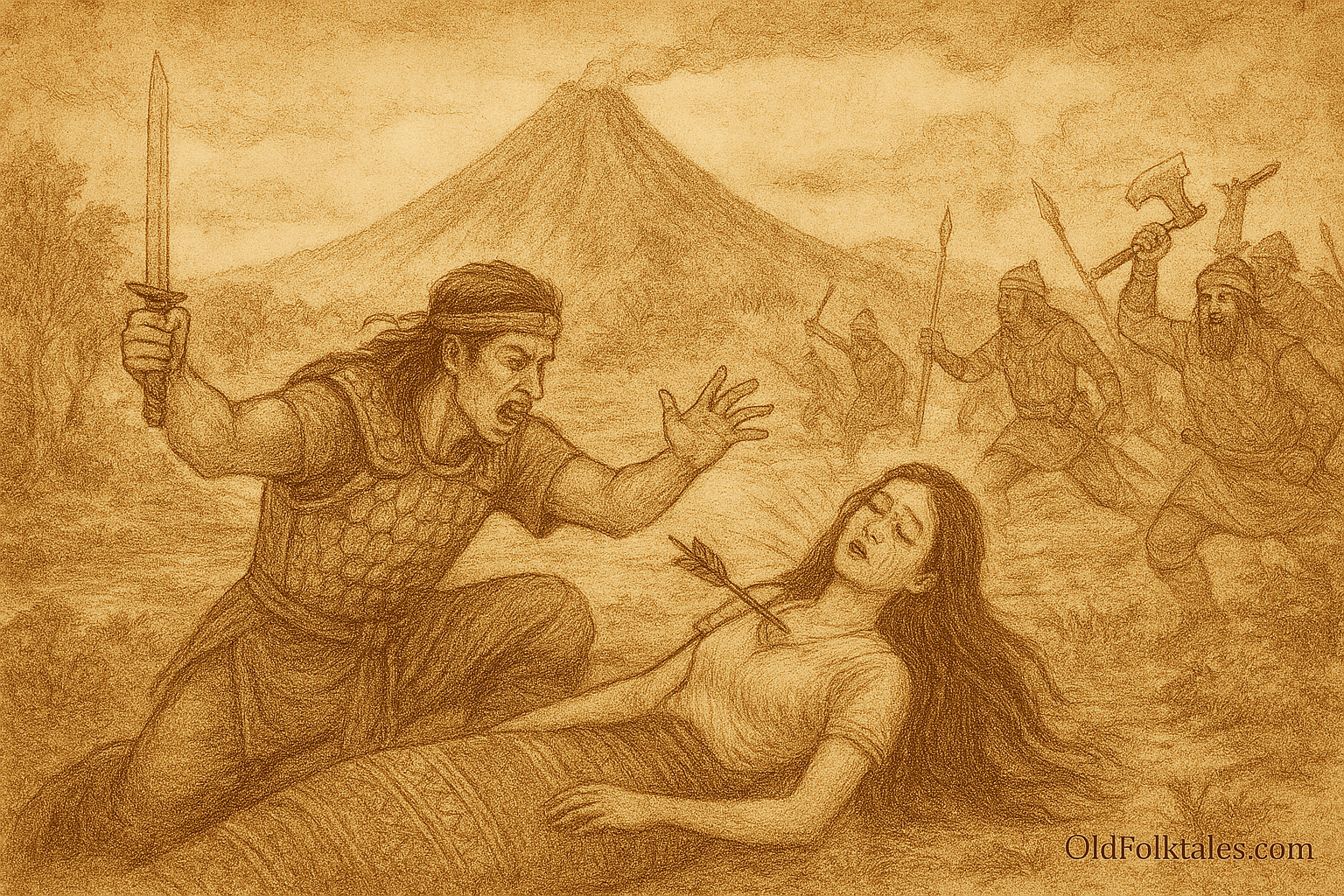
In the midst of the chaos, Magayon saw Panganoron fighting his way toward her, his eyes blazing with determination and love. She broke free from Pagtuga’s grasp and ran toward her beloved. But one of Pagtuga’s archers, seeing his chieftain’s prize escaping, released a poisoned arrow. The arrow found its mark, and Magayon fell into Panganoron’s arms.
Time seemed to stop as Panganoron held his dying love. Tears streamed down his face as he cradled her, whispering words of devotion into her fading ears. In her final moments, Magayon smiled up at him, for she was in the arms of the one she truly loved. As her spirit departed, an enemy warrior struck Panganoron from behind, and he fell across Magayon’s body, dying as he had lived protecting the woman he loved.
The grief-stricken villagers buried the two lovers together in the spot where they had fallen. As days turned to weeks and weeks to months, the earth above their grave began to rise. The mound grew higher and higher, taking the shape of a perfect cone that reached toward the heavens. Trees and vegetation covered its slopes, creating a mountain of breathtaking beauty and symmetry. The people named it Mayon, after the beautiful maiden who rested within.
To this day, Mayon Volcano stands as the most perfectly shaped volcanic cone in the world, a testament to eternal love. When smoke rises from its peak, the locals say it is Panganoron, still watching over his beloved, tenderly kissing Magayon’s forehead. And when the volcano rumbles, they say it is Magayon’s heart, still beating with love for her warrior.
Click to read all Southeast Asian Folktales — featuring legends from Thailand, Indonesia, Vietnam, and the Philippines.
The Moral of the Story
The Legend of Daragang Magayon teaches us that true love transcends even death itself. It reminds us that genuine devotion requires sacrifice, courage, and selflessness. The story also warns against the dangers of pride and possessiveness Pagtuga’s inability to accept rejection led to tragedy for all. Most importantly, it shows that beauty endures not in physical form, but in the legacy of love and sacrifice that inspires generations. Like Mayon Volcano standing tall and perfect through the centuries, true love remains constant and unchanging, a beacon of hope and beauty in an ever-changing world.
Knowledge Check
Q1: Who was Daragang Magayon in the Philippine legend?
A: Daragang Magayon, meaning “Beautiful Maiden,” was the daughter of Chieftain Makusog of the Rawis tribe in the Bicol Region. She was renowned for her extraordinary beauty and eventually fell in love with the warrior Panganoron after he rescued her from drowning in the Yawa River.
Q2: What role did Panganoron play in the Mayon Volcano legend?
A: Panganoron was a brave warrior from the Karilaga tribe who saved Magayon from drowning and became her true love. He died protecting Magayon during a battle to rescue her from the chieftain Pagtuga, and was buried with her. Their grave became Mayon Volcano.
Q3: Why did Chieftain Pagtuga kidnap Magayon’s father?
A: Pagtuga kidnapped Chieftain Makusog to force Magayon to marry him. Consumed by jealousy after learning of her engagement to Panganoron, Pagtuga used her father’s life as leverage to make her become his bride against her will.
Q4: What does Mayon Volcano symbolize in Bicol culture?
A: Mayon Volcano symbolizes eternal love, sacrifice, and beauty. Its perfect cone shape represents the purity of Magayon and Panganoron’s love. When smoke rises from the volcano, locals believe it is Panganoron kissing Magayon’s forehead, showing that their love endures beyond death.
Q5: What is the cultural significance of the Mayon Volcano legend in the Philippines?
A: The legend explains the origin of Mayon Volcano, one of the Philippines’ most iconic natural landmarks. It is a foundational story of the Bicol Region, teaching values of true love, sacrifice, and the consequences of pride while connecting the people to their geographical and cultural heritage.
Q6: What moral lessons does the Daragang Magayon story teach?
A: The story teaches that true love requires sacrifice and courage, that beauty and love can transcend death, and that pride and possessiveness lead to tragedy. It also emphasizes the importance of choosing love freely and the enduring power of genuine devotion over selfish desire.
Source: Adapted from Philippine Folk Literature: The Myths compiled by Damiana L. Eugenio
Cultural Origin: Bicol Region, Philippines (Indigenous Bicolano tradition)








