In a quiet Syrian village surrounded by olive trees and sunlit hills, two children were born into neighbouring families. The girl was called Arzeh, meaning Cedar, and her cousin was named Anbar, meaning Spruce. From the day they came into the world, their families spoke of their union with joy. “Arzeh will marry Anbar, and Anbar will marry Arzeh,” the elders would say, their hearts warmed by the thought of such a destined love.
As they grew, their affection blossomed like spring flowers after the rain. They played together by the river, shared stories under the shade of fig trees, and dreamt of a future bound by love. But fate would not be so kind. When both their fathers passed away, grief changed everything. Arzeh’s mother, bitter and proud, refused to honour the promise made between the two families. She despised Anbar and the bond he shared with her daughter.
When Arzeh declared her wish to marry him, her mother moved their household to a distant part of the village, hiding her daughter from the man she loved. Yet Devotion, stronger than fear, guided Anbar’s heart. He leapt across rooftops, searching every alley until he found where Arzeh lived. But her mother, seeing him from afar, decided that only his death could keep him away forever.
She invited him for lunch the next day, smiling sweetly, her heart filled with deceit. Arzeh sensed the danger. That night, as the moonlight bathed the rooftops, she climbed to the top of the house and sang softly into the night air:
“Anbar, do not touch the fare,
Throw it out the door with care.
Give it to the cat to see,
‘Tis poisoned, God knows I speak truly!”
Her voice, trembling with love and fear, carried through the quiet streets. When Anbar arrived the next morning, he remembered her warning and fed his meal to a cat. The poor creature died instantly. Knowing the truth, Anbar rose in silence and left, his heart heavy but his spirit unbroken.
Days passed, and longing for Arzeh grew unbearable. He returned to her house, but her mother, cunning as ever, sang deceitfully:
“Two ogres took Arzeh away,
To Teetlan Valley, where monsters play.
Go, brave Anbar, rescue your bride,
From the beasts that keep her tied.”
Without hesitation, Anbar set off for Teetlan Valley, a place whispered about in fear, where shadows moved like living creatures. Along the way, a kind neighbour who overheard the false song told him the truth: Arzeh was safe, washing her clothes by the river.
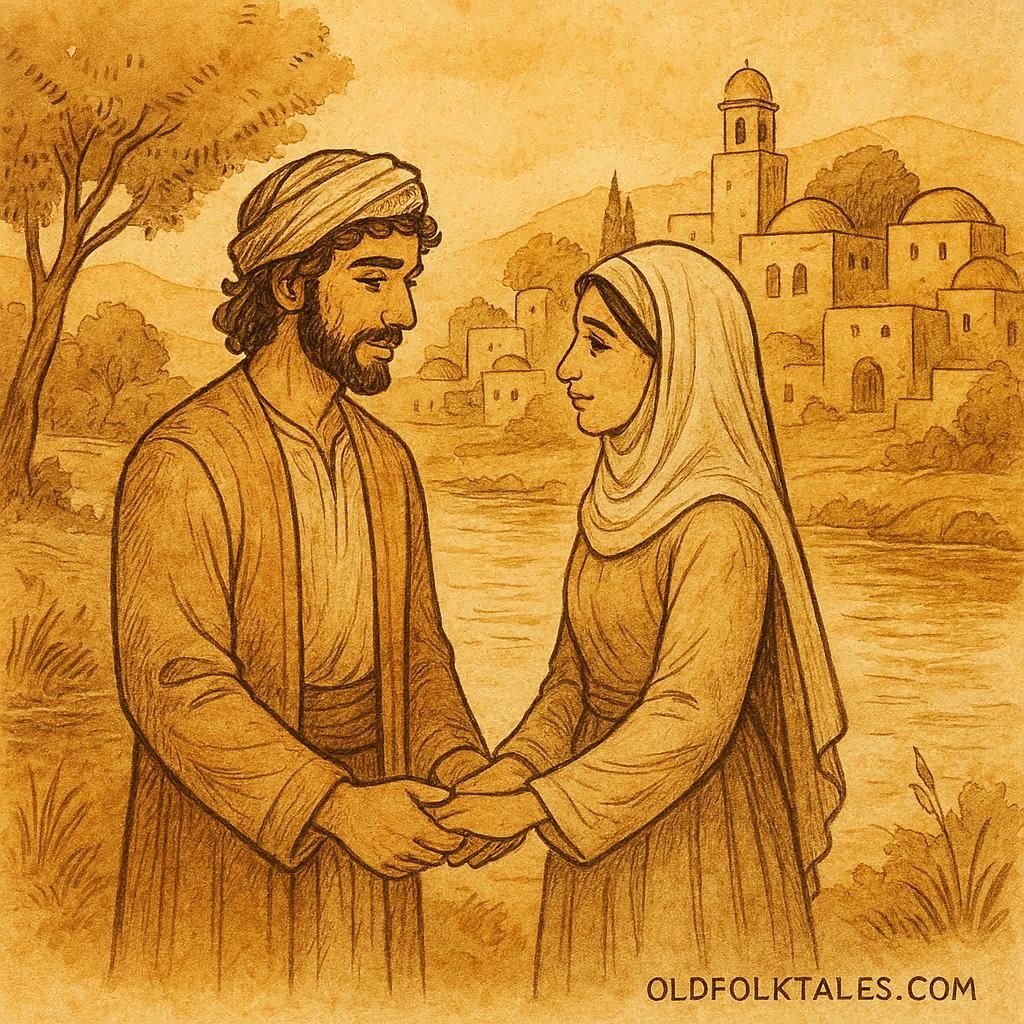
He ran to the riverside, and there she was, radiant beneath the sun, her hair glistening with water, her eyes filled with joy at the sight of him. They embraced, tears mingling with laughter. As they walked home together, her bracelet fell among the thorn bushes. When she reached for it, a sharp thorn pierced her hand, and drops of blood stained her white dress.
When her mother saw the crimson spots, she sang bitterly:
“Arzeh, what’s this blood I see?
God curse the womb that carried thee!
Has Anbar touched you, dark as night,
His skin like soot, devoid of light?”
Arzeh, defiant and pure, replied in song:
“Oh mother, Anbar is gallant and kind,
His heart is noble, his soul refined.
His eyes are black as the starry skies,
And love for him within me lies.”
But her words only enraged her mother more. She dragged Arzeh inside, beat her, and locked her away. Days turned into months, and Anbar came again and again, pleading for his love. Each time, the mother invented a new lie to drive him away.
At last, weary of deceit, Anbar decided to make his love official. He came to the door with resolve and asked for Arzeh’s hand in marriage. Her mother smiled falsely and said, “If you truly love my daughter, bring me a dowry of one thousand and one camels, a house, ten maidens, and jewels worth two thousand golden dinars.”
It was a test no ordinary man could pass. But Anbar’s devotion was extraordinary. He left his homeland and journeyed across distant deserts and cities. For seven long years he toiled, trading, saving, and working until his hands bore the scars of labour.
When he finally returned, rich beyond measure and ready to claim his beloved, he found the village cloaked in mourning. Arzeh’s mother, in his absence, had forced her daughter to marry another man. Heartbroken, Arzeh drank poison on her wedding day, choosing death over betrayal.
Anbar ran to her grave, the earth still fresh, his cries echoing across the fields. For days he lay there, refusing food or water. His grief consumed him until his final breath joined hers. They buried him beside Arzeh, and their souls, divided in life, were at last united in death.
Thus, the people of the village said:
“Love that is true, even death cannot divide.”
Moral Lesson
True devotion endures beyond hardship, deceit, and even death. Love built on sincerity cannot be destroyed by lies or distance, it finds eternity in the hearts of the faithful.
Knowledge Check
1. Who are the main characters in this Syrian folktale?
Arzeh (Cedar) and Anbar (Spruce), two cousins whose love defied all odds.
2. What obstacle separated Arzeh and Anbar?
Arzeh’s mother, who despised their union and used lies and cruelty to keep them apart.
3. What symbolic role does “Devotion” play in this story?
It symbolises pure, unyielding love that remains steadfast through pain, distance, and death.
4. How did Anbar prove his devotion?
He risked his life, refused poisoned food, and worked for seven years to earn the dowry demanded.
5. What is the moral lesson of Arzeh and Anbar’s tale?
True love and devotion can overcome deceit and endure beyond mortality.
6. What is the cultural origin of this folktale?
This story originates from Syrian folklore, reflecting Middle Eastern values of honour, love, and destiny.
Source
Adapted from the Syrian folktale “Arzeh and Anbar (Cedar and Spruce)” in Syrian Folk Stories Anthology, Cultural Heritage without Borders (2015).
Cultural Origin: Syria (Levantine folklore)