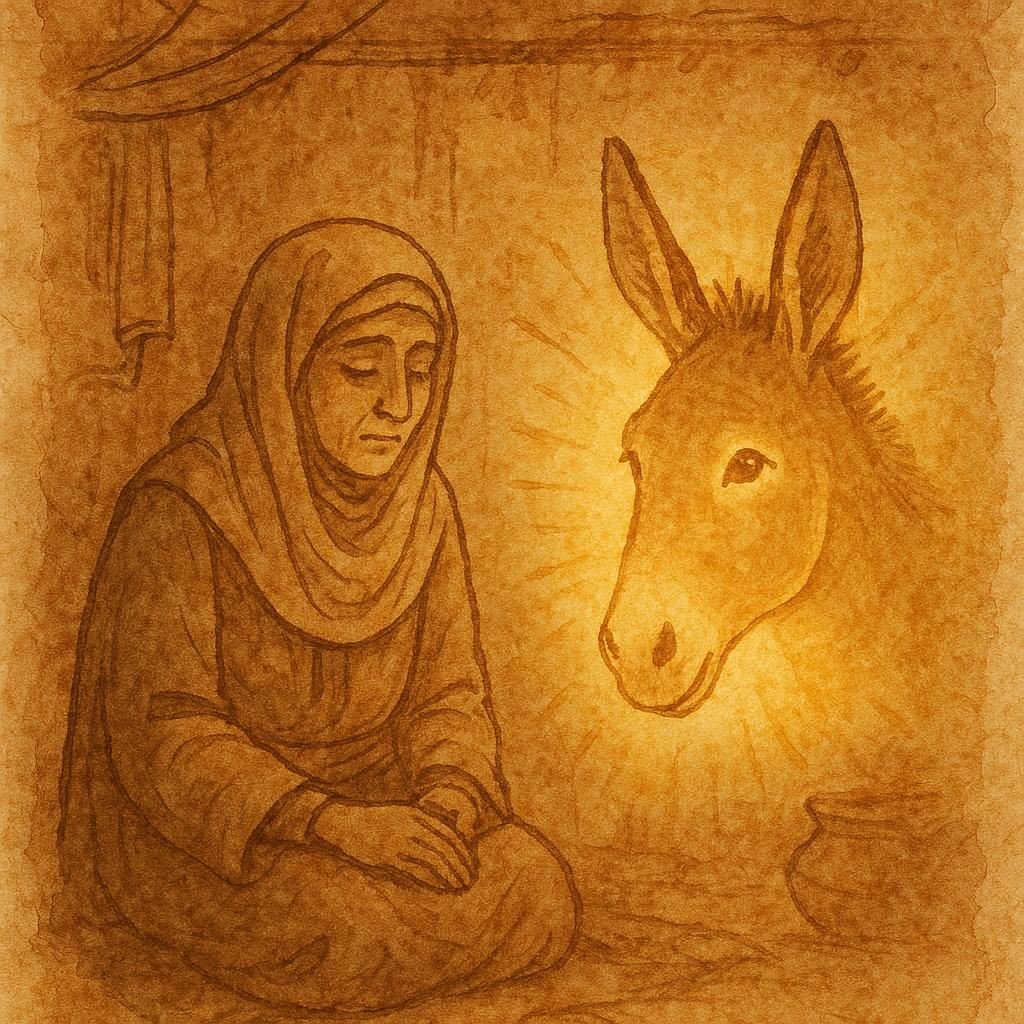
In the heart of an old village, where the desert winds whispered ancient faith, there lived a poor widow who owned nothing but a small hut and a hopeful spirit. One morning, while searching for firewood near a dry riverbed, she stumbled upon a strange sight, a donkey’s head lying half-buried in the sand. Startled yet curious, she approached, and to her astonishment, the head spoke:
“Good woman,” it said, “take me home, and I shall bring you fortune.”
Though afraid, her faith in divine mysteries overcame her fear. She carried the donkey’s head back to her hut and placed it by the hearth. The next morning, a clinking sound woke her. Beneath the head’s tongue lay a shining gold coin. Each day after, the same miracle occurred, a single golden coin appeared, and her poverty slowly vanished.
As her fortunes grew, so did the village gossip. People whispered about her sudden wealth, yet the widow remained humble and continued her acts of kindness. Then, one evening, the donkey’s head spoke again:
“Good woman, it is time to repay your faith. Go to the king and ask that I, the Donkey’s Head, may wed his daughter.”
At first, the widow trembled at the absurd request. But the voice was gentle and persuasive. Trusting once more in her faith, she wrapped the donkey’s head in silk and went to the royal court. The guards laughed, but the widow insisted on seeing the king.
The king, amused by her audacity, said, “If your donkey’s head can perform three impossible tasks, my daughter shall be his bride.”
The first task was to build a golden palace overnight. That night, the widow prayed, and before dawn, a magnificent palace shimmered where her hut had stood. The second task required filling the palace with treasures and servants. By morning, every hall was gleaming with riches and bustling with attendants conjured by unseen forces.
For the final trial, the king demanded that the donkey’s head appear in person to claim his bride. At sunrise, the palace doors opened, and from the donkey’s head emerged a radiant young man dressed in royal robes. He bowed to the king and said, “Your Majesty, I was cursed to dwell as a donkey’s head until faith restored my human form.”
Seeing the miracle, the king consented to the marriage. The prince married the princess in a grand ceremony, and the widow lived in comfort for the rest of her days, honoured as the mother of the man whose faith had transformed despair into destiny.
Moral Lesson
True faith is not blind belief but trust in goodness and perseverance through mystery. Even when the world doubts, faith reveals hidden miracles.
Knowledge Check
1. What is the main moral of “The Donkey’s Head”?
Faith rewards those who trust in goodness and remain steadfast in difficult times.
2. What does the donkey’s head symbolise in this Israeli folktale?
It symbolises hidden blessings and divine assistance that respond to sincere faith.
3. Who collected this version of the story?
It was collected by Dov Noy in the Israeli Folktale Archive (IFA).
4. What are the three tasks in “The Donkey’s Head”?
Building a golden palace, filling it with treasures, and appearing in human form.
5. What cultural values are reflected in this story?
The tale reflects the values of humility, perseverance, and unwavering faith in divine justice.
6. From which cultural tradition does this folktale originate?
It originates from Jewish-Tunisian folklore preserved in Israel.
Source
Adapted from a Jewish-Tunisian variant in the Israeli Folktale Archive (IFA), collected by Dov Noy.
Cultural Origin: Israel (Jewish-Tunisian folklore)