In a quiet village in the Levant, where terraces of olives climbed the hillsides and the scent of thyme drifted through the air, there lived a parent known throughout the region for their devotion to their seven sons. Some said no family was more tightly woven than this one, and travelers often paused to marvel at their unity. The parent, whether working in the fields or offering bread to guests, spoke proudly of the boys, saying, “Together we are stronger than any storm.”
Life moved steadily, each son carrying his share of the labor. Yet as often happens in the folktales of Syria, fate stirred beneath the surface. One evening, as the lamps burned low, the parent received a troubling prophecy, one suggesting that a trial would soon befall the family, one that would demand both courage and sacrifice. It hinted that honor could be lost, or that danger might swallow them whole, unless wisdom and loyalty held firm.
The parent did not reveal this prophecy to the sons, but unease settled in their heart like a stone.
Days later, the trial arrived. Rumors spread in the village, dark suspicions that threatened the family’s reputation. Some whispered of danger approaching from beyond the fields, others feared misfortune was on the way. Whatever form the threat took, the sons understood only that their parent needed them more than ever.
The seven young men stood together, each ready to act. Their strength was not merely physical; they shared a bond shaped by years of shared hardship, laughter, and the guidance of a devoted parent. Still, even among them, it was the youngest, small in stature but sharp in mind, who sensed the path forward.
While his older brothers reacted with fear, anger, or stubborn determination, the youngest observed quietly. Unlike the others, he understood that the crisis required not strength alone, but clarity and faith, faith in the prophecy, faith in the power of unity, and faith in their family’s truth.
He stepped before his parent and said, “Let us trust that what binds us is stronger than what seeks to break us. There must be a way to restore what is threatened.”
His words steadied the others. Under his guidance, the brothers worked together, whether clearing misunderstandings, confronting danger, or proving their innocence, depending on how the trial unfolded in the old storytellers’ variations. In every version, their collective sacrifice played a role: some gave up personal comfort, others risked their safety or reputation, but none faltered in their loyalty.
The youngest son’s cleverness illuminated the way. His strategies, simple, thoughtful, and rooted in faith, unraveled the knots of conflict one by one. Old fears dissolved. Dangers retreated. The prophecy, once heavy with dread, transformed into a blessing. The reversal was miraculous not for its spectacle, but for the truth it revealed: loyalty could overcome suspicion, courage could silence fear, and unity could turn misfortune into triumph.
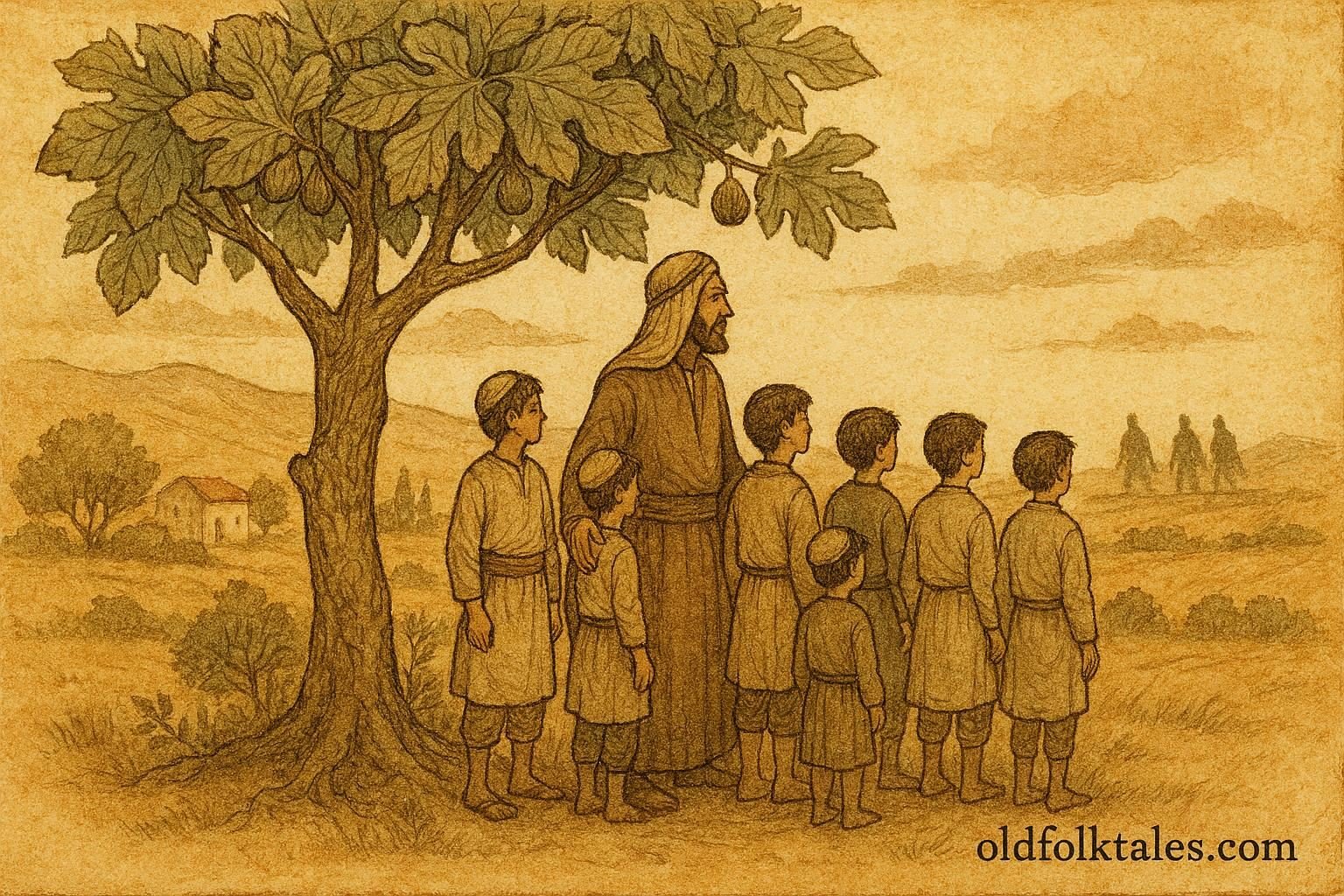
When peace finally returned to the household, the parent gathered the sons beneath the fig tree behind their home. Looking at them with eyes full of gratitude, the parent said, “Strength is not in muscle, but in heart. A family that stands as one cannot be broken.”
The youngest son, humbled by the praise of his elders, simply replied, “We did what we always do, stand together.”
From that day, villagers told and retold the story of the parent and their seven sons, not for the drama of the trial but for the model of unity it offered. The tale became a reminder that in Syrian tradition, faith and family form a shield stronger than any sword.
Moral Lesson
True strength lies in loyalty, unity, and wisdom. A family that stands together, guided by courage and faith, can overcome even the most daunting trials.
Knowledge Check
1. Who are the central characters in “Father of Seven Sons”?
A devoted parent and their seven sons, whose loyalty is tested.
2. What major challenge appears in the Syrian folktale?
A prophecy foretelling danger or disgrace that threatens the family’s honor.
3. How do the seven sons respond to the crisis?
They unite in sacrifice, courage, and determination to protect their family.
4. What role does the youngest son play in the story?
His cleverness, faith, and insight guide the family toward a miraculous reversal.
5. What core values are highlighted in this Syrian legend?
Loyalty, unity, sacrifice, and the strength of family bonds.
6. What cultural lesson does the folktale emphasize?
It reflects Levantine beliefs that wisdom and collective action safeguard families against misfortune.
Source
Adapted from the Syrian folktale “Father of Seven Sons,” referenced in Arab Folktales by Inea Bushnaq. Internet Archive.