The river that flowed through the village had always been both blessing and threat, provider and predator, source of life and occasional harbinger of death. Its waters were murky and deep, its currents unpredictable, and for as long as the oldest elders could remember, it had been home to something that was neither wholly spirit nor completely physical, something the villagers spoke of in whispers as the Hantu Sungai, the River Ghost.
Strange things happened in that river with disturbing regularity. Fishermen would feel invisible hands tugging at their nets, pulling them toward the deeper channels. Boats would capsize in calm waters for no apparent reason. Children playing too close to the bank would slip and fall in, their screams cut short as something dragged them beneath the surface. Not all were lost, some were found downstream, shaken and unable to explain what had grabbed them, but enough disappeared entirely that parents kept their young ones well away from the water’s edge.
Click to read all East Asian Folktales — including beloved stories from China, Japan, Korea, and Mongolia.
The village lived in uneasy coexistence with the river and its resident spirit. They needed the water for drinking, bathing, and transportation. They needed the fish that filled their nets and fed their families. But they also feared what dwelled in the depths, what watched them from beneath the muddy surface, what seemed to delight in causing harm and spreading terror.
“The Hantu Sungai is evil,” some villagers declared at community gatherings. “It takes our children and destroys our livelihood. We should abandon this place and settle elsewhere, away from its malevolence.”
But moving an entire village was no simple matter. Their ancestors had lived here for generations. Their farms were established, their homes built, their lives rooted in this soil beside this troublesome river. To leave would mean abandoning everything they had built and starting anew in an unfamiliar place.
Others suggested more aggressive solutions. “We should perform exorcism rituals,” a young man proposed. “Drive the spirit away or destroy it completely. Why should we live in fear of some water demon?”
But Tok Hassan, the village’s oldest and wisest elder, shook his head gravely at such suggestions. His weathered face, marked by seven decades of experience, showed concern at this aggressive talk.
“You speak of things you do not understand,” he said, his voice carrying the authority of age and knowledge. “The Hantu Sungai has been here far longer than our village, perhaps longer than humans have walked this land. It is not a demon that invaded our space; we are the ones who settled in its territory. To try to destroy or expel it would be both arrogant and dangerous.”
“Then what do you propose, Tok Hassan?” the village headman asked. “We cannot continue losing our people to this entity. Something must be done.”
Tok Hassan was quiet for a long moment, his eyes distant as if seeing into realms others could not perceive. Finally, he spoke.
“I propose we stop treating the Hantu Sungai as an enemy to be conquered and start treating it as what it truly is: the rightful inhabitant and guardian of this river. Our problems come not from its inherent evil, but from our failure to acknowledge its proper role and show appropriate respect.”
Murmurs of confusion and skepticism rippled through the gathered villagers. The spirit had caused so much harm. How could Tok Hassan suggest it was meant to be a guardian?
The old man raised his hand for silence and continued. “Listen to me carefully. When have the incidents occurred? When fishermen take more than they need and waste what they catch. When people pollute the water with careless disposal. When children play disrespectfully at the water’s edge, throwing stones and shouting taunts. The Hantu Sungai does not attack randomly. It responds to disrespect and violation of the river’s sanctity.”
Another elder, a woman named Nenek Mariam who served as the village’s spiritual advisor, nodded slowly in agreement. “Tok Hassan speaks truth. In my grandmother’s time, there was a proper relationship with the river spirit. Offerings were made, taboos observed, respect given. But over generations, we have forgotten these practices. We treat the river as a resource to exploit rather than a sacred space to honor.”
“Then how do we restore this relationship?” the headman asked, now listening more carefully.
“We must perform the proper rituals,” Tok Hassan explained. “We must acknowledge the Hantu Sungai not as a malevolent ghost but as the legitimate guardian of this river. We must apologize for our disrespect, establish clear taboos, and commit to maintaining them. If we approach the spirit with proper reverence and negotiate rather than threaten, I believe it will respond not with hostility but with protection.”
The proposal was controversial. Many villagers doubted it would work, fearing they would waste time and resources on rituals while the spirit continued its attacks. But others, particularly the older generation who remembered fragments of the old ways, felt the truth in Tok Hassan’s words.
The headman made his decision. “We will try Tok Hassan’s approach. What do we need to do?”
Tok Hassan and Nenek Mariam spent three days preparing. They consulted old texts and memories, piecing together the proper rituals that had been largely forgotten. They gathered the necessary offerings: white rice, yellow rice, fresh flowers, betel nuts, incense, and a length of white cloth. They selected seven respected members of the community to participate in the ceremony, representing the village’s commitment to this new understanding.
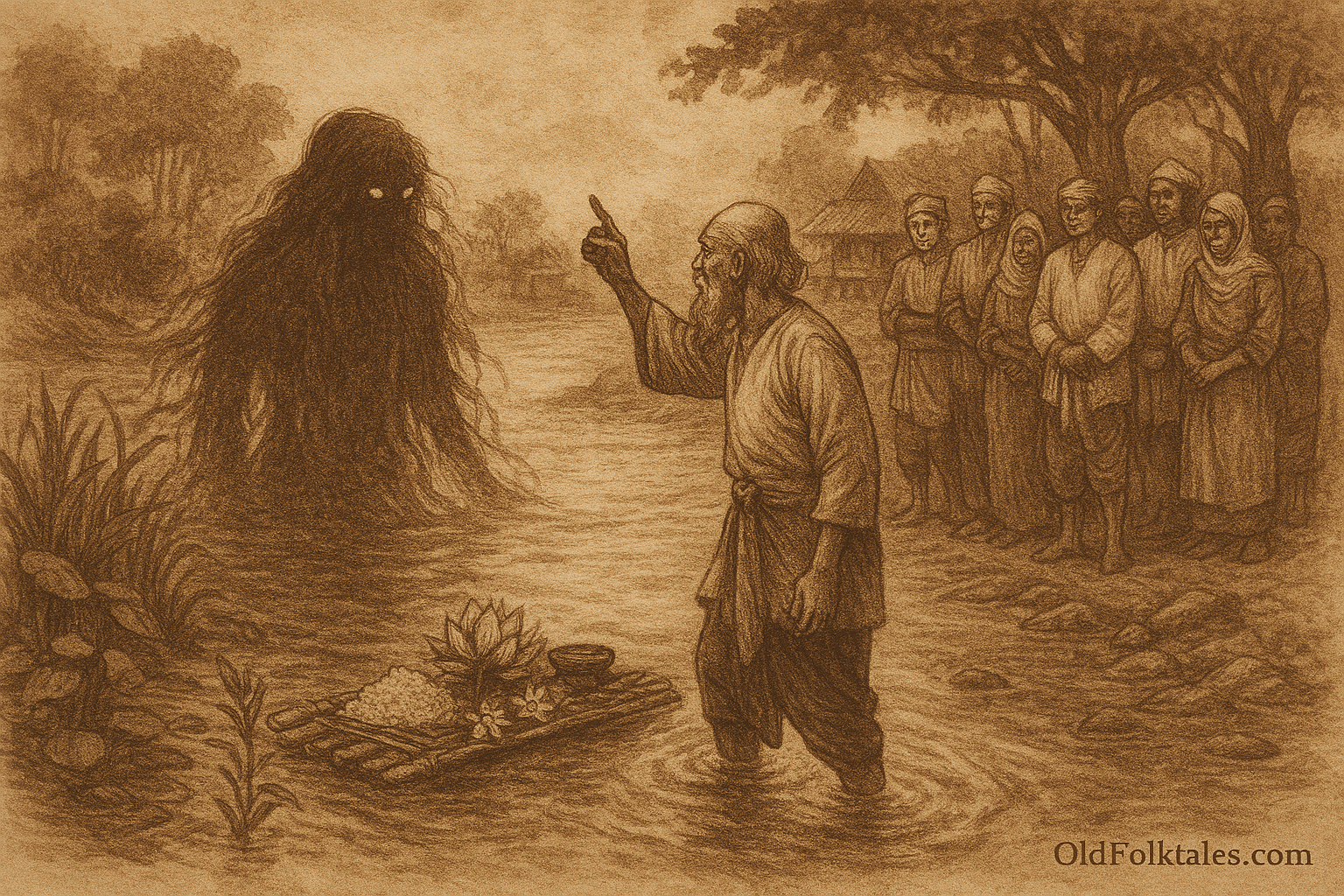
On the night of the full moon, when spiritual forces were believed to be strongest, the entire village gathered at the river’s edge. Tok Hassan and Nenek Mariam led the seven representatives into the shallows, the water lapping at their knees as they placed offerings on a small raft made of bamboo.
Tok Hassan spoke clearly, his voice carrying across the water and into the darkness beyond.
“Hantu Sungai, ancient guardian of these waters, we come before you with respect and humility. We acknowledge that this river is your domain, that you have dwelled here since time before memory. We apologize for the disrespect we have shown, for treating your territory as ours to command, for forgetting the proper ways of coexistence.”
Nenek Mariam continued the invocation. “We ask not that you leave, but that you accept your rightful role as protector and guardian. We commit to honoring the river’s sanctity, to observing proper taboos, and to teaching our children the respect that this sacred space deserves.”
They spoke the old prayers, burned the incense, and released the offering raft into the current. As it floated away, carried by water that suddenly seemed to move with deliberate purpose, a profound silence fell over the gathering. Even the night insects ceased their chirping, and the wind died to absolute stillness.
Then, from the center of the river, the water began to glow with a soft, phosphorescent light. The surface rippled though there was no wind, and a figure rose from the depths, composed of water and mist and moonlight. It was vaguely human in shape but fluid, constantly shifting, its features more suggested than defined.
The villagers gasped and stepped back, but Tok Hassan and Nenek Mariam stood firm, bowing deeply to the manifested spirit.
The Hantu Sungai regarded them with eyes like pools of deep water, ancient and knowing. When it spoke, its voice was the sound of current and waterfall, of rain on leaves and waves on shore.
“I have waited,” it said, the words resonating in minds rather than ears, “for you to remember. I am not the enemy. I am the keeper of this river, as I have been since water first carved this channel through the earth. I act against those who disrespect my domain not from malice but from duty. A guardian must enforce boundaries, or the sacred becomes profane.”
“We understand now,” Tok Hassan replied respectfully. “Will you accept our acknowledgment and our commitment to proper relationship?”
The spirit was silent for a long moment, seeming to consider. Finally, it spoke again.
“I will accept. If you honor the taboos, if you teach your children respect, if you take from the river with gratitude rather than greed, then I will protect rather than punish. Those who fish with respect will find their nets full and their boats safe. Those who swim with permission will not be harmed. But those who pollute, who waste, who mock or violate the river’s sanctity, they will still answer to me. This is the covenant I offer.”
“We accept,” the village headman declared, stepping forward to join Tok Hassan and Nenek Mariam. “We will observe the taboos and maintain respect. We will honor you as guardian rather than fear you as enemy.”
The Hantu Sungai inclined its fluid head in acknowledgment, then slowly sank back into the water, the phosphorescent glow fading until only darkness and the normal sounds of night remained.
From that day forward, the relationship between village and river spirit changed fundamentally. The elders taught the taboos clearly: never fish on the three days of the new moon when the spirit rested, always return the first catch to the river as offering, never pollute the water with waste or harsh words, and always ask permission before entering the water for swimming or bathing.
Those who observed these simple rules found the river incredibly generous. Nets filled with abundance, boats traveled safely even in treacherous weather, and children could swim without fear in the designated safe areas. The Hantu Sungai, acknowledged and respected, became the protector it was always meant to be.
But the spirit kept its promise regarding disrespect as well. On the rare occasions when someone violated the taboos, thinking themselves above such “superstitious” practices, the river would remind them of the covenant. Nets would tangle hopelessly, boats would develop mysterious leaks, or the transgressor would find themselves briefly pulled underwater, released only after experiencing enough fear to teach them respect.
The village prospered under this new arrangement, and the story of how the Hantu Sungai transformed from feared entity to honored guardian spread to neighboring communities. Other villages began reassessing their own relationships with the spirits and forces that shared their lands and waters.
Tok Hassan, in his final years, would sit by the river and speak to the younger generation. “Remember,” he would tell them, “that we share this world with powers older and greater than ourselves. The choice is not between domination or submission, but between disrespect and relationship. When we acknowledge the proper role of spiritual guardians and commit to respectful coexistence, we find protection rather than predation, abundance rather than scarcity, harmony rather than conflict.”
And the river flowed on, its guardian spirit watching over those who honored the covenant, a living testament to the wisdom of negotiation over domination, respect over conquest, and coexistence over conflict.
Click to read all Southeast Asian Folktales — featuring legends from Thailand, Indonesia, Vietnam, and the Philippines.
The Moral Lesson
The legend of Hantu Sungai yang Menjadi Penjaga teaches us that what we perceive as hostile or malevolent forces may simply be misunderstood guardians responding to our own disrespect. True wisdom lies not in trying to dominate or destroy what we fear, but in seeking to understand proper relationships and establishing mutual respect. The story emphasizes that negotiation and acknowledgment of rightful roles can transform adversarial relationships into protective ones. Most importantly, the tale reminds us that humans are not the sole inhabitants or masters of the natural world, and that prosperity comes from honoring the spiritual guardians that share our spaces rather than attempting to conquer or expel them.
Knowledge Check
Q1: What is the Hantu Sungai in this Malaysian folk tale? A: The Hantu Sungai, meaning “River Ghost,” is an ancient spirit that dwells in the village river and initially causes harm to villagers through capsizing boats, tugging nets, and occasionally drowning people. The spirit represents misunderstood supernatural guardians who respond to human disrespect with protective enforcement of boundaries. Its character demonstrates that perceived malevolence may actually be a guardian fulfilling its duty when humans violate sacred space.
Q2: Why does the river spirit harm villagers initially? A: The spirit harms villagers because they have forgotten the proper ways of showing respect to the river and its guardian. The attacks occur specifically when people take more fish than needed, pollute the water, play disrespectfully, or otherwise violate the river’s sanctity. The spirit is not randomly evil but responding to disrespect and breach of boundaries, acting as a guardian enforcing proper behavior in its domain.
Q3: Who is Tok Hassan and what solution does he propose? A: Tok Hassan is the village’s oldest and wisest elder who understands traditional spiritual relationships. He proposes that instead of trying to destroy or expel the spirit, the villagers should acknowledge it as the rightful guardian of the river, perform proper rituals of respect, and establish a covenant of mutual understanding. His wisdom represents the value of traditional knowledge about coexistence with spiritual forces.
Q4: What rituals do the villagers perform to change their relationship with the spirit? A: The villagers perform rituals on the full moon including placing offerings of white rice, yellow rice, flowers, betel nuts, and incense on a bamboo raft, speaking prayers of acknowledgment and apology, and committing publicly to observe river taboos. Seven respected community members participate in the ceremony, representing collective commitment to the new relationship and demonstrating that spiritual negotiation requires proper protocol and sincere respect.
Q5: What taboos must villagers observe to maintain the protective relationship? A: The taboos include never fishing during the three days of the new moon when the spirit rests, always returning the first catch to the river as offering, never polluting the water with waste or harsh words, and always asking permission before swimming or bathing. These simple rules represent the minimal respect required to maintain harmony with spiritual guardians and ensure continued protection and abundance.
Q6: What does this story teach about traditional Malaysian beliefs regarding nature spirits? A: This Malaysian legend teaches that nature spirits are not demons to be exorcised but legitimate guardians of their domains who deserve respect and proper acknowledgment. Traditional belief emphasizes negotiation and relationship building rather than domination or conquest of spiritual forces. The story reflects cultural wisdom that prosperity comes from coexistence with supernatural guardians through observance of taboos, regular offerings, and recognition that humans share the natural world with older, powerful beings who must be honored rather than fought.
Cultural Origin: Malaysia, Southeast Asia.