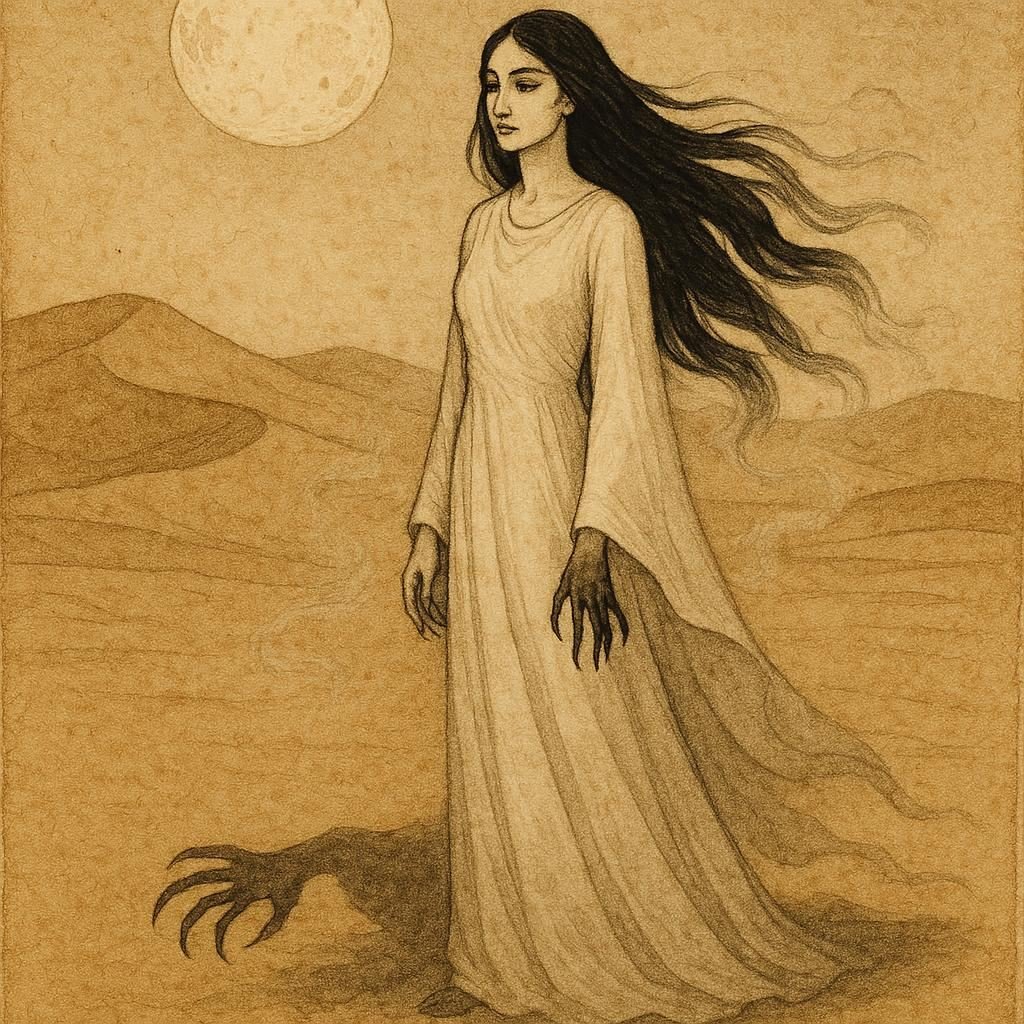
In the vast stillness of the Arabian desert, where palm groves hum with insects and the air smells faintly of oud and salt, whispers once carried the name that no man dared speak aloud after dusk, Umm Al Duwais, the jinn woman no one wished to meet when the sun went down.
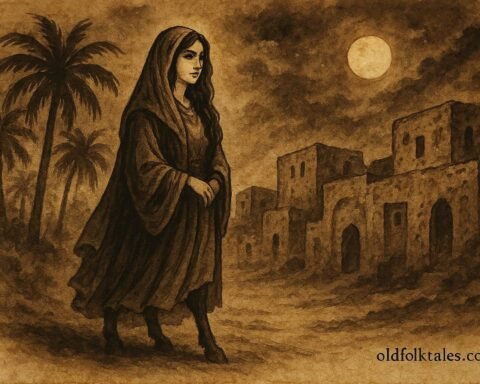
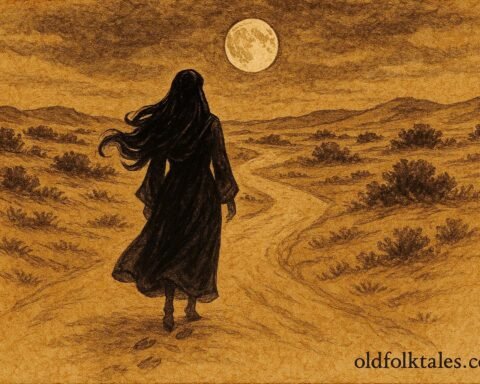
They said she came when the moon hung like a blade over the dunes. Her perfume, sweet, intoxicating, and unforgettable, announced her before she appeared. Clad in white, she moved like drifting smoke between the oases and the coast, her long black hair cascading like a shadowed river, her eyes dark and glimmering with secrets no mortal could bear.
Explore timeless legends from China, Japan, and Korea in our East Asian Folktales collection.
Those who saw her said she was not just beautiful, she was too beautiful. Her gaze drew men close, and her voice flowed soft as the sea breeze. She might ask for water, for a ride, or merely offer a smile that held both promise and peril. If the man was wise, he would keep his distance, bow, and leave her behind. But if pride or lust blinded him, he would never see another dawn.
For Umm Al Duwais was no mortal woman. She was a jinn, a spirit older than the dunes themselves. And when her prey lingered, her beauty twisted into horror. Her perfect mouth stretched wide with too many teeth; her elegant hands turned into claws sharp enough to tear through skin and bone. The scent of jasmine became the stench of decay. By the time the truth revealed itself, it was already too late. The man’s cries would fade into the sand, swallowed by the desert wind.
The people of the Emirates learned to live with her legend. Fishermen along the coast swore that she sometimes appeared at the edge of the water, her white robes gleaming in the moonlight, calling for help as if she were drowning. The kind-hearted who reached out found themselves grasping at nothing, or worse, caught in the grasp of something that was not human.
In the palm villages of Al Ain and Liwa, mothers warned their sons not to wander after evening prayer. They told them that the jinn-woman wore perfume to lure men, that her backwards feet betrayed her nature, and that those who followed her trail never returned. At night, men sitting by lantern-light whispered her name in cautionary tones, their voices low as if afraid she might hear.
Still, there were tales of survivors, men who saw her beauty but fled before her smile turned cruel. They returned home trembling, humbled, and changed. The elders would nod gravely and say, “He met Umm Al Duwais, and she spared him because he remembered his faith.”
Over time, her story became more than a warning; it was a reflection of human folly. She punished vanity and temptation, especially among men who thought themselves beyond danger. Her tale reminded all that the desert and sea, though beautiful, hold mysteries not meant for mortals to touch.
So, even now, when the wind carries the faintest trace of sweet perfume through the dunes, the old ones murmur a prayer and hurry indoors. For it is said that where Umm Al Duwais walks, hearts go missing, and the night belongs to her alone.
Moral Lesson
The legend of Umm Al Duwais warns against vanity, pride, and lust. Beauty can be a snare, and temptation, no matter how alluring, often hides destruction. The tale also teaches respect for unseen powers and the wisdom of self-control.
Knowledge Check
1. Who is Umm Al Duwais in Emirati folklore?
Umm Al Duwais is a female jinn spirit in Emirati legend known for her beauty and deadly deception, haunting men who wander at night.
2. What does the perfume symbolise in the story?
Her perfume symbolises temptation—sweet at first, but ultimately leading to ruin and death.
3. Where is this folktale most common?
The tale originates in the United Arab Emirates, especially among desert and coastal communities in Al Ain, Liwa, and pearl-diving towns.
4. What lesson does the story teach?
It cautions against vanity, lust, and ignoring wisdom—reminding listeners that appearances can be deceiving.
5. Why do some call Umm Al Duwais a jinn?
Because she is believed to be a supernatural being capable of taking human form to punish arrogance and moral weakness.
6. How did Emirati villagers protect themselves from her?
By travelling in groups, carrying charms of salt or iron, reciting prayers, and avoiding strangers at night.
Source: Adapted from the Emirati legend “Umm Al Duwais” as preserved in Folks Tales & Legends — Mindbody Dynamixs flipbook and discussed in PostScript Magazine, Listverse, Vocal Media, and The National (Emirati folklore features).
Cultural Origin: United Arab Emirates (Emirati folklore, desert and coastal oral tradition)