Long before Kampong Ayer became known as the Venice of the East, before its wooden walkways stretched across the Brunei River like a spider’s intricate web, the ancestors of the Bruneian people lived along the muddy banks of the great river. Their homes were simple structures built on solid ground, with walls of woven palm fronds and roofs thatched with dried leaves. They lived as their forefathers had lived, fishing in the shallow waters by day and gathering around fires by night, telling stories of the forest spirits and the mysterious beings that dwelled in the river’s depths.
The river had always been generous to the people. Its waters teemed with fish, its banks rich with fertile soil for growing vegetables and fruit trees. Children played along its edges, women washed clothes on smooth stones, and men launched their boats each morning to cast their nets. Life flowed as steadily as the river itself, and the people were content.
Click to read all East Asian Folktales — including beloved stories from China, Japan, Korea, and Mongolia.
But the river, like all living things, had its moods and mysteries.
It began during the monsoon season, when the skies turned grey and heavy with rain. The downpour came suddenly and with tremendous force, drumming against roofs and turning the river into a churning, muddy torrent. The people had seen floods before, but nothing like this. The water rose higher and higher, swallowing the banks, creeping toward the village with relentless determination.
Families scrambled to save what they could, clutching children and precious belongings as they fled to higher ground. But the flood pursued them, destroying homes, washing away gardens, and sweeping livestock downstream. When the waters finally receded days later, the devastation was complete. Nearly every house lay in ruins, reduced to scattered debris and broken memories.
The village headman, a wise elder named Awang, gathered the survivors. His face was lined with exhaustion and grief, but his eyes remained steady. “We will rebuild,” he declared. “Our ancestors survived worse, and so shall we.”
And rebuild they did. With remarkable determination, the people constructed new homes on the same ground where the old ones had stood. They worked from dawn until dusk, weaving new walls, gathering fresh thatch, replanting gardens. Within weeks, the village looked much as it had before, and life slowly returned to normal.
But the river had not finished teaching its lesson.
The following year, the rains came again, and again the floods destroyed everything. This time, the people rebuilt farther from the riverbank, hoping distance would protect them. Yet when the third monsoon arrived, the water found them once more, rising higher than ever before, as if the river itself were determined to drive them away.
Despair settled over the community like a heavy fog. Some families spoke of leaving, of seeking new lands far from the treacherous river. But Awang refused to accept defeat. “This river has fed us and our ancestors for generations,” he said. “There must be a way to live in harmony with its nature.”
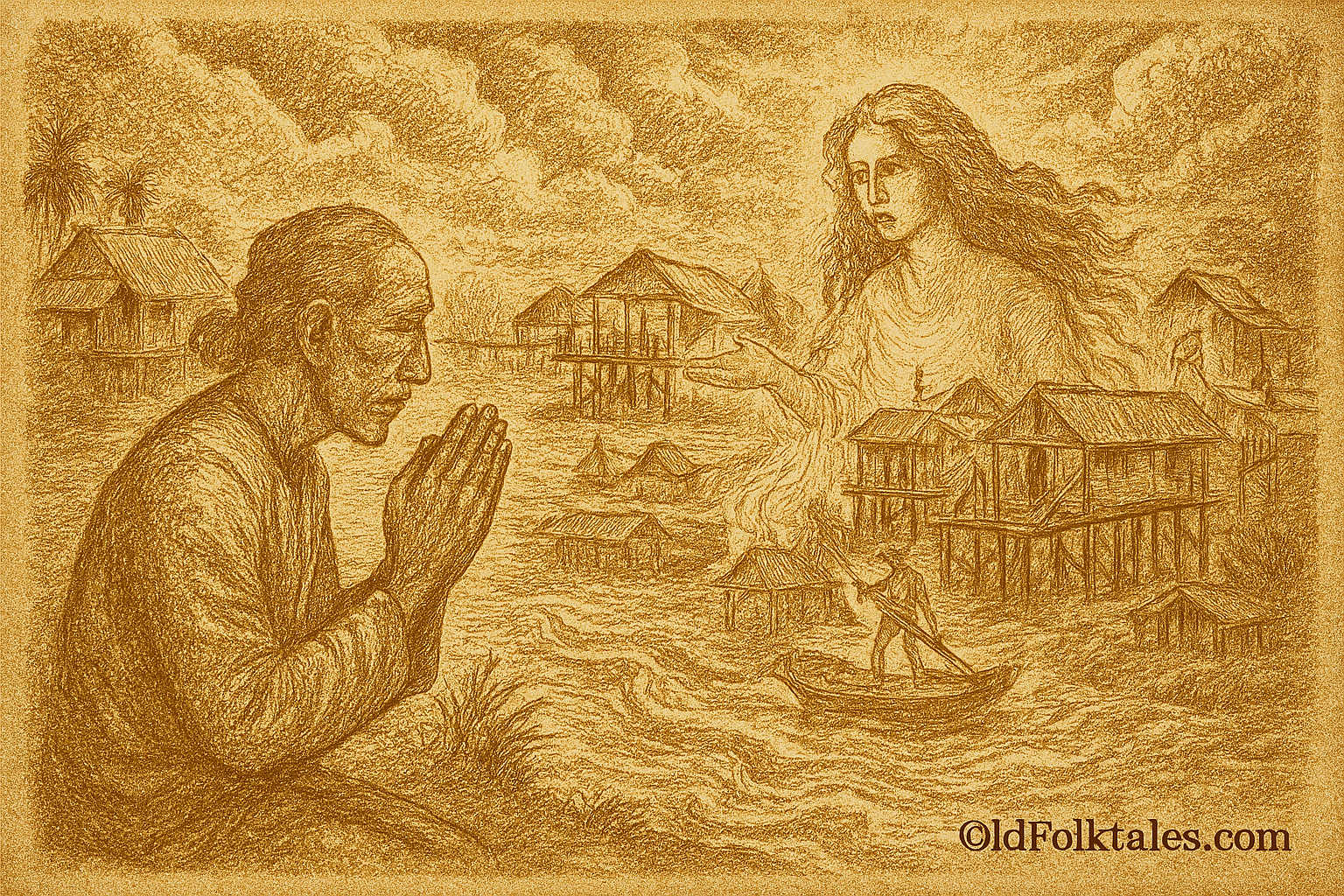
That night, Awang sat alone by the water’s edge, watching moonlight dance across the current. He was exhausted, his heart heavy with responsibility for his people’s suffering. As he gazed into the depths, he began to pray, asking the spirits of the river for guidance.
The water before him began to shimmer with an otherworldly light. From the depths emerged a figure, translucent and graceful, with flowing hair like river grass and eyes that held the wisdom of countless tides. This was the river spirit, one of the ancient guardians of the waterways.
“Why do you weep, child of the land?” the spirit asked, her voice like water flowing over smooth stones.
Awang bowed deeply. “Great spirit, my people suffer. Each year the river destroys our homes. We do not wish to leave this place, but we cannot continue to lose everything we build.”
The spirit regarded him with a gentle smile. “The river does not seek to harm you. It seeks only to flow as it must. You build your homes where the water needs to travel, and so the water must push them aside. But there is another way, if you are willing to learn.”
“Tell me,” Awang pleaded. “We will do whatever is necessary.”
The spirit gestured to the water around her. “Do not fight the river. Become part of it. Build your homes not upon the land, but above the water itself. Raise them on strong stilts, high enough that the floods may pass beneath. In this way, you may live with the river, not against it.”
Awang’s eyes widened with wonder. “Live upon the water? But how?”
Throughout that night, the river spirit taught Awang the secrets of water dwelling. She showed him which woods would resist rot, how to drive stilts deep into the riverbed for stability, where the currents were gentle and where they were treacherous. She taught him the taboos that must be observed: never to pollute the water that gives life, always to leave offerings of rice and flowers, to respect the river creatures, and to build with gratitude and humility.
She revealed safe locations where the riverbed was firm, where the currents would not undermine the foundations, and where the water remained calm even during storms. She warned him of dangerous spots where whirlpools lurked and where the bottom was too soft to support structures.
“Remember,” the spirit said as dawn approached, “the river is alive. Treat it with respect, and it will cradle your homes as gently as a mother holds her child. Disregard its spirit, and it will remind you of its power.”
As the first light of morning touched the water, the spirit faded back into the depths, leaving Awang alone with his newfound knowledge and a heart full of hope.
He returned to the village and gathered the people. At first, they thought grief had driven him mad. Build homes on the water? It seemed impossible, dangerous, foolish. But Awang’s conviction was unwavering. He described his vision in such vivid detail, spoke with such certainty, that slowly, skepticism gave way to curiosity.
A few brave families agreed to try. Under Awang’s guidance, they selected strong timber and began the careful work of driving the first stilts into the riverbed. The work was hard and unfamiliar. They made mistakes, learned from them, and tried again. Slowly, the first houses began to rise above the water, connected by simple wooden walkways.
When the next monsoon came, the village held its breath. The waters rose as they always did, but this time, instead of destroying homes, the flood simply flowed beneath them. The houses on stilts remained safe and dry, swaying gently like boats at anchor but standing firm.
Seeing this miracle, more families joined the water village. Year by year, house by house, Kampong Ayer grew. The people became skilled at water living, building not just homes but entire communities on stilts: markets, mosques, schools, all connected by an ever expanding network of walkways. They learned to read the river’s moods, to honor its spirits with regular offerings, and to live in harmony with the water that had once seemed their enemy.
The river spirits, pleased with the people’s respect and adaptation, blessed the water village. Fish were always plentiful in the waters below the houses. The stilts remained strong for generations. And the community thrived, becoming a wonder that would one day be known across the world.
Click to read all Southeast Asian Folktales — featuring legends from Thailand, Indonesia, Vietnam, and the Philippines.
The Moral Lesson
The origin story of Kampong Ayer teaches us that true wisdom lies in adapting to nature rather than fighting against it. When we respect the environment and seek harmony instead of domination, we discover solutions that benefit both humanity and the natural world. The tale emphasizes the importance of listening to spiritual guidance, respecting the taboos and traditions that protect sacred spaces, and understanding that sometimes the answer to our problems requires us to completely change our perspective.
Knowledge Check
Q1: Who is Awang in the Kampong Ayer origin story? A: Awang is the wise village headman who leads his people through repeated flood disasters and ultimately receives guidance from the river spirit. He represents leadership that is open to spiritual wisdom and willing to embrace radical change for the community’s survival. His character embodies the courage to challenge conventional thinking and the humility to learn from the natural and spiritual world.
Q2: What is the significance of the river spirit in this Bruneian legend? A: The river spirit is the guardian of the waterways who teaches the Bruneian people how to live in harmony with the river. She represents the spiritual dimension of nature and serves as a mediator between the human and natural worlds. Her guidance shows that environmental challenges can be overcome through respect, adaptation, and understanding rather than resistance.
Q3: Why did the floods keep destroying the village homes? A: The floods destroyed the land homes because the people were building in the river’s natural flood path, forcing the water to push through their structures. The repeated destruction was not malicious but simply the river following its nature. This conflict illustrates the consequences of not understanding or respecting natural patterns and cycles.
Q4: What taboos and sacred rules did the river spirit teach the people? A: The river spirit taught several important taboos including never polluting the water, always leaving offerings of rice and flowers, respecting river creatures, and building with gratitude and humility. These rules established a sacred covenant between the people and the river, ensuring that human habitation would not harm the waterway or disrespect its spiritual nature.
Q5: How did building on stilts solve the flooding problem? A: Building homes on stilts elevated them above the flood waters, allowing the river to flow freely beneath during monsoons without destroying the structures. This solution worked with nature’s patterns instead of against them, demonstrating how adaptation and innovation can transform a recurring disaster into a sustainable way of life.
Q6: What is the cultural significance of Kampong Ayer to Brunei? A: Kampong Ayer represents the deep relationship between Bruneian people and river life, symbolizing cultural adaptation, spiritual wisdom, and environmental harmony. As one of the world’s largest and oldest water villages, it embodies Bruneian identity and demonstrates how traditional knowledge and respect for nature can create unique and sustainable communities that thrive for centuries.
Source: Adapted from Bruneian oral folklore traditions and origin narratives
Cultural Origin: Brunei Darussalam, Southeast Asia.