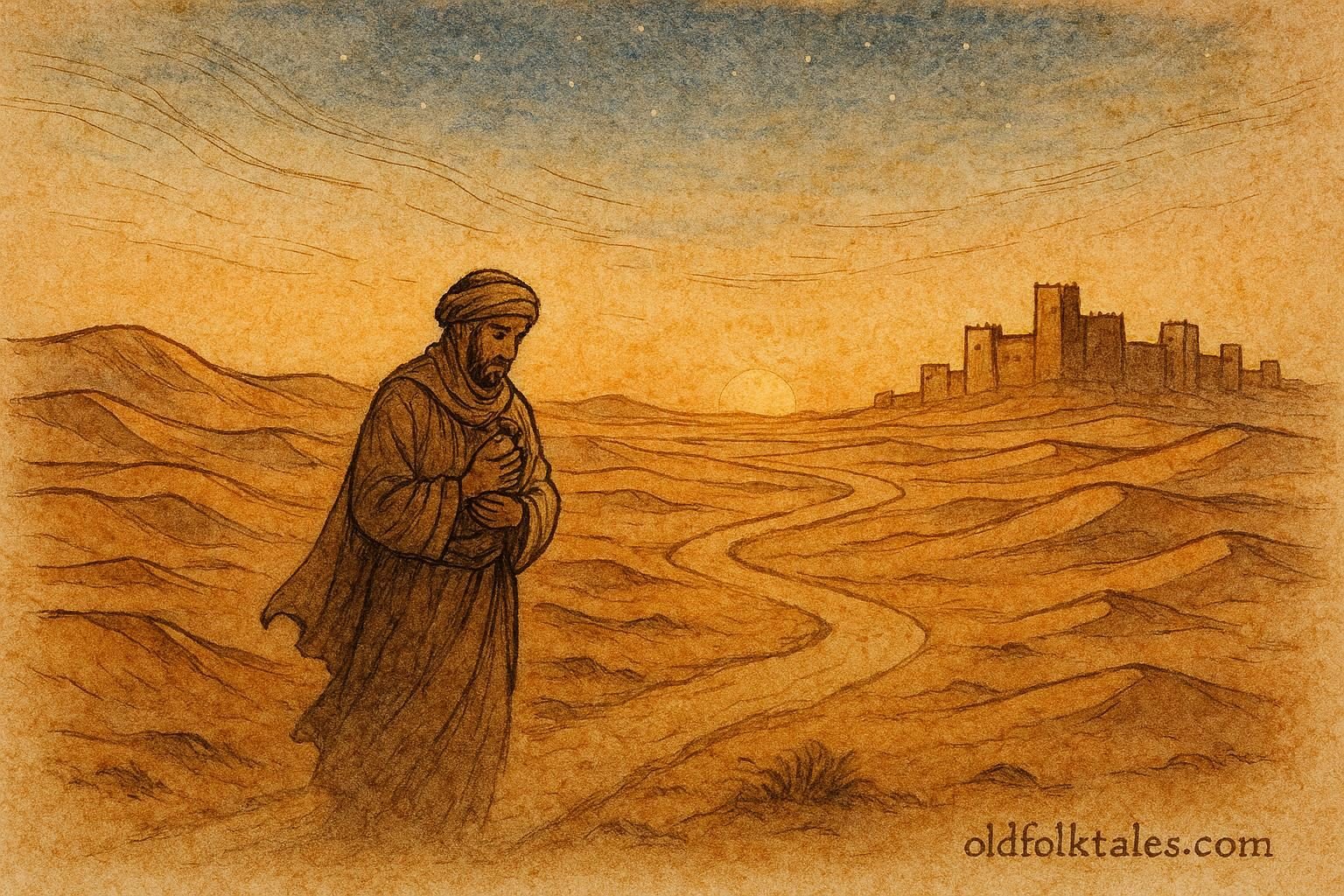
In the dry borderlands where stone villages met the open desert, there lived a young man named Kareem. He was known among his people as steady of hand and quiet of speech, a son raised on stories of honor and obligation. His father, once a respected traveler and trader, lay dying on a woven mat beneath the shade of a low tent. The desert wind moved gently, carrying with it the scent of dust and distant paths.
As the light faded, the father called Kareem close. His voice was weak, yet his eyes were clear. He placed into Kareem’s hands a small object, a carefully wrapped vial of soil taken from their ancestral land, along with a folded note naming a distant relative in a far city. “This must reach him,” the father said. “Promise me.” Kareem bowed his head and swore by his honor to complete the task. With that oath, his father closed his eyes for the last time.
In the days that followed, Kareem prepared for the journey. He packed water, bread, and the precious item entrusted to him. The elders reminded him that an oath once spoken could not be broken without staining one’s name forever. At dawn, Kareem set out alone, crossing stony plains where the sun rose like fire over the horizon.
The road was long and unforgiving. At night, the desert whispered with unseen movement. On the third evening, as Kareem rested beside a dry wadi, strange voices rose from the darkness. Desert jinn, cunning and unseen, tested travelers’ resolve. They spoke softly of turning back, of how no one would know if the promise were abandoned. Kareem pressed the vial against his chest and answered only with silence. The voices faded, leaving the stars cold and distant.
Days later, he reached a trading post where merchants gathered with bright fabrics and polished goods. One merchant noticed Kareem’s tired face and offered him comfort. “Sell what you carry,” the man suggested. “Why suffer for another’s memory? Take silver and live easily.” Kareem felt the weight of hunger and weariness, yet his father’s words echoed louder. He refused the offer and left before doubt could grow.
Further on, the path narrowed into rocky passes. Thieves were known to watch such places, preying on the weak. Kareem was confronted and threatened, his supplies taken. Still, he protected the small wrapped item hidden beneath his clothes. Bruised and shaken, he continued, guided by the belief that a broken body could heal, but a broken oath could not.
At last, Kareem reached the distant city, its walls rising pale against the sky. He found the house named in the note and was welcomed cautiously by an elderly man who studied his face with care. When Kareem presented the vial and spoke his father’s name, the man wept openly. The soil, he explained, proved a long hidden lineage, binding Kareem to a family separated by old disputes and distance.
In gratitude for Kareem’s faithfulness, the man revealed a trust left generations before, a modest fortune set aside for a rightful heir. Yet the greater reward was not gold, but recognition. Kareem learned who he was, where he belonged, and why his father had guarded the promise so closely.
When Kareem returned home, his name traveled ahead of him. He was no longer simply a young man who journeyed far, but one who had carried honor across the desert and returned with it intact.
Moral Lesson
This folktale teaches that true honor lies in keeping one’s word, even when the cost is great. Wealth and safety may tempt, but an unbroken promise preserves dignity, identity, and respect.
Knowledge Check
-
What promise does Kareem make to his father?
He swears to deliver a vial of soil and a message to a distant relative. -
What challenges test Kareem’s commitment?
Desert jinn, tempting merchants, thieves, and physical hardship. -
What cultural value does Kareem embody?
The Bedouin and Palestinian principle of wafa, faithfulness to one’s oath. -
Why is the vial of soil important?
It proves heritage and connects Kareem to his extended family. -
What reward does Kareem ultimately receive?
Recognition of his lineage and a rightful inheritance. -
What lesson does the journey symbolize?
That moral integrity shapes both personal destiny and social honor.
Source
Adapted from Palestinian Bedouin journey folktales emphasizing sharaf and wafa, preserved in regional oral tradition archives and classified as moral journey narratives.