In ancient times, when the kingdoms along the mighty Mekong River flourished under the golden teachings of the Buddha, there stood a prosperous realm in what is now northeastern Laos. The land was blessed with fertile soil, abundant harvests, and a wise prince who ruled with compassion and devotion to the dharma. The great river flowed through his domain like a sacred artery, bringing life to rice paddies and fishing villages, its waters shimmering like liquid silver beneath the tropical sun.
This prince was known throughout the region not only for his just governance but also for his deep spiritual practice. Each dawn, he would walk along the riverbanks to meditate, watching the mist rise from the water like prayers ascending to the heavens. He had studied with learned monks, practiced the precepts with dedication, and earned the respect of both his subjects and the sangha. Yet despite his many virtues and responsibilities, the prince lived alone, never having found a companion worthy of sharing his throne or his heart.
Click to read all East Asian Folktales — including beloved stories from China, Japan, Korea, and Mongolia.
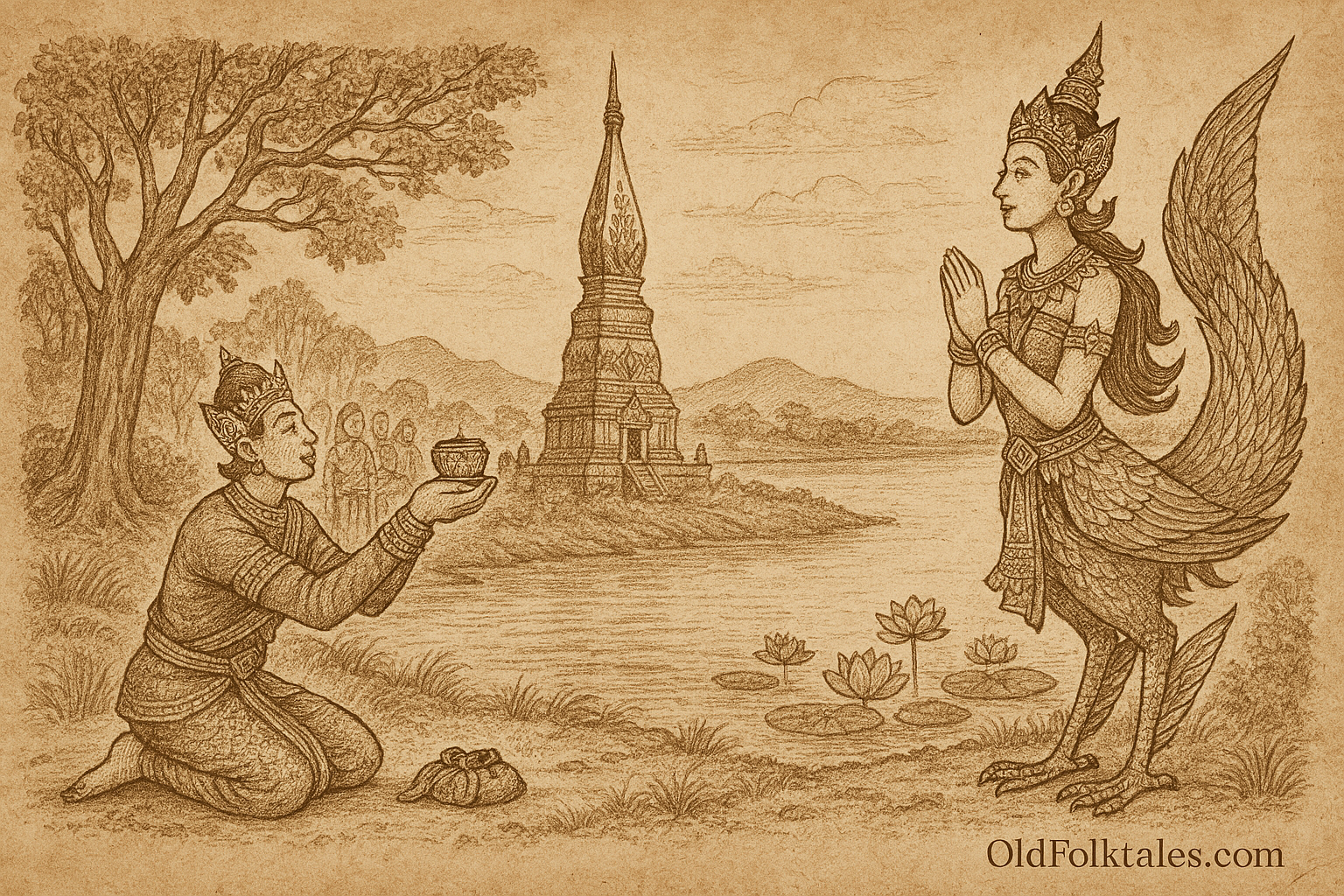
The Mekong River held secrets far older than any human kingdom. Its waters connected the earthly realm to the celestial spheres, and it was known among the enlightened that divine beings occasionally descended to its sacred banks. Among these celestial creatures were the Kinnari exquisite beings who dwelt in the heavenly realms of Himavanta, the mythical forest at the base of Mount Meru. These beings possessed the upper body of a beautiful woman and the lower body and wings of a graceful bird, their forms radiating with ethereal light.
One particular evening, as the sun painted the sky in shades of orange and crimson, a young Kinnari named Manohara descended from the celestial realms. She was among the most beautiful of her kind, with long flowing hair that cascaded like dark silk, eyes that held the wisdom of countless lifetimes, and a voice that could charm even the wind itself. Her feathers shimmered with iridescent colors emerald, sapphire, and gold that shifted with each graceful movement.
Manohara had heard tales of the pure waters of the Mekong and longed to bathe in its blessed currents. With her celestial sisters, she descended through layers of clouds and mist, alighting on a secluded bend in the river where ancient trees provided shade and lotus flowers bloomed in abundance. The spot was sacred and hidden, known only to the most spiritually attuned.
As twilight deepened, the Kinnari removed their celestial garments and ornaments, placing them carefully on the riverbank, and waded into the cool, welcoming waters. They laughed and sang as they bathed, their voices creating melodies that made the very air vibrate with beauty. Fish gathered to watch them, and even the river spirits paused in their eternal dance to witness such grace.
Unknown to the celestial beings, the prince had wandered far from his palace that evening, drawn by an inexplicable feeling a pull toward this remote section of the river. As he approached through the forest path, he heard singing unlike anything he had ever experienced. Following the sound, he emerged at the riverbank and stopped, utterly transfixed.
There, illuminated by the last rays of sunlight and the rising moon, was Manohara. Her beauty transcended anything of the mortal world. The prince felt his heart, which he had thought dedicated only to spiritual pursuits, suddenly awaken with profound longing. This was no mere earthly attraction, it was as if his soul recognized something eternal in her celestial form.
The prince, overcome by both love and a deep fear that she would vanish, made a fateful decision. Moving quietly, he approached the riverbank where the Kinnari had left their belongings. He carefully took Manohara’s celestial garment and ornaments, knowing that without them, she would be unable to return to the heavens. It was an act born of desperation and desire, not malice, but it was a binding nonetheless.
When the Kinnari emerged from their bath, Manohara’s sisters quickly donned their garments and prepared to ascend. But Manohara discovered her belongings missing. Panic filled her celestial heart as her sisters rose into the darkening sky, their calls of distress fading as they returned to the heavens, unable to help her.
The prince stepped forward, revealing himself and the garments he held. He bowed deeply, showing respect despite his actions, and spoke with both humility and passion. He confessed his love, his loneliness, and his conviction that fate had brought her to him. He promised to honor her, to provide her with a life of comfort and dignity, and to love her with all his being if she would consent to remain with him as his wife.
Manohara, stranded between worlds, looked upon this mortal prince. She saw his sincerity, his spiritual cultivation, and the genuine love in his eyes. Though her heart ached for the celestial realms and her freedom, she also recognized that karma had woven this meeting. Perhaps there were lessons to be learned, debts to be repaid, or purposes to be fulfilled in the mortal world. With grace and dignity, she agreed to stay, though a part of her spirit would always long for the heavens.
The prince brought Manohara to his palace, where she became his princess. Their wedding was celebrated throughout the kingdom, though the people whispered in wonder about the bride’s extraordinary beauty and her strange, sorrowful grace. Manohara adapted to palace life, teaching the court celestial songs and dances, and sharing wisdom from the heavenly realms. She was kind to all and grew to care deeply for the prince, who proved true to his word in every way.
Years passed, and Manohara bore the prince children who inherited traces of her celestial nature extraordinary beauty and artistic gifts that set them apart. Yet despite the love that grew between them and the life they built together, Manohara never forgot her true home. She would often stand at the palace windows, gazing at the stars, her heart calling to the celestial realms she had left behind.
The prince, who loved her deeply, could not fail to notice her longing. His heart broke each time he saw the sadness in her eyes. Finally, his love overcame his fear of losing her. One evening, he brought forth the celestial garments he had hidden away and placed them before Manohara.
“I cannot keep you caged,” he said, tears streaming down his face. “Love that imprisons is not true love. If your happiness lies in the heavens, then you must be free to return. Know that you carry my heart with you, wherever you may go.”
Manohara wept at his sacrifice, at the depth of love that could release rather than bind. She held the prince close, and in that moment, their love transformed from earthly possession to something more eternal and pure. She explained that she must return to fulfill her celestial duties, but that their connection would transcend realms and lifetimes.
Before donning her celestial garments, Manohara removed a precious jewel from her ornaments a sacred gem that radiated with inner light, containing a fragment of her celestial essence. “Build a stupa here,” she instructed, “in this place where heaven touched earth, where love learned to set free what it cherished most. This jewel will be its heart, and this place shall become a beacon of the dharma, drawing pilgrims who seek merit and blessing.”
With final embraces of her children and a last, lingering kiss for the prince, Manohara donned her celestial garments. Her bird form manifested in full glory, wings spreading wide and radiant. As the prince and his court watched in awe and sorrow, she rose into the night sky, ascending through layers of starlight until she vanished into the celestial realms.
True to her instruction, the prince commissioned the construction of a magnificent stupa at the very spot where Manohara had departed. The sacred jewel she left was enshrined at its heart, and the monument rose toward the heavens like a prayer made solid. This became That Phanom, one of the most revered stupas in all of Laos and northeastern Thailand, a place where the boundary between earthly and celestial grows thin.
To this day, That Phanom stands as a major Buddhist pilgrimage site along the Mekong River. Thousands of devotees journey there each year to pay homage, to seek blessings, and to remember the celestial being who descended from heaven and the prince who loved her enough to set her free. The stupa reaches toward the sky like a finger pointing to the heavens, a eternal reminder of Manohara’s presence and the sacred moment when divine and human love transcended earthly attachment.
Click to read all Southeast Asian Folktales — featuring legends from Thailand, Indonesia, Vietnam, and the Philippines.
The Moral Lesson
The legend of the Kinnari of That Phanom teaches profound spiritual truths about love, freedom, and attachment. True love, the story reveals, is not about possession but about honoring the beloved’s true nature and needs. The prince’s ultimate act of releasing Manohara demonstrates that genuine compassion requires letting go, even when it causes personal suffering. The tale also illustrates Buddhist principles of impermanence and non-attachment that all things, even the most precious relationships, are temporary in form but can be eternal in spirit. Finally, it shows how acts of selfless love and sacrifice can create lasting spiritual merit, transforming personal moments into sacred sites that serve countless beings. The stupa stands as proof that when we release what we love with pure intention, we create something far greater than what we possessed.
Knowledge Check
Q1: What is a Kinnari and where do these beings come from? A: A Kinnari is a celestial being from Buddhist and Hindu mythology that dwells in Himavanta, the mythical forest at the base of Mount Meru. Kinnari have the upper body of a beautiful woman and the lower body and wings of a graceful bird, and they inhabit the heavenly realms between the earthly and divine worlds.
Q2: Why did Manohara descend to the Mekong River? A: Manohara descended from the celestial realms with her sister Kinnari to bathe in the pure, sacred waters of the Mekong River. The river was known as a place where the earthly and celestial realms connected, and its blessed waters attracted divine beings seeking to experience its spiritual purity.
Q3: How did the prince capture Manohara and why? A: The prince discovered Manohara and her sisters bathing in the river and was instantly overwhelmed by love for the celestial being. While she bathed, he took her celestial garments and ornaments, knowing that without them she could not return to the heavens. He did this out of desperate love and loneliness, not malice, hoping she would agree to become his wife.
Q4: What was the sacred jewel that Manohara left behind? A: Before returning to the celestial realms, Manohara gave the prince a precious sacred jewel from her ornaments that contained a fragment of her celestial essence and radiated with inner light. She instructed that this jewel should be enshrined in a stupa built at the spot where she departed, and it became the spiritual heart of That Phanom stupa.
Q5: Why did the prince eventually release Manohara? A: Despite his deep love for Manohara, the prince recognized her ongoing longing for the celestial realms and realized that true love means honoring the beloved’s nature and needs rather than imprisoning them. His compassion and spiritual understanding led him to return her celestial garments, freeing her to return home even though it broke his heart.
Q6: What is the significance of That Phanom stupa today? A: That Phanom is one of the most important Buddhist pilgrimage sites in Laos and northeastern Thailand, built at the exact location where Manohara ascended back to the heavens. It houses the sacred jewel she left behind and serves as a place where thousands of devotees seek blessings and spiritual merit, representing the enduring connection between earthly and celestial realms and the power of selfless love.
Source: Adapted from Lao oral tradition as preserved in the Lao National Museum Oral Tradition Archive
Cultural Origin: northeastern Laos , Southeast Asia.