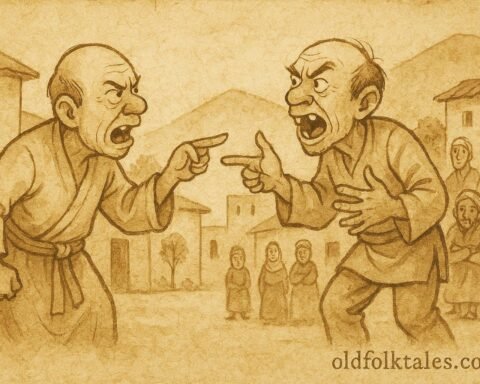
In the ancient hills of Jordan, where olive groves whisper to the desert winds, there once lived a humble king with three wives. One day, as they sat spinning fine silk, the eldest said, “If His Majesty would wed me again, I would weave him a carpet so vast it could cover the whole kingdom.” The second declared, “I would bake bread so fine that the fragrance alone could feed a thousand souls.” But the youngest smiled and said softly, “If the king wed me, I would bear him three children, one with golden hair, one with silver hair, and one with the sun and moon upon his forehead.”
When the king heard this, he married the youngest, for her words stirred his heart with wonder. In time, the queen gave birth to three children, just as she had foretold. The first child’s hair shone like gold, the second gleamed like silver, and the third had a radiant mark on his brow that glowed like dawn. But envy brewed among the elder wives. In the dark of night, they stole the infants and replaced them with three lifeless puppies. Then, they ordered that the true children be cast into the river.
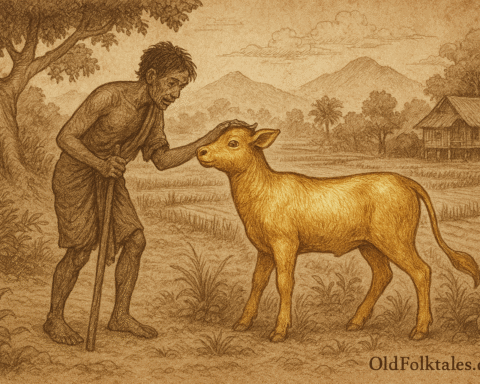
A poor fisherman found the basket drifting among the reeds. Seeing the glowing faces of the children, he and his wife took them in, raising them as their own. They named the eldest Amir, the second Nour, and the youngest, a daughter, Layla, who was as gentle as moonlight.
Years passed, and the children grew into beauty and grace. Yet whispers of their mysterious birth reached jealous ears once more. The elder wives, fearing discovery, sent an old witch to their home disguised as a peddler. She told Layla of a wondrous bird called the Little Nightingale (the Crier), a creature whose song revealed the deepest secrets of heaven and earth. “If you bring this bird,” said the witch, “you shall know your true origin.”
Curious and brave, Layla told her brothers, and Amir set forth to find the Little Nightingale. He crossed deserts and mountains, passing enchanted gardens and sleeping lions, until he reached a crystal palace guarded by stone statues. A whisper warned him: “Take the bird without looking back.” He grasped the cage, but the bird cried out, and he turned, turning to stone himself.
Nour, determined to save his brother, set out next and met the same fate. At last, Layla went, her heart trembling but steadfast. She reached the same palace, took the bird, and ran. When it cried, she shut her ears and did not look back. At dawn, she freed her brothers from their stony sleep. Together, they returned home with the Little Nightingale.
When the bird sang before the king, its voice filled the hall with light. “Your children live, O King,” it cried. “They were cast away by envy and raised by love.” The king’s heart broke with joy and sorrow. He punished the guilty wives and restored his true queen and children to honour.
From that day on, the Little Nightingale (the Crier) became a symbol of truth that cannot be silenced, no matter how deep it is buried.
Moral Lesson
Jealousy may darken hearts, but truth, like the song of the nightingale, always finds its voice. The story reminds us that destiny favours the innocent and that love and courage can restore what envy destroys.
Knowledge Check
-
Who are the main characters in “Little Nightingale (The Crier)” from Jordan?
The story features a queen, her three miraculous children, jealous co-wives, and the magical bird, the Little Nightingale. -
What does the Little Nightingale symbolize in Jordanian folklore?
It represents truth, justice, and divine revelation. -
What moral lesson does this Jordanian folktale teach?
It teaches that jealousy and deceit lead to downfall, while truth and courage bring redemption. -
Where does the tale “Little Nightingale (The Crier)” originate?
It is a traditional Jordanian folktale shared across the Levant. -
Why were the miraculous children cast away in the story?
They were victims of jealousy from the king’s other wives who feared losing favour. -
How does the story of the Little Nightingale end?
The bird sings the truth, the royal family reunites, and justice is served.
Source
Adapted from the Jordanian variant of “Little Nightingale (The Crier)”, ATU 707 (“The Three Golden Children”), as recorded in Muhawi & Kanaana’s Speak, Bird, Speak Again: Palestinian Arab Folktales (University of California Press, 1989).
Cultural Origin: Jordan (Levantine folklore)