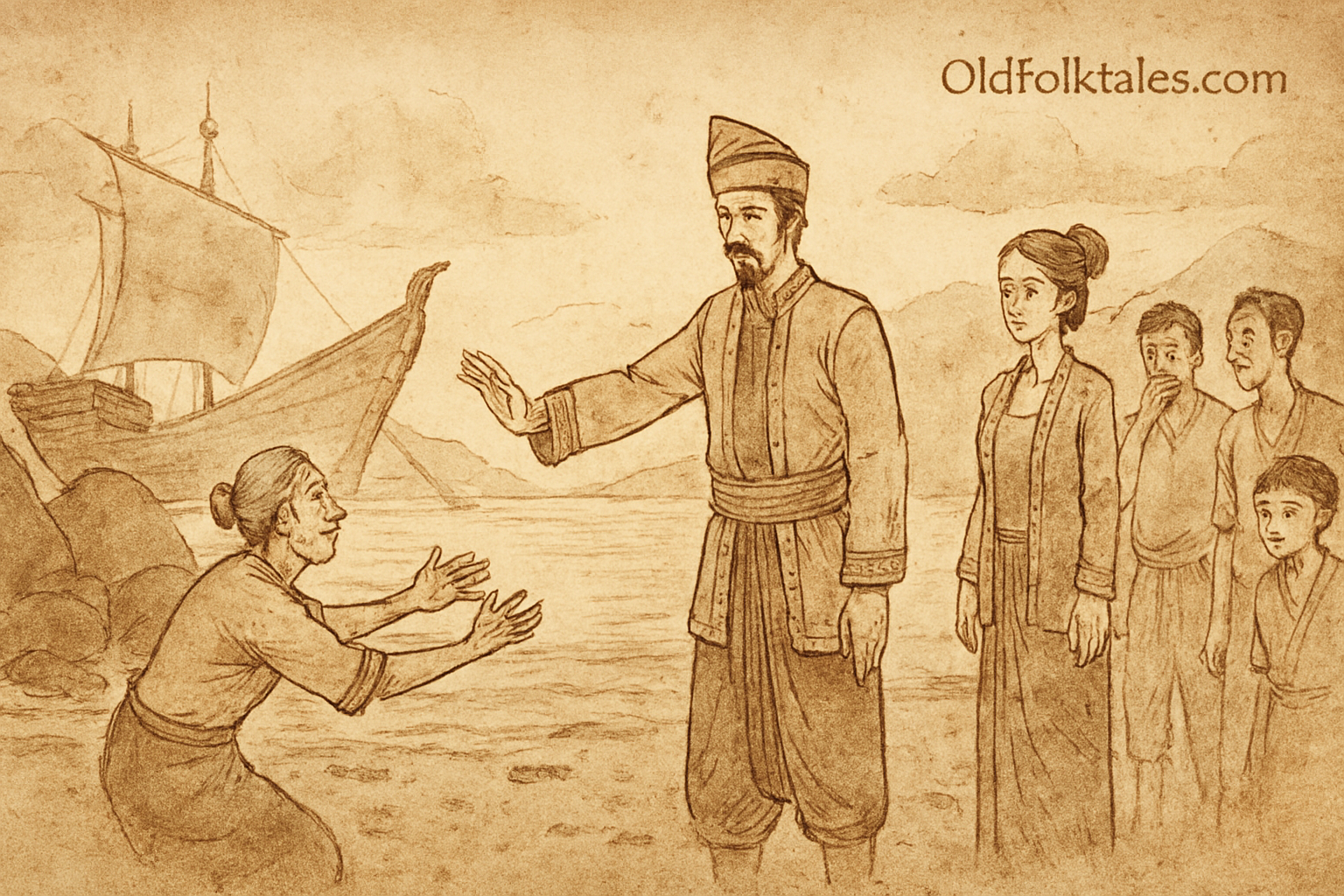
In a small fishing village on the rugged coast of Sumatra, where the waves crashed against black volcanic rocks and palm trees swayed in the salty breeze, there lived a poor widow and her only son, Malin Kundang. Their home was a simple bamboo hut with a thatched roof that leaked during the monsoon rains, and their meals consisted of whatever fish the widow could afford to buy from the morning catch and plain rice cooked in an old clay pot.
Despite their poverty, the widow loved her son with a fierce and unwavering devotion. Malin Kundang’s father had been lost at sea years before, swallowed by a storm that had taken many of the village’s fishermen. Since that dark day, the widow had worked tirelessly mending fishing nets, selling vegetables in the market, doing laundry for wealthier families all to ensure her beloved son had enough to eat and clothes on his back.
Click to read all Southeast Asian Folktales — featuring legends from Thailand, Indonesia, Vietnam, and the Philippines.
Malin Kundang grew into a handsome and intelligent young man, but his heart burned with restless ambition. He would stand on the shore, watching the merchant ships pass by with their colorful sails billowing in the wind, their hulls heavy with exotic goods from distant lands. He dreamed of adventure, of wealth, of a life far grander than the one his small village could offer.
One day, when the heat of ambition became too much to bear, Malin Kundang approached his mother. “Ibu,” he said, using the respectful Indonesian term for mother, “I cannot stay in this village any longer. I want to sail away and seek my fortune. I want to become a merchant, to see the world, to make something of myself.”
The widow’s heart shattered at these words. Tears welled in her tired eyes, carving paths down her weathered cheeks. “You are all I have in this world, my son. Who will care for me in my old age? Who will I have when you are gone?”
But Malin Kundang’s mind was set. “When I return, Ibu, I will be rich. I will build you a fine house and buy you beautiful clothes. You will never have to work again. Just let me go, and I promise I will come back for you.”
Though her heart was breaking, the widow could not refuse her only child. She gave him her blessing, along with the few coins she had saved, hidden away in a tin beneath the floorboards. She embraced him tightly, memorizing the feel of his arms around her, breathing in his scent, wondering when or if she would see him again.
Malin Kundang boarded a merchant vessel the next morning. His mother stood on the shore, waving until the ship became nothing more than a tiny speck on the horizon, then disappeared entirely. She returned to her empty hut and wept.
Years passed slow, lonely years for the widow. Her back grew more bent, her hands more gnarled from hard work. Her hair turned completely white, and her face became deeply lined with age and sorrow. But she never stopped hoping, never stopped scanning the horizon for her son’s return.
Meanwhile, far across the sea, fortune smiled upon Malin Kundang. He proved himself clever in business, brave in the face of danger, and ruthless when necessary. He rose through the ranks of the merchant trade, eventually becoming the captain of his own ship. His wealth grew beyond his wildest dreams, he owned warehouses filled with spices, silk, and precious gems. He wore fine clothes of imported fabric and ate delicacies from porcelain plates.
He also married a beautiful woman from a wealthy family, a woman who had never known poverty or hardship. She was elegant and refined, but also proud and cold-hearted. She knew nothing of Malin Kundang’s humble origins, for he had carefully hidden his past, ashamed of the poor village and the simple mother he had left behind.
After many years at sea, Malin Kundang’s ship happened to anchor near his home village to take on fresh water and supplies. Word spread quickly through the small community, a magnificent merchant vessel had arrived, its owner clearly a man of great importance and wealth.
The old widow heard the news and felt her heart leap with impossible hope. Could it be? Could her son have finally returned? Despite her aged, aching body, she hurried to the harbor as fast as her weak legs could carry her. Her clothes were tattered and worn, patched many times over. Her feet were bare and calloused. But her eyes shone with desperate love and longing.
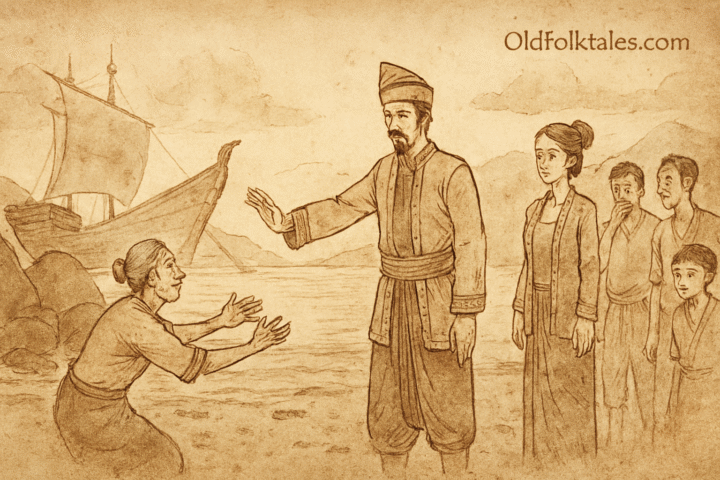
When she reached the dock, she saw him, her Malin Kundang, now a grown man, dressed in magnificent robes of silk and brocade, standing tall and proud on the deck of his grand ship. Beside him stood a beautiful woman in expensive garments, looking down at the villagers with obvious disdain.
“Malin! Malin Kundang!” the widow cried out, pushing through the crowd. “My son! My beloved son! You have returned!”
She rushed toward him with open arms, tears streaming down her face. But when she reached him, Malin Kundang stepped back, his face twisting with disgust and embarrassment. His wealthy wife looked at the old woman with contempt.
“Who is this filthy beggar?” his wife demanded. “Send her away!”
The widow’s hands trembled as she reached for her son. “Malin, it is I, your mother! Do you not recognize me? I have waited so long for you to come home!”
But Malin Kundang’s heart had grown as hard as stone. He looked at his poor, elderly mother and saw only an obstacle to his new life, a shameful reminder of the poverty he had escaped. In front of the gathered crowd and his proud wife, he denied her.
“I do not know this woman,” he declared coldly. “My mother was a noble lady, not some wretched beggar. Leave us alone!”
He pushed her away roughly, and she fell to the ground. The villagers gasped in horror. Some rushed to help the widow to her feet, while others whispered among themselves about the merchant’s cruelty.
The widow stood, her body shaking not with weakness now, but with a grief and rage so deep it seemed to come from the very core of her being. She raised her trembling hands to the sky, and her voice rang out across the harbor, strong and terrible.
“Malin Kundang! You who came from my body! You whom I raised with love and sacrifice! You have denied your own mother and rejected the one who gave you life! For your arrogance, your ingratitude, and your cruelty, I curse you! May you turn to stone, along with your ship and all your wealth! May you remain forever as cold and hard as your heart has become!”
The sky, which had been clear and blue, suddenly darkened with storm clouds. Thunder rumbled across the heavens. Lightning split the sky, and the sea began to churn violently. Malin Kundang’s face filled with terror as he felt his body beginning to stiffen. He tried to run, but his legs would not move. His skin grew hard and gray. His wife screamed, but she too was turning to stone.
The magnificent ship began to crack and splinter, its wooden planks transforming into rock. Within moments, Malin Kundang, his wife, his crew, and his entire vessel had become stone, frozen forever in that terrible moment of recognition and regret.
The storm passed as quickly as it had come. The villagers stood in awed silence, staring at the stone figures on the shore. The widow, her curse fulfilled, collapsed from exhaustion and heartbreak. Though she had gained justice, she had lost her son forever.
To this day, on the coast of Sumatra, there are said to be stone formations that resemble a ship and human figures, a permanent reminder of the young man who forgot where he came from and paid the ultimate price for his ingratitude.
Journey through enchanted forests and islands in our Southeast Asian Folktales collection.
The Moral of the Story
The legend of Malin Kundang teaches us the sacred importance of honoring and respecting our parents, no matter how successful or wealthy we become. It reminds us that our origins are nothing to be ashamed of, and that true nobility comes from gratitude, humility, and loyalty to those who loved and sacrificed for us. Malin Kundang’s tragedy shows that material wealth means nothing if we lose our humanity and forget the people who made us who we are. No amount of riches can justify cruelty toward those who gave us life and love.
Knowledge Check
Q1: Who is Malin Kundang in this Indonesian folktale from Sumatra?
A1: Malin Kundang is a poor boy from a fishing village in Sumatra who leaves his mother to seek his fortune at sea. He becomes a wealthy merchant but later denies his mother when he returns, leading to his tragic transformation into stone.
Q2: Why does Malin Kundang leave his village in this Sumatran legend?
A2: Malin Kundang leaves his village driven by ambition and the desire for wealth and adventure. He dreams of becoming a successful merchant and living a life far grander than what his poor fishing village can offer.
Q3: What happens when Malin Kundang’s mother tries to greet him upon his return?
A3: When Malin Kundang’s mother rushes to embrace him, he cruelly denies knowing her, ashamed of her poor appearance in front of his wealthy wife. He pushes her away and calls her a beggar, breaking her heart with his ingratitude.
Q4: What curse does the mother place on Malin Kundang in the folktale?
A4: In her anguish and rage at being rejected by her ungrateful son, the mother curses Malin Kundang to turn into stone along with his ship, his wife, and all his wealth, leaving him forever as cold and hard as his heart had become.
Q5: What cultural values does the Malin Kundang story emphasize?
A5: The story emphasizes core Indonesian and Asian cultural values including filial piety (respect and care for parents), gratitude, humility, and remembering one’s roots. It warns against arrogance, ingratitude, and the dangers of valuing material wealth over family bonds.
Q6: What is the origin and cultural significance of the Malin Kundang legend?
A6: Malin Kundang is a traditional folktale from Sumatra, Indonesia. It is one of the most famous Indonesian legends and is used to teach children about respecting parents and elders. Stone formations on the Sumatran coast are said to be the petrified remains of Malin Kundang and his ship.
Source: Indonesian folktale from Sumatra, Indonesia