In the heart of Luzon, where the land rises into gentle slopes covered with dense forests and mist clings to the peaks like silk veils, there stands a mountain whose beauty has inspired awe and reverence for countless generations. This is Mount Makiling, named after its immortal guardian, Maria Makiling, the diwata who once walked freely among mortals, bringing blessings of abundance and healing to all who lived in her domain.
Long before Spanish galleons arrived on Philippine shores, before cities sprawled across the valleys, the people who lived at the foot of Mount Makiling knew they were not alone. The mountain breathed with life beyond the visible world. Streams flowed with crystalline water that never ran dry. Fruit trees bore harvests so generous that no family ever went hungry. Medicinal plants grew in abundance, their healing properties more potent than anywhere else in the islands. The forest teemed with game, and the soil yielded crops with minimal toil.
Discover more East Asian Folktales from the lands of dragons, cherry blossoms, and mountain spirits.
This prosperity was no accident. It was the gift of Maria Makiling.
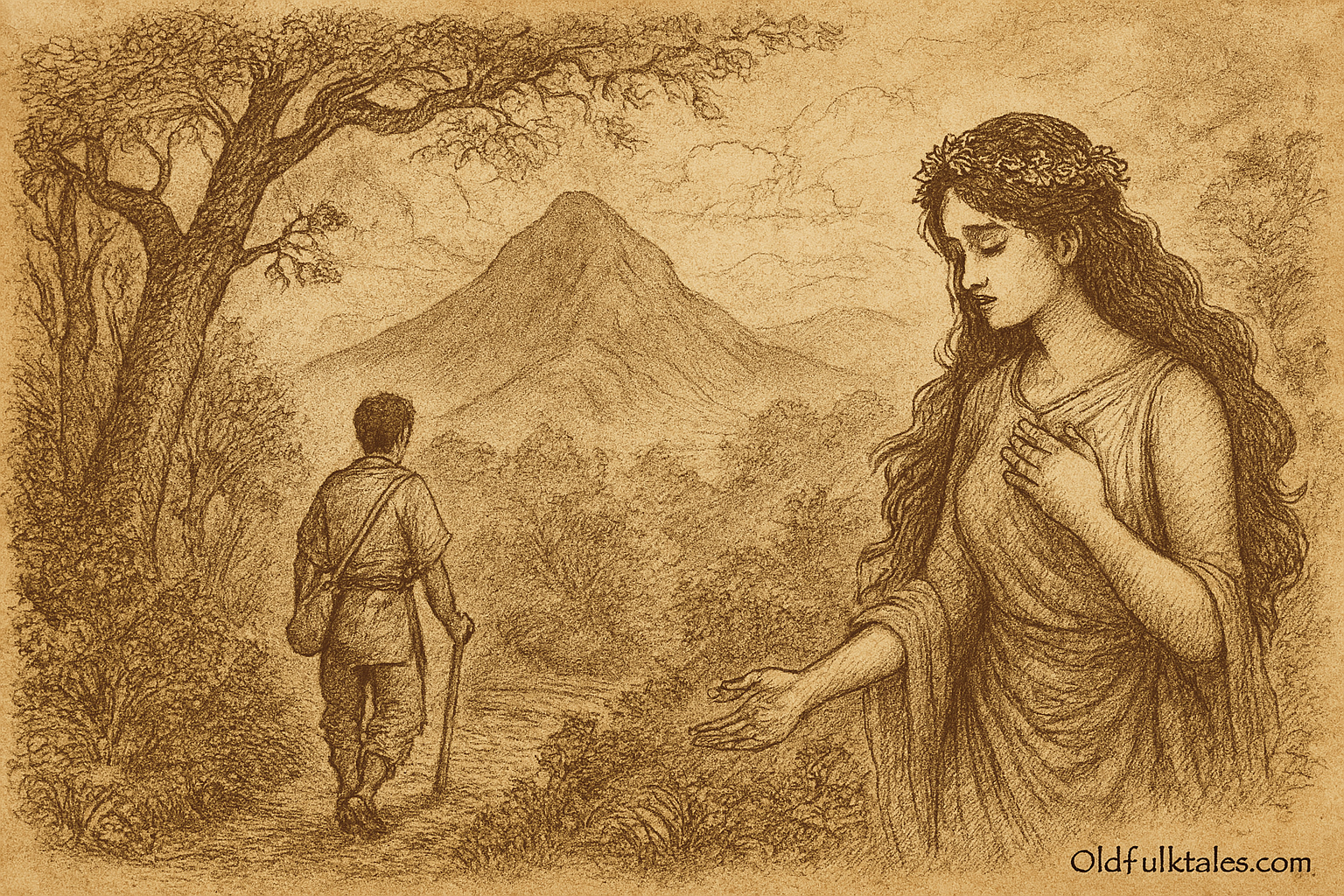
The diwata appeared in many forms, for she was not bound by a single shape or appearance. Sometimes she manifested as a beautiful young woman with flowing black hair that reached her waist, her skin the warm brown of fertile earth, her eyes reflecting the deep green of the forest canopy. She wore garments woven from mist and moonlight, and flowers bloomed wherever her bare feet touched the ground. At other times, she appeared as a kind elderly woman offering guidance to lost travelers, or as a radiant maiden bathing in mountain streams, her laughter like the sound of water over smooth stones.
But regardless of her form, Maria Makiling’s nature remained constant she was the protector of the mountain, the guardian of its forests and creatures, and the benefactor of the simple farmers and hunters who lived in harmony with her domain.
The people loved their diwata, and she loved them in return. Farmers who worked diligently would find baskets of the finest fruits waiting at their doorsteps at dawn, though no one had seen who left them. Children who became lost in the forest would be guided home by a gentle woman who vanished the moment they reached safety. When illness struck a family, they would journey to certain springs on the mountain where Maria Makiling’s healing power infused the waters, and the sick would return home restored.
She walked among them often in those days, attending fiestas in the villages, her presence recognized by the subtle signs the sudden sweet fragrance of sampaguita flowers, the inexplicable feeling of peace that settled over a gathering, the way animals became calm and gentle in her vicinity. She delighted in the simple joys of mortal life: the laughter of children, the songs of farmers returning from their fields, the prayers of gratitude offered beneath ancient trees.
But Maria Makiling, for all her divine nature, possessed a heart capable of mortal emotions. And it was this capacity for love that would ultimately lead to her withdrawal from the human world.
In one of the villages at the mountain’s base lived a young man of exceptional character. He was strong but gentle, hardworking but generous, handsome but humble. His name has been remembered differently in various tellings some call him Jose, others Juan but his essence remained the same: a mortal man who captured the heart of a goddess.
Maria Makiling first saw him as he worked his small farm with dedication and respect for the land. Unlike others who had begun to take the mountain’s blessings for granted, this young man still offered prayers of thanksgiving. He never took more than he needed, always leaving offerings for the spirits of the forest. He spoke to the trees and streams with reverence, understanding that all living things deserved respect.
The diwata found herself drawn to him in a way she had never experienced before. She began to appear to him more frequently, first in fleeting glimpses a figure at the edge of the forest, a voice carried on the wind. Then, emboldened by emotions she didn’t fully understand, she revealed herself to him in her most beautiful form.
The young man was awestruck, but not afraid. He recognized the divine nature of the woman before him, yet he also saw in her eyes something achingly human a loneliness, a longing for connection that transcended the boundary between mortal and immortal.
They began to meet in secret places on the mountain beside hidden waterfalls, in groves where ancient trees formed natural cathedrals, under moonlight that turned the forest into a realm of silver and shadow. Maria Makiling shared with him the secrets of the mountain, showed him plants with miraculous properties, taught him the language of birds and the wisdom of stones. In return, he shared his dreams, his hopes, his very human fears and joys.
For a time, it seemed that love might bridge the impossible divide between their worlds. The young man spoke of a future together, and Maria Makiling, her divine wisdom clouded by the intensity of mortal emotion, dared to believe it might be possible.
But the human heart is complex, and the mortal world is filled with temptations that even the purest intentions cannot always resist.
In a neighboring village lived a woman of great beauty and worldly wealth. When she saw the young man, she desired him for herself. She was not content to wait for his affection to grow naturally; instead, she employed cunning and manipulation. She presented herself as helpless, as needing his protection. She offered him comforts and luxuries he had never known. She whispered doubts about the diwata was such a relationship not unnatural? Was he not meant for a real woman, one who could give him a normal life, children, a future in the mortal world?
The young man found himself torn. His love for Maria Makiling was real, but so were the pressures of his human existence, the expectations of his community, the practical concerns that divine love could not address. The other woman represented everything familiar and acceptable, while Maria Makiling, for all her love, belonged to a world he could never fully enter.
In some versions of the tale, the young man betrayed Maria Makiling outright, wedding the mortal woman and denying his relationship with the diwata. In others, he simply grew distant, his visits to the mountain becoming less frequent, his eyes no longer seeking her in the forest shadows. In still other tellings, it was not the young man himself who betrayed her, but the growing greed of the village people who began to abuse the mountain’s generosity cutting down sacred trees, killing animals needlessly, polluting the streams, taking and taking without gratitude or restraint.
Regardless of the specific nature of the betrayal, the result was the same. Maria Makiling’s heart, capable of such profound love, proved equally capable of profound hurt.
The diwata withdrew from the mortal world.
The people did not realize immediately what had happened. But slowly, inexorably, the mountain’s blessings began to fade. Streams that had never run dry began to dwindle in the dry season. Fruit trees produced smaller harvests. The game animals retreated deeper into the forest, beyond the reach of hunters. Crops required more labor for less yield. The healing springs lost their miraculous properties, their waters becoming ordinary.
Those who ventured deep into the forest reported strange phenomena paths that led in circles, guiding lights that vanished, voices calling from nowhere. Some claimed to have glimpsed Maria Makiling in the distance, her beautiful face filled with such sorrow that it brought tears to their eyes, but when they approached, she would dissolve into mist.
The elderly remembered the times of abundance and wept for what had been lost. They told the younger generations about the diwata who had loved them, who had provided for them, asking only for respect and gratitude in return. They spoke of the mortal man whose betrayal or whose love affair, depending on the telling had driven their guardian away.
Some said Maria Makiling still dwells on her mountain, watching over it from a distance, protecting it from those who would do it complete harm, but no longer granting the abundance she once bestowed so freely. Others claimed she retreated into the spirit realm entirely, her heart too broken to remain even as a distant guardian. A few whispered that she could still be won back, if humanity could prove itself worthy once more, if people could return to the old ways of respect and gratitude.
The farmers and villagers eventually learned to adapt to the mountain’s reduced generosity. They worked harder for their harvests, traveled farther for water during dry seasons, and accepted that the miraculous abundance of the old days was gone. But something essential had been lost not just the material blessings, but the sense of living in harmony with forces greater than themselves, the knowledge that their home was watched over by a being who cared for them.
Mount Makiling still rises above the landscape of Laguna province, its slopes still covered in forest, though less dense than in the days of Maria Makiling’s presence. People still tell stories of the diwata, still claim to see her on rare occasions a beautiful woman in traditional dress, appearing and vanishing like morning mist, her expression eternally sorrowful.
The legend serves as a reminder that some losses cannot be undone, that betrayal and greed have consequences that echo through generations, and that the greatest treasures are often those we fail to value until they are gone. Maria Makiling’s love was freely given and carelessly rejected, her blessings abundant until greed replaced gratitude. And now the mountain stands as a monument to what once was a paradise lost through human failing, a goddess’s love spurned by mortal weakness, a blessing withdrawn but never quite forgotten.
Click to read all Southeast Asian Folktales — featuring legends from Thailand, Indonesia, Vietnam, and the Philippines.
The Moral Lesson
The legend of Maria Makiling teaches us that nature’s blessings should never be taken for granted, and that the relationship between humanity and the natural world requires mutual respect, gratitude, and restraint. When we treat the environment and those who care for us with greed, ingratitude, or betrayal, we lose far more than material abundance; we lose the sacred connection that makes life truly rich. The story warns against the dangers of allowing materialism and social pressure to override authentic love and spiritual values. Maria Makiling’s withdrawal represents the consequences of broken trust and disrespect once certain bonds are severed, they may never be fully restored. The continuing diminishment of the mountain’s blessings across generations shows how our actions create ripples that affect not just ourselves but all who come after.
Knowledge Check
Q1: Who is Maria Makiling and what is her role in Philippine folklore?
A1: Maria Makiling is a diwata (guardian spirit) of Mount Makiling in Luzon, Philippines. She is the mountain’s immortal protector who appeared in various forms often as a beautiful woman to help farmers, heal the sick, ensure abundant harvests, and protect the forest. She represents the benevolent relationship between nature spirits and humans who live respectfully with the environment.
Q2: What blessings did Maria Makiling provide to the people living near her mountain?
A2: Maria Makiling blessed the region with streams that never ran dry, fruit trees with generous harvests, abundant game animals, fertile soil that yielded crops easily, and healing springs with miraculous medicinal properties. She also guided lost children home, left baskets of finest fruits at farmers’ doorsteps, and ensured no family went hungry.
Q3: Why did Maria Makiling fall in love with a mortal man, and what happened to their relationship?
A3: Maria Makiling fell in love with a humble, respectful young farmer who treated the mountain and its gifts with gratitude and reverence. Their love affair seemed to bridge mortal and divine worlds, but the man was eventually tempted by a wealthy mortal woman or succumbed to social pressure, leading to betrayal or abandonment of the diwata, breaking her heart.
Q4: What caused Maria Makiling to withdraw from the mortal world?
A4: Maria Makiling withdrew due to heartbreak from the mortal man’s betrayal and/or the growing greed and disrespect of villagers who began abusing the mountain’s blessings cutting sacred trees, killing animals needlessly, polluting streams, and taking without gratitude. The betrayal and human ingratitude wounded her divine heart deeply.
Q5: What happened to Mount Makiling and its people after Maria Makiling’s withdrawal?
A5: After her withdrawal, the mountain’s blessings gradually faded: streams dwindled during dry seasons, fruit harvests decreased, game animals retreated, crops required more labor for less yield, and healing springs lost their miraculous properties. The region experienced decline from abundance to ordinary struggle, with the loss affecting generations.
Q6: What does the legend of Maria Makiling symbolize in Philippine culture?
A6: The legend symbolizes the sacred relationship between humanity and nature, warning against taking environmental blessings for granted. It represents the consequences of greed, betrayal, and disrespect toward nature and those who care for us. The story embodies Filipino values of gratitude, respect for spirits and nature, and serves as a cultural reminder that broken environmental and spiritual bonds have lasting consequences.
Source: Adapted from traditional Philippine folklore and documented versions in Philippine Folk Literature: The Legends compiled by Damiana L. Eugenio
Cultural Origin: Filipino people, Laguna Province, Luzon Island, Philippines, Southeast Asia