Many centuries ago, when the world was still filled with wonders and mysteries, there lived an old man and his wife in a quiet mountain village of Japan. Their home was small but peaceful, surrounded by rice fields and soft green hills. Each day, the old man went to the mountains to gather firewood, while his wife washed clothes by the river. They lived happily, yet one sorrow remained in their hearts they had no child to share their love or laughter.
One bright morning, when the sun glowed like gold upon the water, the old woman walked down to the river with her bundle of clothes. The air was warm and filled with birdsong, and the sound of flowing water comforted her as she worked. Suddenly, she noticed something strange drifting down the river. At first, she thought it was a boat, but as it floated closer, she saw that it was a giant peach, shining with a golden light.
Amazed by the sight, she waded into the river and caught the peach in her arms. It was large and heavy, almost too beautiful to be real. Laughing with joy, she carried it home, thinking, “My husband will be so happy to taste such a rare fruit.”
When the old man returned from the mountains, tired from his work, he was astonished to see the enormous peach resting in their home. “What a gift from Heaven!” he said. “Surely this is a blessing for our old age.”
Together, they decided to cut the peach and share it for supper. But just as the knife touched its soft skin, the peach split open with a burst of light, and from within stepped a baby boy, healthy, strong, and smiling brightly. The old couple stared in amazement.
The child bowed politely and spoke in a clear voice. “Do not be afraid. Heaven has sent me to be your son.”
The couple fell to their knees, tears streaming down their faces. “At last,” cried the old woman, “our prayers have been answered.” They named the boy Momotarō, meaning “Peach Boy,” because he was born from a peach. From that moment, the lonely house was filled with warmth and laughter.
Momotarō grew quickly, stronger and wiser than any child in the village. He helped his parents with their chores, carried wood, fetched water, and always showed kindness to neighbors. Though he was powerful, he was gentle at heart, never boasting or fighting without reason. The villagers admired him and often said, “Surely this boy is touched by the gods.”
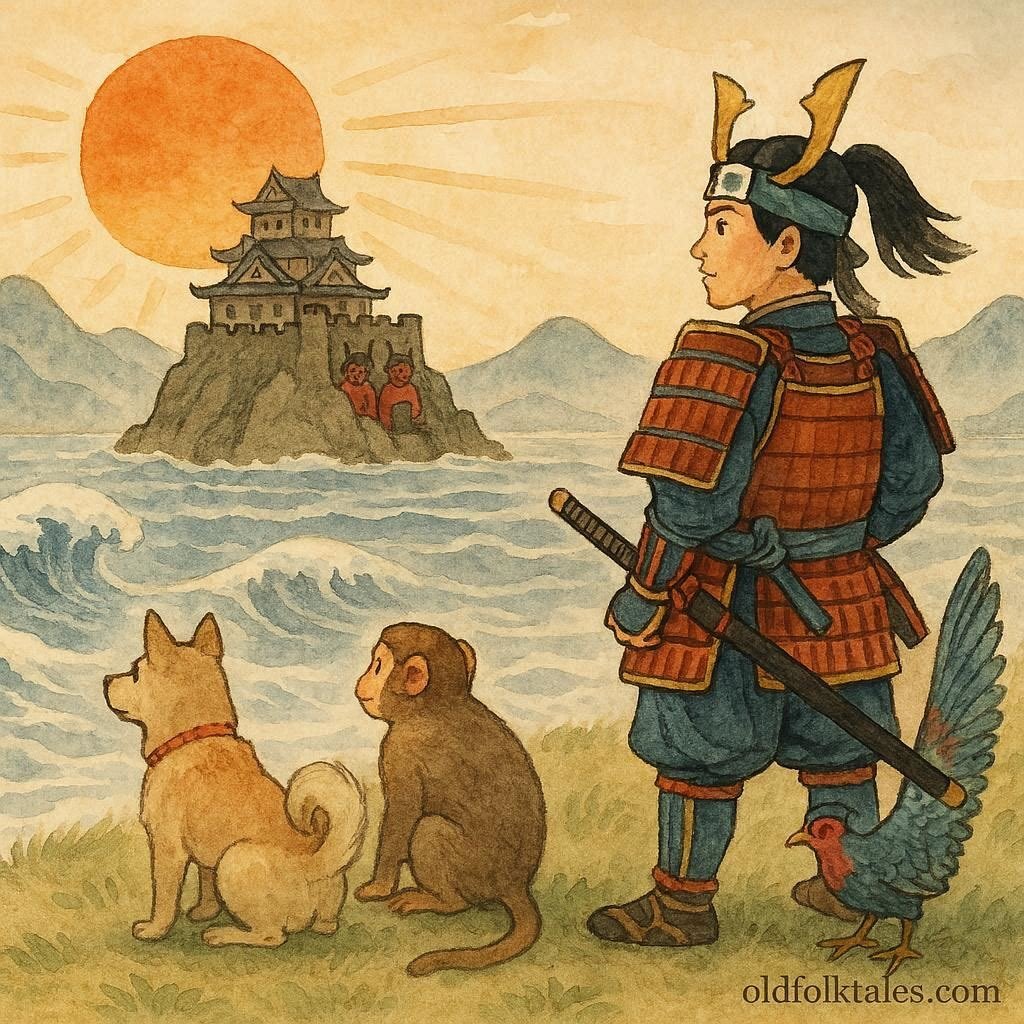
One year, word spread that terrible oni, or ogres, were terrorizing the coastal lands. These fearsome creatures lived on a distant island called Onigashima. They raided villages, stole treasures, and kidnapped people, leaving sorrow behind wherever they went.
When Momotarō heard these stories, his heart burned with determination. “Father, Mother,” he said one morning, “I cannot stand by while our people suffer. I must go to Onigashima and drive away the ogres.”
The old man and woman trembled with worry, for they loved him dearly. “It is dangerous, my son,” his mother said softly. “The ogres are fierce and cruel.”
“I know,” Momotarō replied, bowing deeply, “but it is my duty to protect the innocent. Please give me your blessing.”
Seeing his courage, they agreed. The old woman spent days preparing special millet dumplings, known as kibi dango, said to give the strength of a hundred men. She wrapped them carefully in a pouch, and the old man gave Momotarō a sword and armor that had been passed down through their family.
With their blessings, Momotarō set out on his journey. The sky was clear, and his heart was full of purpose.
As he walked along the road, he met a dog who barked and asked, “Brave traveler, where are you going?”
“I am going to Onigashima to fight the ogres,” said Momotarō.
The dog wagged his tail eagerly. “That is a noble quest. If you will share one of your dumplings with me, I will join you.”
Momotarō smiled, gave him a dumpling, and together they continued their journey.
Soon after, they met a monkey leaping through the trees. “Good day, young man,” said the monkey. “Where are you headed with such spirit in your eyes?”
“I am going to fight the ogres on Onigashima,” Momotarō answered.
The monkey scratched his head thoughtfully. “That sounds exciting! If you give me one of those dumplings, I will come and help.”
Momotarō gladly shared another dumpling, and the monkey joined the group.
Not long after, a pheasant swooped down from the sky and called out, “Where are you bound, fine traveler?”
“To Onigashima,” Momotarō replied, “to defeat the ogres who harm our land.”
The pheasant nodded proudly. “Then I shall fly ahead and scout the way. But first, please share one of your dumplings with me.”
Momotarō laughed and gave the bird a dumpling. Thus, the brave boy and his three loyal companions, the dog, the monkey, and the pheasant traveled together toward Onigashima.
After days of journeying, they reached the island. The sea roared around them, and dark clouds gathered above the ogres’ fortress. Tall stone walls surrounded the island, and terrifying cries echoed from within.
“Let us work together,” said Momotarō firmly. The pheasant flew over the walls, pecking at the guards’ eyes. The monkey climbed up the stones, sneaking inside to open the gate. The dog rushed forward, barking fiercely, while Momotarō charged in with his sword blazing in the sunlight.
The battle was fierce. The ogres swung their clubs, shaking the ground, but Momotarō and his friends fought bravely. The dog bit the legs of the largest ogre, the monkey clawed at their armor, and the pheasant attacked from above. Momotarō struck with the strength of thunder, his heart pure and fearless.
At last, the ogres fell to their knees. Their leader, a great red-faced ogre with horns like iron, cried out, “We surrender! Spare us, noble warrior. We will never harm humans again.”
Momotarō lowered his sword. “Then keep your word and live in peace,” he said. He gathered their stolen treasures gold, silks, and precious stones to return them to the people of Japan.
When he returned home, the villagers welcomed him with cheers. His parents ran to embrace him, tears of joy in their eyes. “You have brought honor to our home and peace to our land,” they said.
From that day forward, Momotarō and his loyal companions were celebrated as heroes throughout Japan.
Explore timeless legends from China, Japan, and Korea in our East Asian Folktales collection.
Moral Lesson
The story of Momotarō teaches that true strength lies not only in courage but also in kindness, teamwork, and faithfulness. Bravery joined with compassion can overcome even the darkest of evils.
Knowledge Check
1. Where did the old couple find Momotarō?
They found him inside a giant peach floating down the river.
2. What does Momotarō’s name mean?
It means “Peach Boy,” because he was born from a peach.
3. Why did Momotarō decide to go to Onigashima?
He wanted to stop the ogres from terrorizing the land and stealing from villages.
4. Who were Momotarō’s three companions?
A dog, a monkey, and a pheasant who joined him after he shared his dumplings.
5. What special food did his mother prepare?
Millet dumplings called kibi dango, believed to give great strength.
6. What is the main lesson of the story?
Courage, cooperation, and kindness together can overcome any challenge.
Source:
Adapted from “Momotarō,” a traditional Japanese folktale recorded during the Edo period (17th–19th centuries) in collections such as Otogi-zōshi and Nihon Mukashibanashi.
Cultural Origin: Japan (Edo-era folklore)