Along the winding Brunei River, where the water flows brown and rich with the soil of the rainforest, there stands a rock formation that has captured the imagination of generations. The locals call it Jong Batu, and they say if you look closely, you can still see the outline of a ship’s hull and the figure of a man at its bow, frozen forever in stone. This is the story of how that rock came to be a tale of poverty and ambition, love and betrayal, pride and divine justice. This is the legend of Nakhoda Manis, the captain who denied his mother and paid the ultimate price.
In the time when Brunei was a bustling port where traders from across the seas exchanged spices, textiles, and precious goods, there lived a poor widow in a simple house near the river. Her dwelling was humble bamboo walls, a thatched roof that leaked during heavy rains, and a cooking fire that sometimes went cold when there was no food to prepare. But despite her poverty, she possessed something more valuable than gold: her son, Manis, the light of her life and the reason she rose each morning to face another day of struggle.
Discover more East Asian Folktales from the lands of dragons, cherry blossoms, and mountain spirits.
The widow worked tirelessly to provide for her boy. She sold small household items door to door, her back bent under the weight of her basket. She did odd chores for wealthier families washing clothes in the river until her hands were raw, sweeping courtyards, preparing food for celebrations she would never attend. Every coin she earned went toward feeding Manis, clothing him, ensuring he had opportunities she had never possessed. Her greatest dream was not for her own comfort but for her son to have a better life than she had known.
Manis grew into a young man filled with ambition and restless energy. He would stand on the riverbank watching the merchant ships arrive and depart, their sails billowing in the wind, their holds filled with exotic goods from distant lands. “Mother,” he would say, his eyes alight with dreams, “I want to explore the world. I want to become wealthy and give you everything you deserve. I want to make you proud.”
The widow’s heart was torn. She did not want to lose her son, but she recognized that his spirit would wither if confined to their small, poverty-stricken existence. With tears streaming down her weathered face, she agreed to let him go. She gathered her last savings coins she had been hoarding for emergencies, hidden away in a cloth bundle beneath the floorboards and pressed them into his hands. It was a sacrifice that left her with nothing, but her love demanded nothing less.
“Come back to me safely,” she whispered, embracing him one final time before he boarded a trading vessel as a deckhand. “And remember, no matter how far you travel or how much you achieve, you will always be my son.”
Manis proved to be clever, hardworking, and blessed with the kind of fortune that sometimes favors the ambitious. He learned the trading routes quickly, developing an instinct for which goods would fetch the best prices in which ports. He saved his earnings carefully, invested wisely, and within a few years had accumulated enough capital to become a merchant in his own right. His success grew exponentially. Soon he commanded his own vessel, then a fleet, earning the title Nakhoda Manis, Captain Manis a name spoken with respect in trading ports across the region.
With wealth came refinement. Nakhoda Manis dressed in fine silk robes and wore jewelry that glinted in the tropical sun. His flagship was a magnificent vessel adorned with golden decorations, carved teak railings, and sails of the finest cloth. His crew was loyal and well-paid, and his reputation as a successful merchant spread far and wide. He married a beautiful noblewoman from a high-class family, a woman who had never known poverty, who moved through the world with the confidence of someone who had always been comfortable, always been respected.
Years passed. The poor boy from the riverbank had become a wealthy captain, his origins buried beneath layers of success and social status. Then, one day, Nakhoda Manis decided to return to Brunei. Perhaps it was nostalgia, or perhaps it was pride the desire to show his hometown how far he had risen from his humble beginnings.
News of his return spread quickly through the river communities. When the widow heard that her son was coming home in a magnificent ship, her joy knew no bounds. After years of separation, of wondering if he was safe, of praying for his success, she would finally see him again. She prepared gifts with trembling hands simple cakes and local snacks wrapped carefully in banana leaves. They were humble offerings, made with the same love that had once pressed her last coins into his palm, the same love that had worked her fingers raw so he could have a chance at something better.
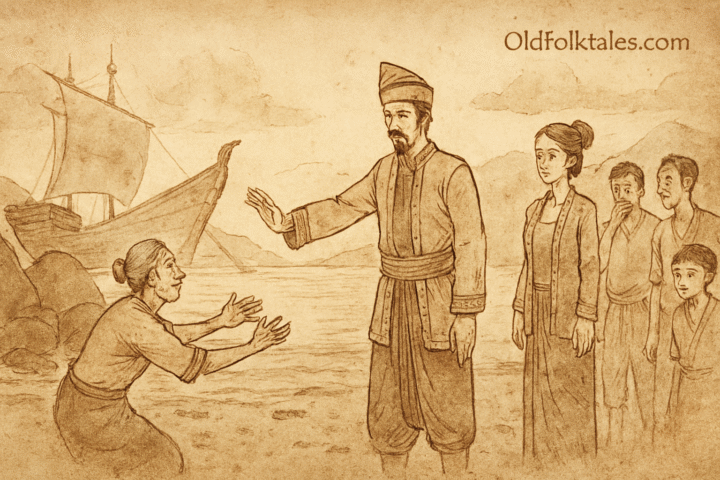
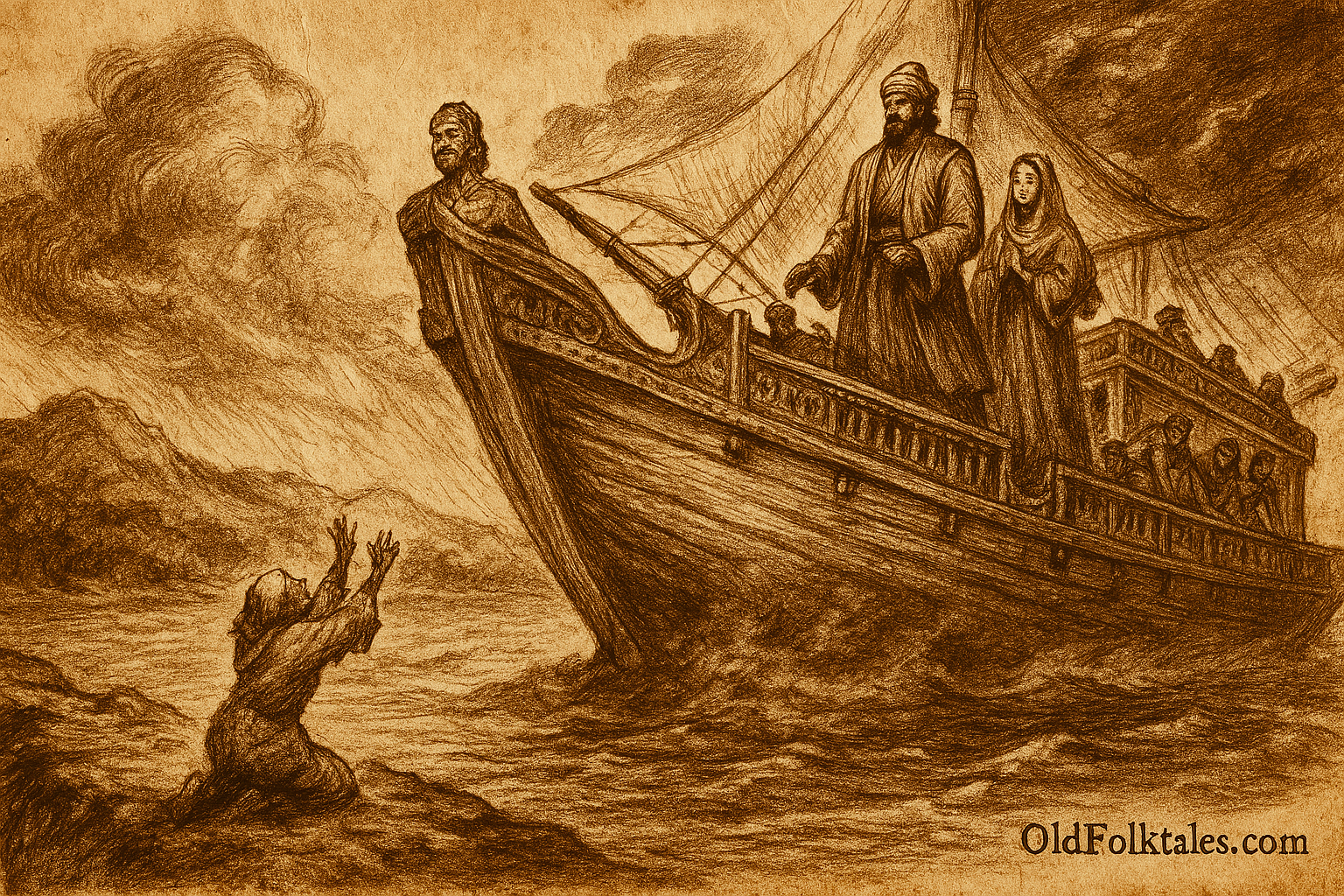
When the magnificent vessel appeared on the river, gliding toward the dock with its golden decorations catching the sunlight, the widow rushed to the riverbank. Her heart pounded with excitement and emotion. She waved, calling out to her son, tears of joy streaming down her face. In her mind, this was the moment she had been waiting for the reunion, the embrace, the fulfillment of all her sacrifices.
But when Nakhoda Manis saw the old woman calling to him poorly dressed, her face lined with years of hardship, her gifts wrapped in simple banana leaves something cold and terrible stirred in his chest. Shame. His noble wife stood beside him, beautiful and elegant, looking down at the dock with polite interest. His crew watched, waiting to see who this woman was who seemed to know their captain.
The widow called out again, her voice breaking with emotion: “Manis! My son! I am here! I’ve been waiting for you!”
But Nakhoda Manis, standing on the deck of his golden ship, did not move to embrace her. Instead, his face hardened. He looked at his wife, saw the confusion in her eyes, and made a choice that would seal his fate. “I don’t know this woman,” he said loudly, his voice carrying across the water. “She must be confused. Some beggar, perhaps.”
The widow’s smile faltered. Surely she had misheard. “Manis,” she said again, her voice trembling now. “It’s me your mother. I am your mother.”
But Nakhoda Manis turned to his crew and ordered coldly, “Push her away from the ship. She’s disturbing us.”
The words struck the widow like physical blows. Her son the boy she had sacrificed everything for, the child she had loved more than her own life was denying her. He was ashamed of her. The gifts fell from her hands, the banana leaf wrappings coming undone, the simple cakes scattering on the dock.
Heartbroken and humiliated, the widow fell to her knees. Through her tears, she raised her face to the sky and cried out to God in anguish: “If this is truly my fate, if my own son denies me after all I have done… then let justice be done. Let the truth be known to all.”
The response was immediate and terrible.
Dark clouds materialized out of nowhere, boiling across the sky like smoke from an enormous fire. The bright tropical day turned dark as twilight in moments. Wind began to howl, whipping the river into churning waves. Thunder crashed with a sound like mountains splitting, and the first drops of rain fell not gently, but with the force of divine fury.
The magnificent ship began to pitch and roll. Nakhoda Manis gripped the railing, his earlier confidence evaporating into terror. His crew shouted in panic, trying to control the vessel, but it was useless. The ship would not respond to their commands. Lightning split the sky, illuminating the scene in stark flashes of white light the terrified captain, the panicking crew, the noble wife screaming, and on the dock, the widow still on her knees, her face streaming with tears and rain.
Wave after wave slammed into the golden ship. The decorations that Nakhoda Manis had been so proud of now seemed to mock him as they rattled and broke. The vessel that had carried him safely across countless miles of ocean was now trapped, unable to move despite the desperate efforts of his crew.
Then came the final judgment.
A bolt of lightning, brighter and more powerful than any before it, struck the ship directly. But instead of destroying it, something far stranger occurred. The wood began to transform, the organic material becoming mineral, the living vessel turning to lifeless stone. The transformation spread from the point of impact outward the deck, the hull, the masts, the very planks and timbers becoming solid rock. The crew had fled by then, diving into the churning water and swimming for shore, but Nakhoda Manis remained frozen at the bow, his body solidifying along with his ship, preserved forever in the moment of his greatest shame.
When the storm finally cleared and the sun emerged again, the magnificent vessel was gone. In its place stood a rock formation, unmistakably ship-shaped, with the petrified figure of a man still visible at its bow.
The widow, still on the dock, looked at what her son had become and wept not with satisfaction but with profound sorrow for what might have been if only he had remembered love instead of embracing pride.
Today, the rock formation known as Jong Batu still stands in the Brunei River. Locals point it out to visitors, telling them the story of Nakhoda Manis, the captain who achieved great success but lost everything that truly mattered. Some say that on stormy nights, you can still hear the echo of a mother’s cry and a son’s belated remorse, forever preserved in stone as a warning to all who would value status above family, wealth above gratitude, and pride above the love that made everything possible.
Journey through enchanted forests and islands in our Southeast Asian Folktales collection.
The Moral Lesson
The legend of Nakhoda Manis teaches us that success and wealth are meaningless if they cause us to forget those who sacrificed for us. No achievement justifies abandoning or denying our parents, especially those who gave everything so we could have opportunities they never had. The story emphasizes that true nobility lies not in social status or material wealth but in gratitude, humility, and honoring the bonds of family. Pride and shame about our origins ultimately destroy us, while acknowledging our roots with grace strengthens our character. The tale also illustrates the concept of divine justice that profound betrayals, especially of parental love, carry consequences that transcend human punishment.
Knowledge Check
Q1: Who was Nakhoda Manis in Bruneian legend?
A1: Nakhoda Manis (Captain Manis) was the son of a poor widow who grew from humble beginnings to become a wealthy and successful merchant captain. He commanded a magnificent ship adorned with gold and married a noblewoman, but his success led him to deny his own mother when he returned to Brunei, resulting in his divine punishment.
Q2: What sacrifices did Manis’s mother make for him?
A2: The widow worked tirelessly in poverty, selling household items and doing odd chores with raw hands to support her son. When Manis wanted to travel and seek his fortune, she gave him her last savings everything she had hidden away for emergencies so he could have the opportunity to pursue his dreams, leaving herself with nothing.
Q3: Why did Nakhoda Manis deny his mother?
A3: When his mother came to greet him at the dock, Nakhoda Manis was ashamed of her poor, worn appearance. Standing beside his noble wife on his magnificent ship, he feared that acknowledging his humble origins would damage his reputation and social status, so he cruelly claimed not to know her and ordered his crew to push her away.
Q4: What happened when the mother called for divine justice?
A4: After being denied and humiliated by her son, the widow cried out to God for justice. Immediately, dark clouds gathered, a violent storm erupted, and lightning struck Nakhoda Manis’s ship. Instead of destroying it, the lightning transformed the entire vessel and the captain himself into stone, creating the rock formation known as Jong Batu.
Q5: Where can you see the result of Nakhoda Manis’s punishment today?
A5: The rock formation called Jong Batu on the Brunei River is believed to be the petrified ship of Nakhoda Manis. Locals say you can still see the outline of the ship’s hull and the figure of a man at the bow, forever frozen in stone as a permanent reminder of what happens when children betray their parents.
Q6: What does the petrified ship symbolize in Bruneian culture?
A6: The stone ship symbolizes the permanence of divine justice and the consequences of filial betrayal. It serves as a cultural reminder that material success means nothing without moral integrity, that we must never forget those who sacrificed for us, and that pride and shame about our origins lead to destruction. The rock formation stands as a perpetual warning about the importance of honoring parents and remaining humble regardless of achievement.
Source: Adapted from traditional Bruneian Malay oral folklore, documented in collections of Southeast Asian maritime legends.
Cultural Origin: Brunei Darussalam, Borneo, Southeast Asia