In the heart of central Thailand, where merchants once traveled long dusty roads carrying woven baskets and clay jars filled with goods, lived a humble young woman named Nang Hom. She was known for her gentle speech, her respectful manner, and her willingness to offer water and shade to travelers who passed by her family’s modest stall. The village where she lived was small and quiet, and her parents sold simple items such as rice cakes, pottery, and handwoven cloth. Business was not always steady, and some days the family earned barely enough to buy ingredients for the next morning.
But Nang Hom never complained. She believed that kindness itself was a form of fortune, and that generosity invited blessings in ways not always seen. When merchants passed along the road, she greeted them with a warm smile, speaking with sincerity. Many travelers paused at the stall not only because they needed rest but also because they felt welcomed by her presence. Her parents often said that her heart held more light than a lantern and that this light drew good things toward her.
One year, after the rainy season, a great drought settled across the central plains. The rivers shrank, buffalo fields cracked, and traveling merchants became fewer. With fewer visitors came fewer sales, and many families struggled. Nang Hom saw her parents’ worry, though they tried to hide it. She gathered herbs from the forest and crafted small items to sell, hoping to attract customers. Yet even with all her efforts, the village remained quiet.
Explore timeless legends from China, Japan, and Korea in our East Asian Folktales collection.
One afternoon, her father sent her to seek fresh water from a spring deep in the forest. Though the journey was long, she walked with determination, believing that the spring’s pure water would refresh her family and perhaps bring a blessing to their home. As she traveled deeper into the trees, the air grew cooler, and sunlight filtered through leaves in silvery beams.
She reached the spring, where the water glowed with unusual clarity. She knelt to fill her jars when she heard gentle footsteps behind her. Turning, she saw two figures dressed in garments that shimmered like sunlight on water. They were forest spirits, guardians of the sacred spring. Their presence carried a calmness so deep it made the entire forest seem to exhale.
The spirits spoke with kindness, saying they had watched Nang Hom for many years. They admired her generosity, her humility, and her service to others without expectation of reward. They explained that such purity drew the attention of beings who cared for the world’s harmony.
The spirits told her that although prosperity had faded from the land, her heart held enough goodness to nourish her entire village. They touched her forehead with a soft radiance, blessing her with a gift that could help both her family and countless others.
From that moment, a gentle power awakened within her, one that allowed her presence alone to draw goodwill, customers, and opportunities. The spirits told her she would become a light of prosperity, not only for her parents but for all who placed trust in her sincerity. They instructed her to return home and continue acting with the same kindness she always carried, for her strength came from her character.
When Nang Hom returned, the villagers noticed a new aura about her. It was not bright or fiery but warm and peaceful, like the glow of dawn. Travelers who had not visited in months suddenly appeared again, drawn without knowing why. They bought pottery and cloth from her parents, and many even left with blessings they insisted had come from the girl’s gentle presence.
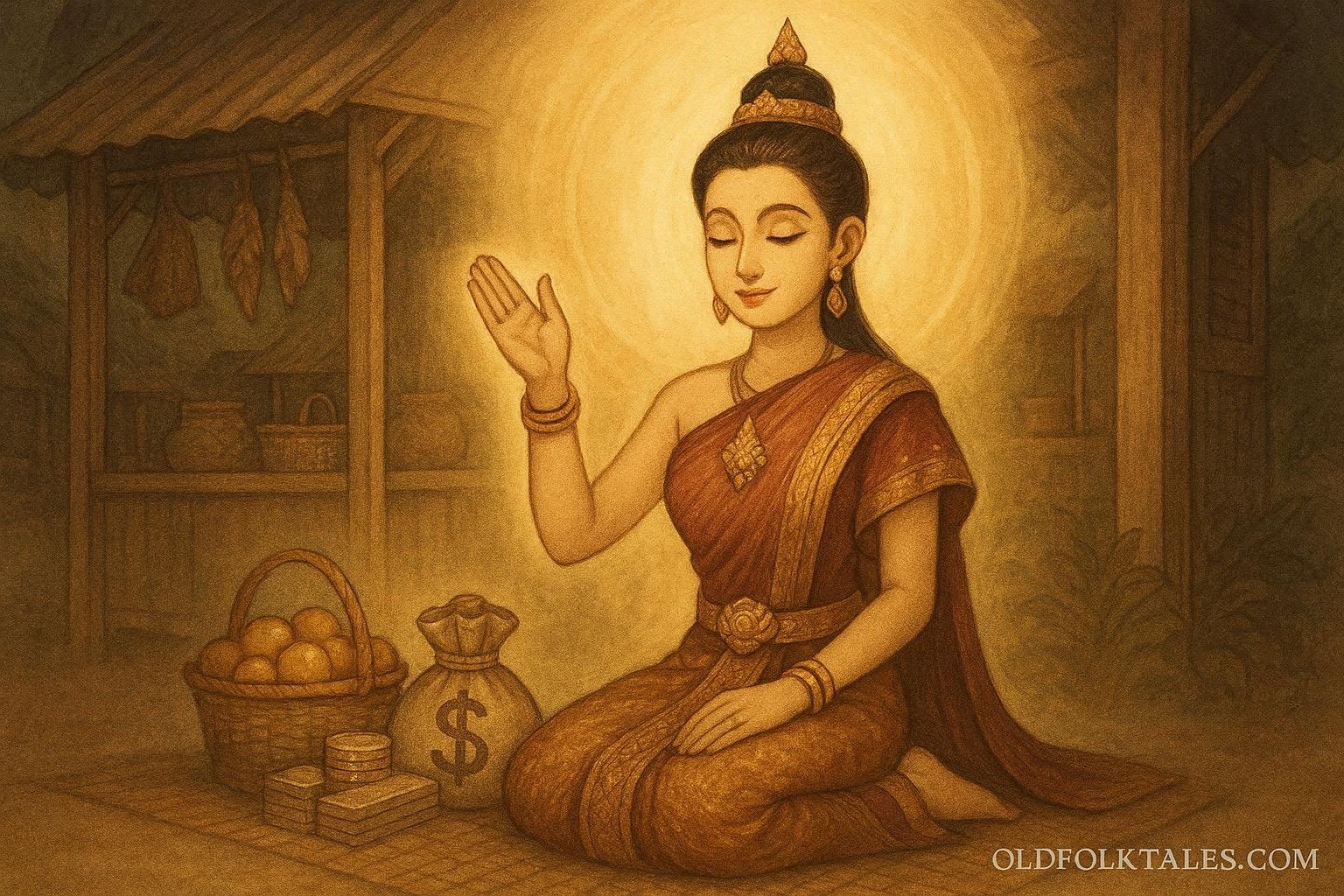
Word spread through the region. Merchants told one another about a young woman whose mere gesture of welcoming seemed to invite good fortune. They described how she raised her hand with a soft beckoning motion, as though inviting blessings toward those who approached. Some claimed that even on difficult journeys they felt protected after meeting her. Others said storms seemed to calm when she offered a prayer before they continued their travels.
Soon merchants from distant towns visited the stall, offering thanks and seeking her goodwill. Yet Nang Hom never charged for blessings. She said fortune was like water; it flowed best when shared.
Years passed, and her name became known far beyond the borders of her village. When she eventually left the human world, the villagers created statues in her likeness to remember the power of her kindness. They depicted her seated gracefully, wearing traditional Thai garments, with one hand raised in a gentle beckoning gesture. These statues were placed in homes and shops, and merchants prayed before them, asking for guidance, prosperity, and protection during their daily work.
Over time she became known as Nang Kwak, the Beckoning Lady. People believed she brought good fortune to those who honored her with sincerity and gratitude. Her image spread across Thailand, from small village stalls to large city stores, always reminding people that prosperity begins with a heart that welcomes others.
Even today, in markets bustling with colorful fruits, fabric shops lined with silks, and small food stalls sizzling with fragrant dishes, one can find her image placed carefully near the entrance. Her figure sits gracefully, hand raised in a soft welcoming gesture, bringing comfort to shopkeepers who trust in the blessings of kindness.
For many, Nang Kwak is not merely a symbol of wealth but a reminder that true prosperity grows from generosity, respect, and an open heart. Her blessing continues to flow, just as the forest spirits foretold, touching the lives of those who carry goodness in their intentions.
Journey through enchanted forests and islands in our Southeast Asian Folktales collection.
Moral Lesson
The story teaches that genuine prosperity grows from kindness, honesty, and gratitude. Wealth gained through compassion lasts longer than wealth gained through selfishness. The tale also reminds us that blessings come to those who help others without expecting reward, and that generosity can transform entire communities.
Knowledge Check
- What was Nang Hom’s family occupation?
Answer: They ran a small stall selling pottery, cloth, and simple goods. - Where did Nang Hom meet the forest spirits?
Answer: At a sacred spring deep inside the forest. - Why did the spirits bless her?
Answer: Because of her kindness, humility, and generosity. - What power did she gain after the blessing?
Answer: The ability to draw prosperity and good fortune to those around her. - How did merchants describe her gesture?
Answer: A gentle beckoning motion that invited blessings. - What became of her image after she left the human world?
Answer: She became known as Nang Kwak, and statues of her were placed in shops to bring prosperity.
Source
Adapted from Thai National Folklore Digital Reference Collection, 2012.
Cultural Origin
Central Thai merchant and household spiritual tradition.