In the verdant heart of Java, where rice terraces cascade down hillsides like emerald staircases and mist clings to the mountains at dawn, there lived a young hunter named Jaka Tarub. He was skilled with bow and snare, moving through the jungle with the quiet grace of one who understood the forest’s rhythms. His days were spent tracking deer through bamboo groves and following wild boar along hidden trails. He lived simply, content with the gifts the forest provided, knowing nothing of the celestial wonders that existed beyond the realm of mortal sight.
But fate, as it often does, had other plans for the humble hunter.
One evening, as the sun painted the sky in shades of crimson and gold, Jaka Tarub ventured deeper into the forest than he had ever gone before. The air grew cooler, tinged with moisture and the perfume of night-blooming flowers. He heard something that made him pause the sound of laughter, light and musical, like wind chimes dancing in a breeze. Following the sound through curtains of hanging vines and beneath ancient trees whose roots twisted like serpents across the earth, he emerged at a place of extraordinary beauty.
Click to read all East Asian Folktales — including beloved stories from China, Japan, Korea, and Mongolia.
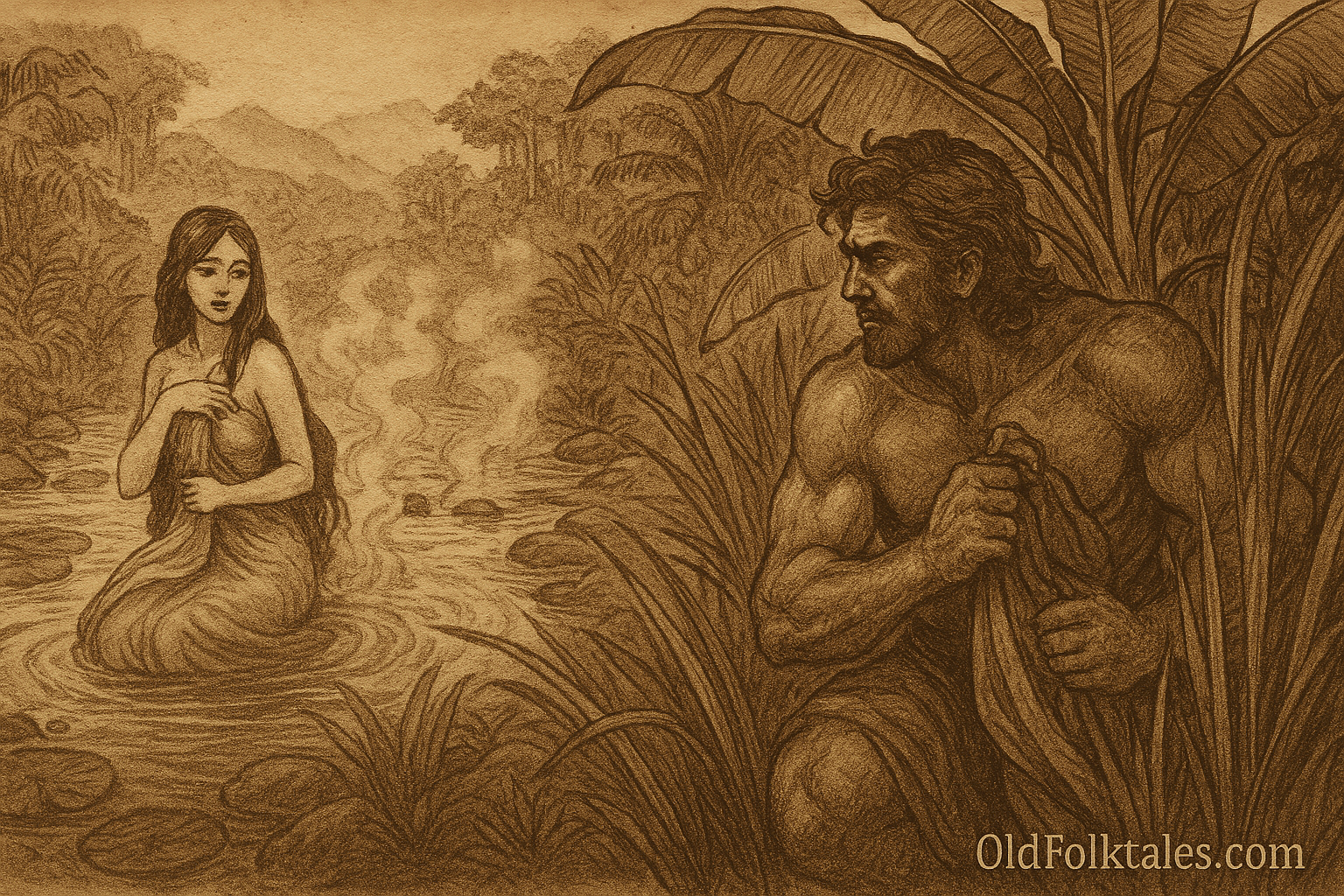
Before him lay a sacred pond, its waters so clear they reflected the emerging stars like liquid mirror. Steam rose from the surface in delicate wisps, suggesting hot springs beneath. But it was not the pond that stole Jaka Tarub’s breath it was the seven maidens bathing in its crystalline waters.
They were not of this world.
The celestial nymphs moved through the water with impossible grace, their skin luminous as moonlight, their hair flowing like black silk down their backs. They splashed and played, their laughter filling the twilight air with joy. On the pond’s edge, neatly arranged on smooth stones, lay seven shawls of heavenly fabric garments woven from starlight and cloud, each one shimmering with colors no earthly loom could produce.
Jaka Tarub’s heart thundered in his chest. He had heard stories of bidadari heaven’s daughters who sometimes descended to bathe in sacred waters but had dismissed them as old wives’ tales. Now, hidden behind the broad leaves of a banana tree, he witnessed the impossible made real.
His eyes were drawn to the youngest of the nymphs. Her name, though he did not yet know it, was Nawang Wulan, and she possessed a beauty that seemed to capture the essence of dawn itself. While her sisters laughed and splashed with abandon, Nawang Wulan moved with a gentle grace, occasionally gazing up at the darkening sky as if already homesick for the celestial realm.
Desire seized Jaka Tarub a longing so powerful it eclipsed all reason. If he could somehow keep one of these divine beings here, perhaps… Without allowing himself to complete the thought, driven by impulse rather than wisdom, he crept forward through the shadows. His hunter’s skill served him well; he moved as silently as moonrise. Reaching the pile of heavenly garments, he seized the shawl that lay closest the one belonging to Nawang Wulan and retreated into the forest, his prize clutched against his chest.
When the nymphs finally emerged from their bathing, shaking water from their hair like morning dew from lotus petals, six found their shawls waiting. But Nawang Wulan searched frantically, her graceful composure dissolving into panic. Without her celestial garment, she could not fly. She could not return home.
Her sisters, after searching desperately for the missing shawl as the stars wheeled overhead, were forced to make a terrible choice. Dawn was approaching, and they could not remain in the mortal world. With tears streaming down their luminous faces, they wrapped their shawls around their shoulders and rose into the sky like birds taking flight, their forms growing smaller until they vanished among the stars. Nawang Wulan’s cries of despair echoed across the forest, the sound piercing Jaka Tarub’s hiding place like an arrow through his heart.
Only then, when her sorrow filled the night, did the hunter emerge. He approached with feigned surprise, offering comfort and shelter. What choice did Nawang Wulan have? Stranded in the mortal realm, vulnerable and alone, she accepted his kindness. And Jaka Tarub, playing the role of compassionate protector, carefully concealed his crime.
In time, companionship grew between them. Nawang Wulan’s celestial sorrow softened into something approaching contentment. They married beneath the swaying palms, and she bore him a daughter. To outward eyes, they seemed a blessed couple. Their home was modest but filled with love, and Nawang Wulan proved herself extraordinary even without her divine powers fully intact.
She possessed a remarkable secret a gift from her heavenly origins. When cooking rice, she needed only a single grain. Through her magic, that single grain would multiply to fill their pot, feeding the family abundantly. But this power came with a sacred condition, a taboo: Jaka Tarub must never observe her while she cooked. He must never lift the lid of the rice pot until she permitted it.
For years, Jaka Tarub honored this boundary. But curiosity is a persistent thing, gnawing at the mind like a rat at grain stores. Why such secrecy? What did she hide? One day, when Nawang Wulan stepped out to fetch water from the well, the temptation proved too strong. Jaka Tarub approached the cooking pot, his heart pounding with guilt and anticipation. Slowly, carefully, he lifted the lid.
Inside lay a single grain of rice, swelling impossibly, multiplying before his eyes through celestial magic.
The moment he observed it, the spell shattered. The magic, born of trust and mystery, could not survive scrutiny. From that day forward, Nawang Wulan’s power diminished. She now needed a full measure of rice to cook each meal. Their granary, once seemingly inexhaustible, began to empty at a normal rate.
Nawang Wulan knew immediately what had happened. Her eyes, when she looked at her husband, held a deep sadness not anger, but the profound grief of trust betrayed. She said nothing of it, but something between them had broken.
Seasons passed, and their rice stores dwindled. One day, while searching through the granary for the last remaining rice, Nawang Wulan’s hand brushed against something soft, something that shimmered even in the dim light. Hidden all these years beneath the grain, buried where she would never have found it had abundance continued, was her celestial shawl.
The truth crashed over her like a wave. Her husband’s kindness, their meeting, their entire life together all built on a foundation of theft and deception. Jaka Tarub had stolen her wings, stolen her choice, stolen her home among the stars.
Nawang Wulan wept as she wrapped the shawl around her shoulders. Immediately, her celestial nature returned in full force, her body growing light, beginning to float. Jaka Tarub, returning home to find her rising, fell to his knees, begging forgiveness, pleading with her to stay. But some betrayals cannot be forgiven, some boundaries once broken cannot be mended.
She looked down at him, and in her eyes swam love and sorrow in equal measure. “Care for our daughter,” she said, her voice already distant as the wind. “Tell her that her mother loved her, but that I cannot remain in a world where I was never truly free.”
Then Nawang Wulan rose into the sky, her form growing smaller and smaller until she became just another star in the vast heavens, leaving Jaka Tarub on the earth below, devastated by the consequences of his desire and deception.
Click to read all Southeast Asian Folktales — featuring legends from Thailand, Indonesia, Vietnam, and the Philippines.
The Moral Lesson
The tale of Jaka Tarub and Nawang Wulan teaches that love built on deception and control can never endure. True love requires freedom, honesty, and respect for boundaries. When we trap others whether through lies, secrets, or stolen choices we may possess their presence but never their hearts. The story warns against allowing desire to override conscience, and reminds us that breaking sacred taboos, whether out of curiosity or control, leads inevitably to loss. Some boundaries exist not to frustrate us but to protect the very things we cherish most.
Knowledge Check
Q1: Who is Jaka Tarub in Javanese folklore and what did he do?
A: Jaka Tarub was a young hunter who spied on seven celestial nymphs bathing in a sacred pond and stole the heavenly shawl belonging to Nawang Wulan, the youngest nymph, trapping her in the mortal world so he could marry her.
Q2: What was Nawang Wulan’s magical ability and what taboo protected it?
A: Nawang Wulan could cook rice using only a single grain that would magically multiply to feed the family. The sacred taboo required that Jaka Tarub never observe her cooking or lift the rice pot lid breaking this taboo caused her celestial magic to fade.
Q3: How did Nawang Wulan eventually discover her husband’s betrayal?
A: When her magic faded after Jaka broke the taboo, their rice supply depleted normally. While searching the granary for remaining rice, she discovered her hidden celestial shawl beneath the grain, revealing that Jaka had stolen it and deceived her from the beginning.
Q4: What does the stolen shawl symbolize in this Indonesian folktale?
A: The stolen shawl symbolizes freedom, identity, and the ability to return home. By stealing it, Jaka Tarub literally stole Nawang Wulan’s autonomy and choice, trapping her in a life she did not freely choose, representing control and deception in relationships.
Q5: What cultural themes does the Jaka Tarub story explore?
A: The story explores the boundaries between mortal and divine worlds, the consequences of desire overriding moral judgment, the importance of respecting sacred taboos, the inevitability of truth being revealed, and the fundamental need for freedom and honesty in relationships.
Q6: Why is Nawang Wulan’s departure both tragic and necessary?
A: Her departure is tragic because she leaves behind genuine love her daughter and the life she built—but necessary because she was never given true choice in staying. She cannot remain in a relationship founded on theft and deception, making her return to heaven both a loss and a reclamation of her stolen freedom.
Source: Adapted from Javanese folktales as documented in H. W. McDonald’s Javanese Folktales
Cultural Origin: Java, Indonesia (Javanese Classical Literature and Oral Tradition)