In the kampung villages scattered across the Malay Peninsula, where coconut palms sway lazily in the tropical breeze and the call to prayer echoes across rice paddies, there lived a man whose name became synonymous with foolishness throughout the land. His name was Pak Pandir “Father Fool” and his misadventures have been told and retold for generations, bringing both laughter and wisdom to all who hear them.
Pak Pandir was not a cruel man, nor was he lazy or unkind. In fact, he possessed a cheerful disposition and always meant well. His problem was far simpler and far more profound: he lacked even the smallest grain of common sense. Where others saw obvious solutions, Pak Pandir saw elaborate complications. Where wisdom suggested one path, his peculiar logic inevitably led him down another, more absurd route entirely.
Click to read all East Asian Folktales — including beloved stories from China, Japan, Korea, and Mongolia.
His wife, Mak Andeh, was a patient woman perhaps too patient, some neighbors whispered who spent her days trying to minimize the chaos her husband created. She had learned through painful experience that leaving Pak Pandir alone with any task, no matter how simple, was an invitation to disaster.
One sweltering afternoon, when the sun hung like a brass gong in the cloudless sky, Mak Andeh prepared to visit the market in the neighboring village. Her sister had recently given birth, and the infant needed temporary care while his mother recovered. Mak Andeh, knowing her husband’s limitations, gave him the most explicit instructions she could manage.
“Pak Pandir,” she said slowly, looking directly into his eyes, “you must watch the baby while I am gone. Keep him clean, keep him fed, and above all, keep him safe.”
“Of course, of course!” Pak Pandir replied with an enthusiastic nod, already imagining himself as the model caretaker. How difficult could caring for one small baby be?
For the first hour, all went remarkably well. The baby slept peacefully in his sarong cradle, and Pak Pandir sat nearby, fanning the air and feeling rather proud of his competence. But then the inevitable happened the baby awoke crying, his tiny face scrunched and reddened, his diaper soiled and reeking.
Pak Pandir stared at the messy infant with growing concern. “This baby is very dirty,” he muttered to himself, his brow furrowed in thought. “If I just wipe him with cloth and water, he will only get dirty again tomorrow, and the day after that. What a waste of effort! There must be a better way a permanent solution.”
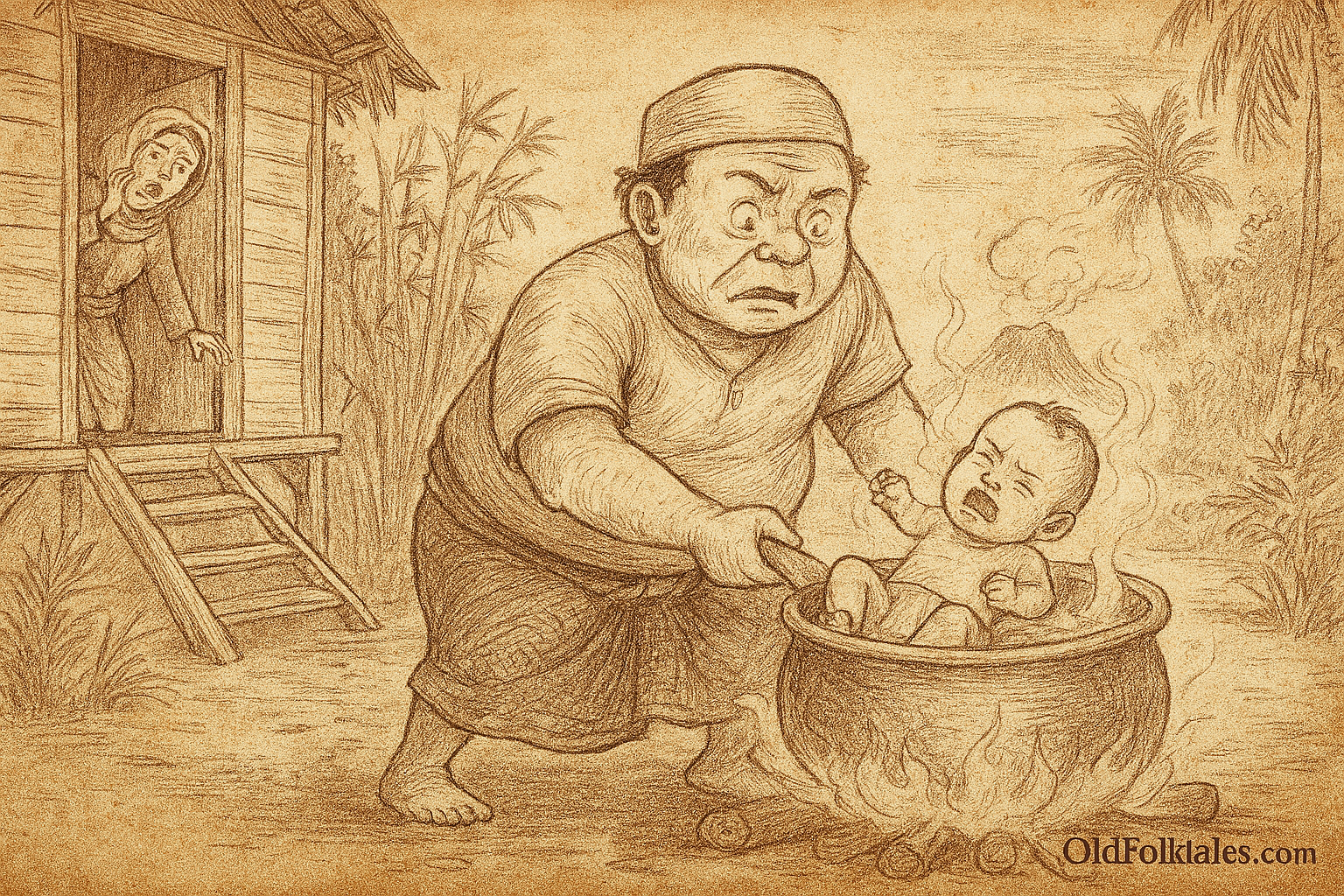
His eyes fell upon the large clay pot sitting over the cooking fire, where water bubbled and roiled, sending up clouds of steam. A wide smile spread across his face as inspiration struck like lightning. “Of course! If I wash the baby in boiling water, he will become so clean that he will never need washing again! Just like when Mak Andeh sterilizes the cooking utensils!”
With the confidence of a man who believed he had discovered a revolutionary childcare technique, Pak Pandir lifted the crying infant and moved toward the bubbling pot. Fortunately, at that precise moment, Mak Andeh returned home early, having forgotten her market basket. Her scream could be heard three houses away.
“What are you doing, you foolish man?” she shrieked, snatching the baby from his arms and clutching the child protectively to her chest.
“I was going to make him permanently clean,” Pak Pandir explained, genuinely confused by her distress. “Boiling water cleans everything perfectly!”
Mak Andeh’s response was swift and involved a wooden ladle, a great deal of shouting, and Pak Pandir sleeping outside beneath the coconut palms that night, nursing a sore head and wondering where his brilliant plan had gone wrong.
Some months later, after the baby incident had become village legend and Mak Andeh had recovered most of her composure, another opportunity for Pak Pandir’s unique logic presented itself. While cooking his breakfast rice, he accidentally knocked his favorite clay pot against the edge of the stove. A thin crack appeared along its side nothing serious, just a small imperfection that could be easily repaired with some clay paste.
But Pak Pandir stared at that crack as though it were a mortal wound. “This pot has served me well for many years,” he said solemnly, speaking as though delivering a eulogy. “It has cooked countless meals, boiled water for tea, and never complained. But now it is damaged, broken, flawed.”
He held the pot up to the morning light streaming through the window, examining the crack from every angle. His face grew increasingly sorrowful as he contemplated the pot’s fate. Then, with the gravity of a man making a life-changing decision, he declared: “This faithful servant deserves a proper burial. It would be disrespectful to simply throw it away or let it suffer the indignity of being repaired with inferior clay. No, I shall give it the honorable end it deserves!”
And so, while his neighbors prepared their fields and tended their livestock, Pak Pandir spent the entire morning digging an elaborate grave in his garden. He lined it with banana leaves, placed the slightly cracked pot at the bottom, and covered it with earth. He even fashioned a small marker from bamboo and spent the afternoon sitting beside the “grave,” mourning the loss of his cooking vessel.
When Mak Andeh returned from her weaving and discovered her husband sitting in the garden, tearfully eulogizing a perfectly serviceable cooking pot now buried in the ground, she didn’t know whether to laugh or cry. She did both, eventually, along with the entire village when the story spread like wildfire through the kampung.
“Pak Pandir,” she said with the weariness of someone who has had this conversation a thousand times before, “that pot had only a small crack. We could have fixed it with a bit of clay paste. Now we have no pot, and you’ve wasted an entire day digging a grave for cookware!”
Pak Pandir looked up at her with wounded eyes. “But it deserved respect,” he protested weakly.
The tales of Pak Pandir spread throughout the Malay Peninsula, from Kedah to Johor, from coastal fishing villages to highland plantations. Parents told these stories to their children, not just for entertainment though the laughter they inspired was precious but as cautionary tales wrapped in humor. Through Pak Pandir’s absurd logic, children learned to think critically, to question their assumptions, and to test their solutions before implementing them.
The village elders would gather in the evening, sipping thick coffee and chewing betel nut, sharing the latest Pak Pandir story while younger listeners absorbed the lessons hidden within the comedy. “Better to be called careful than to be called Pak Pandir,” became a common saying. His name became a gentle warning: “Don’t be a Pak Pandir about this.”
Yet there was also affection in these tales. Pak Pandir was not malicious or selfish he was simply a man who saw the world through a lens so distorted that common sense became absurdity. In a way, his stories reminded everyone that wisdom must be cultivated, that thinking requires practice, and that even the most well-meaning actions can lead to disaster without proper reflection.
To this day, when someone proposes an overly complicated solution to a simple problem, or suggests something that defies all logic while believing themselves clever, someone in the room will inevitably smile and whisper, “Ah, just like Pak Pandir,” and everyone will understand exactly what they mean.
Click to read all Southeast Asian Folktales — featuring legends from Thailand, Indonesia, Vietnam, and the Philippines.
The Moral Lesson
The Pak Pandir tales teach essential life lessons through the power of humor and absurdity. By showing the catastrophic results of his illogical thinking nearly boiling a baby, burying a repairable pot these stories encourage children and adults alike to pause and think critically before acting. They warn against taking good intentions too far without considering consequences and demonstrate that elaborate solutions are often worse than simple, practical approaches.
Knowledge Check
Q1: Who is Pak Pandir in Malay folklore?
A: Pak Pandir, meaning “Father Fool,” is a beloved comedic character in Malay folklore known throughout Malaysia, Singapore, Brunei, and Indonesia. He is a well-meaning but foolish villager whose complete lack of common sense leads to absurd misadventures. Despite his good intentions, his bizarre logic results in disasters that teach wisdom through humor. He represents the archetypal fool whose mistakes serve as cautionary tales, particularly for teaching children critical thinking and practical judgment.
Q2: What is the significance of the baby-washing story in the Pak Pandir cycle?
A: The baby-washing story is one of the most famous Pak Pandir tales, illustrating the danger of taking logic to absurd extremes without considering consequences. When Pak Pandir decides to wash a baby in boiling water “so it will be clean forever,” he demonstrates catastrophically flawed reasoning that could have led to tragedy. This story teaches children (and adults) to think through the actual effects of their actions, not just the intended goals, and shows how good intentions mean nothing without practical wisdom and common sense.
Q3: Why does Pak Pandir bury his cracked cooking pot?
A: Pak Pandir buries his cracked cooking pot because his twisted logic tells him the pot “deserves” an honorable burial after years of faithful service. Rather than simply repairing the small crack with clay paste the obvious, practical solution he treats the slightly damaged pot as though it were a deceased family member. This story satirizes overthinking and excessive sentimentality, teaching that simple problems require simple solutions, and that respect or sentiment should not override common sense and practicality.
Q4: What role does Mak Andeh play in the Pak Pandir stories?
A: Mak Andeh, Pak Pandir’s long-suffering wife, serves as the voice of reason and common sense in the tales. She represents normal, practical thinking and often arrives just in time to prevent her husband’s foolish schemes from causing complete disaster. Her patience (and occasional exasperation) provides contrast to Pak Pandir’s absurdity, helping listeners understand what sensible behavior looks like. She embodies the wisdom and practicality that Pak Pandir lacks, making the moral lessons clearer through comparison.
Q5: How do Pak Pandir tales use humor to teach moral lessons?
A: The Pak Pandir tales employ satire and comedy to make moral lessons memorable and engaging. By presenting extreme examples of foolish behavior in humorous contexts, these stories allow listeners to laugh at Pak Pandir’s mistakes while simultaneously recognizing similar flawed thinking in themselves or others. The exaggerated absurdity makes the lessons stick in memory far better than straightforward moralizing would. This technique teaching through laughter is central to Malay oral tradition and makes wisdom accessible to children and adults alike.
Q6: What is the cultural significance of Pak Pandir in Malay society?
A: Pak Pandir holds significant cultural importance across Malay communities as both entertainment and educational tool. These tales have been passed down for generations through oral tradition, serving to teach critical thinking, caution, and humility in an engaging way. The character’s name has entered common language calling someone “Pak Pandir” or warning them not to be one has become a gentle way to encourage more careful thinking. The tales reflect Malay values of community wisdom, practical intelligence, and the importance of learning from others’ mistakes. They remain relevant today, adapted to modern contexts while preserving traditional storytelling elements.
Source: Adapted from Malay Folklore and Folk-Tales by R.O. Winstedt and Cerita Jenaka Melayu
Cultural Origin: Malay people, Malaysia, Singapore, Brunei, and Indonesia (Maritime Southeast Asia)