In ancient Cambodia, long before the great temples of Angkor rose from the jungle floor, there stood a mountain of extraordinary beauty. Phnom Kulen lifted its green shoulders above the plains, its slopes thick with ancient trees whose roots gripped stone like the fingers of giants. Waterfalls cascaded down its rocky faces, their waters crystal clear and sweet. Wild orchids bloomed in hidden grottos, and the air itself seemed different there, charged with a quality that made even animals move quietly, as if walking through a natural temple.
The mountain had always been beautiful, but it was not yet sacred. That transformation would come through the devotion of a single soul.
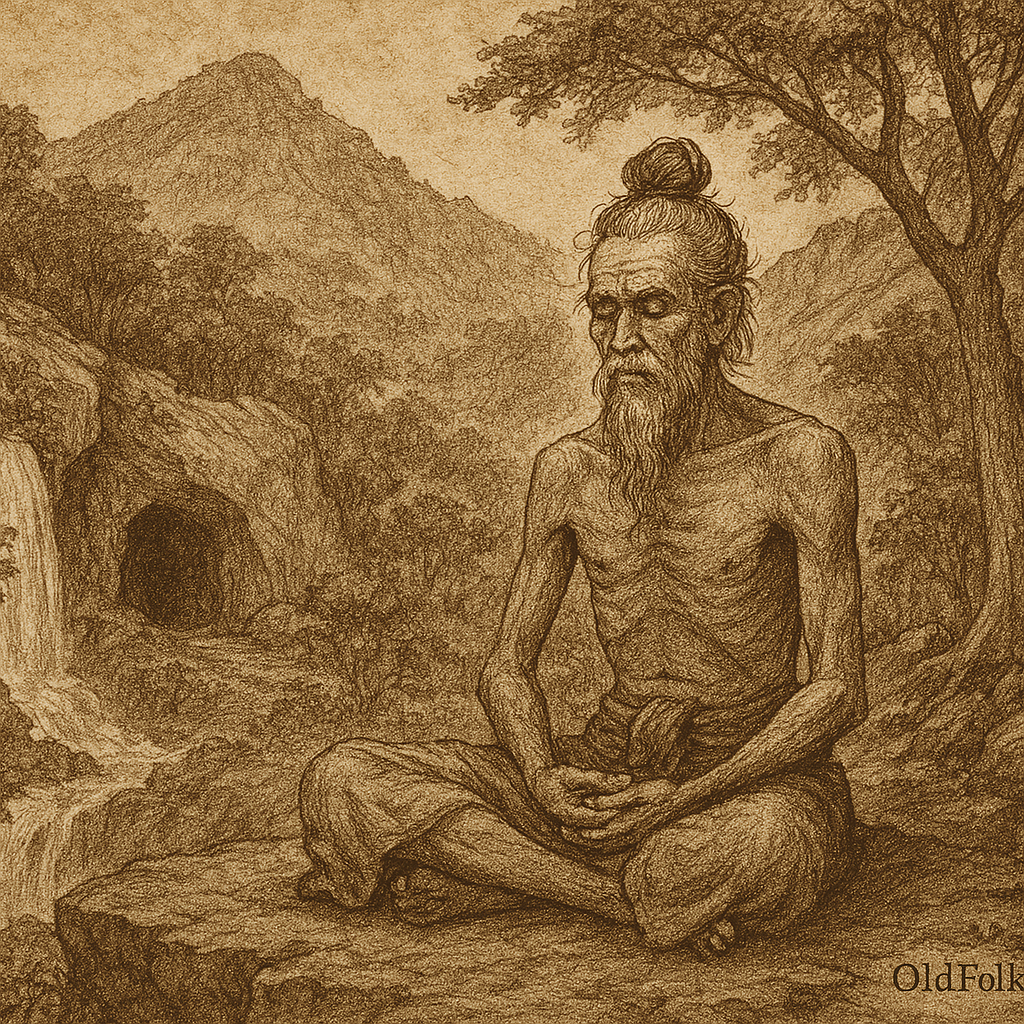
There came to this mountain a hermit whose name has been lost to time, though some called him Preah Thong, the Holy One. He was a man who had turned away from the world of pleasure and ambition, seeking instead the path of spiritual enlightenment. His face was weathered like old wood, his body thin from years of ascetic practice, but his eyes held a light that spoke of inner peace and profound understanding.
Click to read all East Asian Folktales — including beloved stories from China, Japan, Korea, and Mongolia.
The hermit chose a cave high on the mountain’s northern face, where a natural spring bubbled from the living rock and the view stretched across the endless green forest below. Here, he vowed, he would remain in meditation until he achieved the highest wisdom or until his body returned to the dust from which it came.
He sat cross-legged on the stone floor, his back straight as a temple pillar, and began his practice. Days became weeks, weeks became months, and months flowed into years. The hermit remained motionless except for the gentle rise and fall of his breathing, his mind turned inward, seeking the ultimate truth that lay beyond the illusions of the material world.
The forest creatures grew accustomed to his presence. Birds nested near his cave without fear. Deer would approach to drink from the spring, their soft eyes regarding the meditating figure with gentle curiosity. Even the tigers that prowled the mountain’s lower slopes seemed to respect the sanctity of his chosen place, never disturbing his profound stillness.
As the years of meditation accumulated, something extraordinary began to happen. The hermit’s spiritual practice was so pure, his devotion so complete, that it began to transform the mountain itself. The divine forces that flow through all things, the energies that the ancient people knew by many names, responded to his dedication.
Hindu deities, observing from their celestial realms, took notice of this exceptional soul. Shiva, the great transformer, saw in the hermit’s practice a reflection of his own eternal meditation. Vishnu, the preserver, recognized the hermit’s commitment to dharma and right living. The Buddha’s teachings, which had begun to spread through the land, found perfect expression in this solitary practitioner’s quest for enlightenment.
The mountain began to accumulate spiritual power like a vessel filling with sacred water. The rocks themselves seemed to hum with subtle energy. The spring that bubbled near the hermit’s cave began to exhibit remarkable properties, its water bringing clarity of mind to those who drank it and healing to those who bathed in it. The very trees on Phnom Kulen’s slopes grew stronger and more beautiful, as if nourished by invisible blessings.
When the hermit finally emerged from his meditation after many years, he was transformed. His body seemed to glow with an inner radiance, his presence radiating peace and wisdom. He had achieved what few mortals accomplish, touching the divine through his unwavering practice. But rather than departing the mountain for the world below, he chose to remain, continuing his spiritual work and teaching those few seekers who made the pilgrimage to find him.
Word of the holy mountain spread throughout the kingdom. Pilgrims began to climb its slopes, seeking blessings and spiritual guidance. Kings came to perform sacred ceremonies, carving lingams into the riverbed and building shrines to honor the gods who had blessed this place. The water that flowed from Phnom Kulen was collected and carried to temples throughout the land, where it was used in purification rituals and royal consecrations.
The hermit eventually passed from the world, his body returning to the elements as all bodies must. But the spiritual power he had awakened in the mountain remained, a permanent gift to all who approached with reverence and pure hearts.
Yet with this blessing came a warning, one that would be learned through bitter experience.
Years after the hermit’s passing, a wealthy merchant came to Phnom Kulen. Unlike the humble pilgrims who approached with respect, this man came with arrogance and greed. He had heard that the mountain contained valuable timber and precious stones, and he saw only profit where others saw sanctity.
“These are just trees and rocks,” he scoffed to his servants. “The foolish superstitions of peasants should not prevent me from harvesting what nature provides.”
He ordered his workers to begin cutting the ancient trees and quarrying stone from the mountainside. When local people protested, citing the mountain’s sacred status, the merchant dismissed them with contempt. “I fear no spirits or gods,” he declared. “I acknowledge only the reality of gold and silver.”
The mountain’s response was swift and terrible. On the first night of the merchant’s desecration, a violent storm arose, though the sky had been clear at sunset. Lightning struck his camp repeatedly, destroying his tools and scattering his workers. Thunder rolled like the anger of the gods themselves, echoing through the valleys below.
The merchant, stubborn in his pride, refused to relent. The next day, his workers returned to their destructive labor. This time, the very earth seemed to rebel. A rockslide cascaded down the mountain, destroying the merchant’s equipment and nearly killing several men. The spring that had always flowed sweet and clear turned bitter and foul, and those who drank from it fell ill with terrible fevers.
Still the merchant persisted, his greed blinding him to the clear signs of divine displeasure. On the third day, as he personally supervised the felling of an ancient tree that grew near the hermit’s old cave, disaster struck with finality. The tree, as it fell, twisted impossibly in midair and crushed the merchant beneath its weight. His death was instant, and his body was found with his eyes wide open, as if he had finally seen, in his last moment, the reality he had denied.
His servants fled down the mountain, carrying tales of the merchant’s fate. The story spread quickly, and from that day forward, people understood with renewed clarity that Phnom Kulen was not merely beautiful but truly sacred. The mountain would protect itself and punish those who approached with disrespect or sought to exploit its resources for selfish gain.
Generations passed, and the mountain’s reputation as a sacred site grew stronger. Kings continued to make pilgrimages to Phnom Kulen, carving elaborate sculptures into its rocks and channeling its waters through intricate carvings of gods and sacred symbols. The riverbed itself became a gallery of devotion, its stone blessed by the prayers of countless faithful souls.
The mountain gave generously to those who approached with reverence. Its waters continued to heal and purify. Its slopes provided sanctuary for meditation and spiritual practice. Animals found refuge in its forests, protected by the sacred prohibition against hunting on holy ground. The air remained charged with that special quality that made people naturally quiet their minds and open their hearts.
But to those who came with disrespect or destructive intent, the mountain showed its other face. Trees would fall on desecrators, paths would become treacherous beneath careless feet, and misfortune would dog those who sought to violate the sacred space. The mountain demanded reverence, not from arbitrary cruelty but because sacredness itself requires respect to maintain its power and continue its blessings.
And so Phnom Kulen remains to this day, a mountain blessed by the devotion of a forgotten hermit, protected by divine forces, and revered by all who understand that some places in this world are meant to remain untouched, serving as bridges between earth and heaven, between the material and the spiritual, between human ambition and divine peace.
Click to read all Southeast Asian Folktales — featuring legends from Thailand, Indonesia, Vietnam, and the Philippines.
The Moral Lesson
This legend teaches us that sacred spaces earn their holiness through devotion and spiritual practice, and once blessed, they must be protected through continued reverence. The story emphasizes that not everything in nature exists for human exploitation, some places serve higher purposes as spiritual sanctuaries that benefit all beings when preserved. It warns that disrespect for sacred sites brings not superstitious punishment but natural consequences, as the spiritual forces that bless these places will also defend them. The tale reinforces the Buddhist and Hindu values of reverence for nature, respect for spiritual heritage, and the understanding that true wealth lies in spiritual rather than material treasures.
Knowledge Check
Q1: Who was the hermit of Phnom Kulen and what did he do on the mountain?
A1: The hermit, sometimes called Preah Thong (the Holy One), was an ascetic spiritual seeker who chose a cave high on Phnom Kulen’s northern face to meditate. He remained in meditation for many years, seeking enlightenment through pure spiritual practice, and his unwavering devotion eventually transformed the mountain into a sacred site blessed by divine forces.
Q2: How did the hermit’s meditation transform Phnom Kulen?
A2: The hermit’s years of pure spiritual practice accumulated spiritual power in the mountain itself. Divine forces from both Hindu and Buddhist traditions responded to his devotion, blessing the mountain with sacred energy. The spring near his cave gained healing properties, the rocks hummed with subtle energy, and the entire mountain became charged with spiritual power that remained even after his death.
Q3: What happened to the wealthy merchant who disrespected the sacred mountain?
A3: The merchant came to Phnom Kulen seeking timber and precious stones, dismissing its sacred status as peasant superstition. Despite warnings in the form of violent storms, rockslides, and poisoned waters, he persisted in desecrating the mountain. On the third day, an ancient tree he was felling twisted impossibly and crushed him to death, a final demonstration of the mountain’s divine protection.
Q4: What role does Phnom Kulen play in Cambodian spiritual tradition?
A4: Phnom Kulen became Cambodia’s most sacred mountain, serving as a site for royal pilgrimages, religious ceremonies, and spiritual practice. Kings carved lingams into its riverbed and built shrines there. Its waters were used throughout the kingdom for purification rituals and royal consecrations, making it central to both Hindu and Buddhist spiritual practices in ancient Cambodia.
Q5: What does the story teach about the relationship between humans and sacred nature?
A5: The legend teaches that certain natural places possess spiritual significance that transcends economic value, and these sacred sites must be approached with reverence rather than exploited for material gain. It demonstrates that spiritual forces will protect sacred spaces from desecration, and that respecting these places benefits entire communities through their continued blessings and healing properties.
Q6: How does this legend reflect Buddhist and Hindu values in Cambodian culture?
A6: The story embodies the synthesis of Buddhist and Hindu traditions in Cambodian spiritual life, showing both religions’ deities responding to the hermit’s devotion. It reflects Buddhist values of meditation, enlightenment, and non-attachment, while incorporating Hindu reverence for sacred mountains, water, and the presence of deities like Shiva and Vishnu. The tale emphasizes dharma (right living), karma (consequences of actions), and the belief that spiritual practice can sanctify physical spaces.
Source: Adapted from traditional Cambodian oral legends and historical accounts documented in “Angkor and the Khmer Civilization” by Michael D. Coe and Damian Evans .
Cultural Origin: Phnom Kulen Mountain, Siem Reap Province, Cambodia