In the warm valleys of Palestine, where pomegranate trees bloom like drops of crimson fire beneath the golden sun, there once lived a young girl known to all as Pomegranate Seeds. Her name came from the beauty of her lips, red as the fruit’s jewels, and her heart, pure and radiant like its sweet flesh.
But her world was shadowed by terror. In the nearby town lived a wicked sheikh, a devourer of children, whose hunger for innocent souls had no end. Mothers whispered his name with trembling lips and warned their little ones never to stray far from home. Yet fate, as it often does, had its own path for Pomegranate Seeds.
One evening, as the girl gathered firewood at the edge of the village, the air turned still. The sheikh appeared, tall, cloaked, and grinning with teeth like polished bone. “Child,” he said, “come closer. I will give you gold.” But she saw the red stains upon his hands and fled, running until her breath tore at her chest. Her slippers struck the stones as she raced through the darkness, until one fell off and vanished behind her. She did not stop to find it.
She reached a distant town by dawn and hid in the corner of a poor man’s shop. The kind shopkeeper, seeing her tears, offered shelter. “Stay until you are safe,” he said, giving her bread and water. She thanked him and stayed quietly, helping sweep the shop each morning.
In that same town, a king ruled, a just man known for his wisdom. One day, as his soldiers passed through the marketplace, one of them found a single slipper lying by the road, small, delicate, and shining like a pearl in the dust. The soldier brought it to the palace. The king, curious, lifted it and said, “Find the maiden whose foot fits this slipper, for she shall be honoured in my house.”
Messengers went from house to house. When they reached the shop, Pomegranate Seeds shyly stepped forward. The slipper fit perfectly. The soldier smiled, and the townspeople marvelled at her grace. Soon, she was brought before the king, who was struck by her quiet strength and kindness. “You shall be my queen,” he declared. And so, the girl who had once fled in fear became a queen, beloved for her compassion and wisdom.
For a time, peace reigned. She bore two children, bright, gentle souls who filled the palace with laughter. But darkness had not yet loosened its grip. The wicked sheikh learned of her new life and plotted revenge. Disguised as a holy man, he came to the palace gates, pretending to bring blessings. The guards, seeing his robes, let him in.
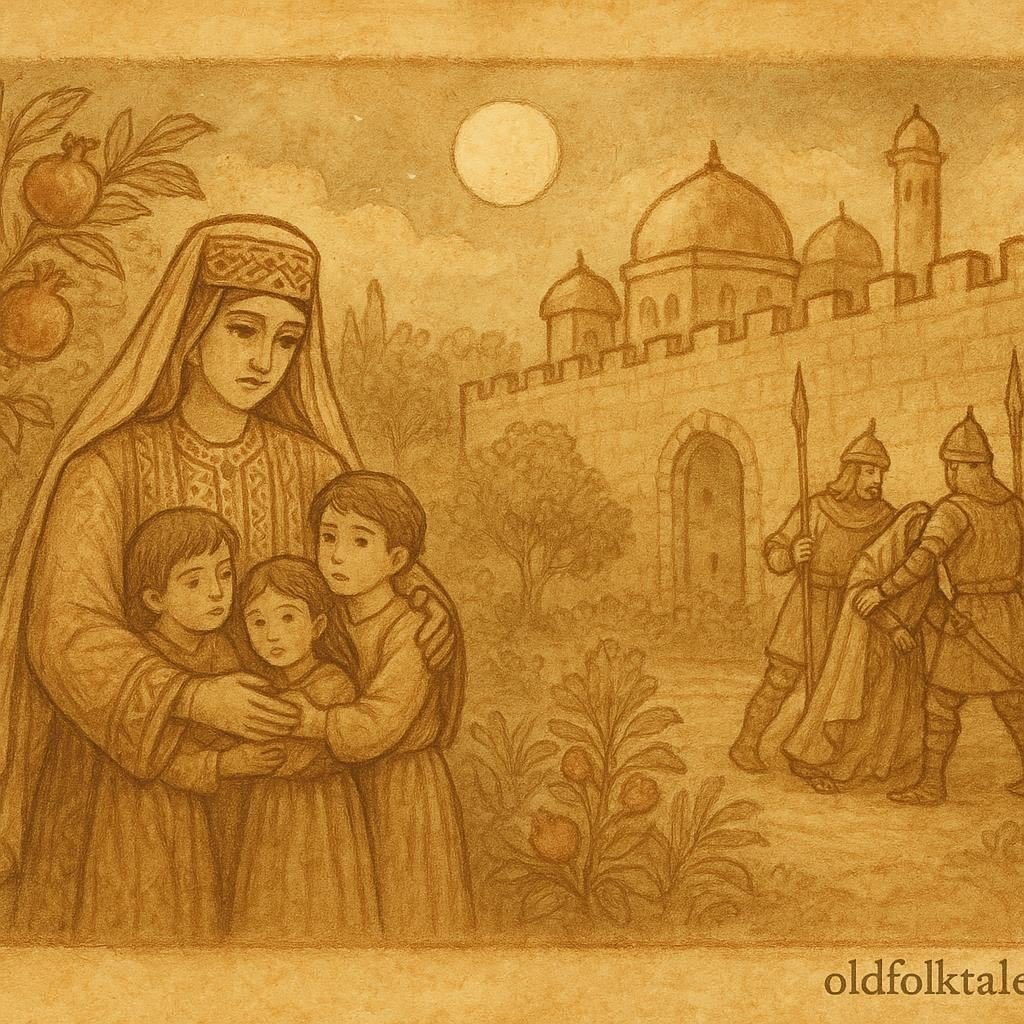
That night, he crept into the nursery and carried away the two royal children. When the queen awoke and found their beds empty, she fell to the floor in grief. The court was thrown into turmoil. The king’s advisors, seeing no intruder, accused the queen of wrongdoing. “She has angered Heaven,” they whispered. The king, torn between love and doubt, ordered that she be kept under watch.
Days turned into months. The queen prayed each night beneath the stars, her heart burning with faith. Then one evening, as she sat by her window, she heard a faint cry from the garden. Rushing outside, she saw two small figures by the fountain, her lost children, miraculously returned. They clung to her with tears of joy.
The king, seeing the reunion, realized the truth, that evil had deceived them all. The sheikh, found lurking near the city walls, was captured. The people rejoiced, praising the queen’s steadfastness. The wicked one met his end, and peace returned once more to the land.
From that day forward, Queen Pomegranate Seeds ruled beside her husband with grace and mercy. Her story spread across Palestine, a tale of resilience, faith, and the triumph of good over darkness. Mothers told their daughters, “Be like Pomegranate Seeds, brave, patient, and pure.”
Moral Lesson
The tale of Pomegranate Seeds teaches that true virtue shines brightest in adversity. Courage, patience, and faith can turn even the darkest fate into triumph, for goodness, once planted, will always bear fruit.
Knowledge Check
1. Who is Pomegranate Seeds in the story?
She is a brave young girl who escapes evil, becomes a queen, and overcomes trials through courage and faith.
2. What danger does Pomegranate Seeds flee from?
She escapes from a wicked sheikh who devours children, symbolising the triumph of innocence over corruption.
3. What is the significance of the lost slipper?
The slipper represents destiny — the turning point that leads her from hardship to honour.
4. How does the sheikh deceive the palace?
He disguises himself as a holy man, showing how evil often hides behind false virtue.
5. What does the reunion of mother and children symbolise?
It symbolises divine justice, faith rewarded, and the restoration of truth.
6. What lesson does this Palestinian folktale convey?
That steadfastness, purity, and belief in righteousness can overcome deceit and cruelty.
Source: Adapted from the Palestinian folktale “Pomegranate Seeds” (Tale 35) in Palestinian Arab Folktales, Institute for Palestine Studies.
Cultural Origin: Palestine (Arab folklore)