In the ancient days of Cambodia, when the kingdom stretched across vast territories and the Khmer kings ruled from magnificent palaces adorned with gold and precious stones, there existed two beings whose presence brought blessings and protection to the entire realm. They were not ordinary creatures, nor were they entirely human. They were Preah Ko and Preah Keo, the Sacred Bull and the Divine Boy, miraculous siblings born with supernatural powers that would shape the destiny of Cambodia itself.
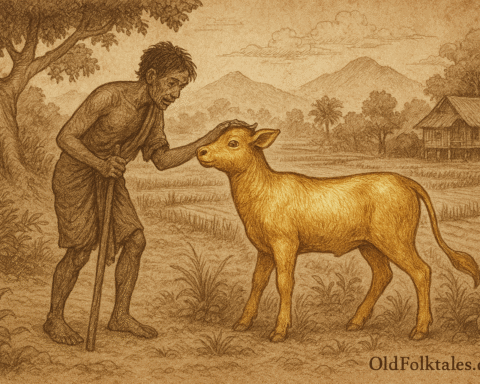
The story of their birth is itself miraculous. They came into the world not through ordinary means but through divine intervention, emerging as manifestations of celestial blessing upon the Cambodian people. Preah Keo took the form of a beautiful boy whose eyes sparkled with otherworldly wisdom and whose very presence seemed to illuminate the spaces he occupied. His brother, Preah Ko, manifested as a magnificent bull not the common cattle that pulled plows through rice paddies, but a creature of pristine white, with horns that gleamed like polished ivory and eyes that held the same divine intelligence as his human sibling.
Discover more East Asian Folktales from the lands of dragons, cherry blossoms, and mountain spirits.
Despite their different forms, the bond between the two was profound and unbreakable. They were two aspects of the same sacred force, connected by bonds deeper than blood, stronger than any earthly tie. Where one went, the other followed. What one knew, the other understood. Together, they formed a protective shield around Cambodia, a spiritual defense that kept the kingdom safe from both visible and invisible threats.
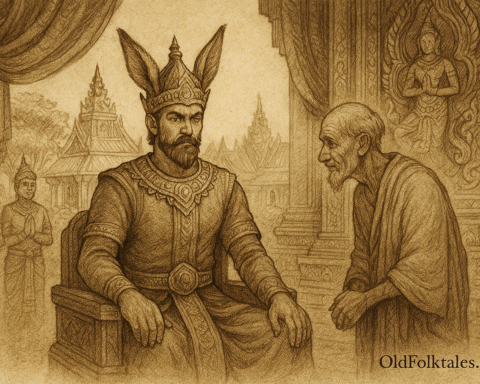
The King of Cambodia quickly recognized the extraordinary nature of these beings. He welcomed them into his palace, treating them not as subjects but as honored guardians, as spiritual advisors whose counsel carried the weight of divine authority. The palace built special quarters for them, a beautiful chamber for Preah Keo where scholars could consult with him on matters of wisdom and prophecy, and a magnificent stable for Preah Ko, adorned with silks and precious ornaments befitting his sacred status.
The people soon learned that Preah Ko and Preah Keo possessed powers beyond human comprehension. When foreign armies gathered at Cambodia’s borders, threatening invasion, the Sacred Bull would bellow a sound that carried across mountains and valleys, filling enemy soldiers with inexplicable dread. The Divine Boy would speak prophecies, revealing to the King where dangers lay hidden and what strategies would bring victory without bloodshed. Time and again, Cambodia was spared from conquest through the intervention of these miraculous siblings.
But their powers extended beyond military protection. When drought threatened the rice harvests, Preah Ko would walk through the fields, and rain would follow. When disease spread through villages, Preah Keo would offer blessings and remedies that healed the afflicted. When disputes arose that human wisdom could not resolve, the Divine Boy would listen to both sides and pronounce judgments that satisfied even the most aggrieved parties. The kingdom flourished under their guardianship, experiencing an era of peace and prosperity that seemed almost magical in its perfection.
The King came to rely on Preah Ko and Preah Keo for every important decision. Should he build a new temple? Preah Keo would advise on the most auspicious location and timing. Was a neighboring kingdom trustworthy as an ally? The Sacred Bull would sense truth or deception in ambassadors’ words. Were the omens favorable for a royal wedding or the coronation of a prince? The miraculous siblings would read signs invisible to ordinary eyes and guide the royal family accordingly.
This dependence, though understandable, grew profound. The King consulted the divine guardians for matters large and small. Ministers sought their approval before implementing policies. Generals would not march without their blessing. Farmers planned their planting seasons according to Preah Keo’s prophecies. The entire kingdom had structured itself around the presence and guidance of these sacred beings, their confidence in Cambodia’s future built upon the foundation of supernatural protection.
But such perfect security could not last forever.
Neighboring kingdoms watched Cambodia’s prosperity with a mixture of envy and fear. They understood that the source of Cambodia’s strength was not merely its armies or its wealth but the presence of Preah Ko and Preah Keo. Whispered consultations took place in distant courts. Spies were sent to observe and report. Slowly, a plan took shape a plan born of desperation and cunning, a plan that would strike at the very heart of Cambodia’s power.
The enemies knew they could not defeat Preah Ko and Preah Keo through force. The sacred siblings were too powerful, too vigilant. Instead, they would use deception, trickery, and dark magic. They sent agents disguised as humble pilgrims, as traveling merchants, as wandering monks people who would not arouse suspicion. These agents infiltrated the palace, moving quietly through the capital, learning the routines of the guardians, discovering their patterns and habits.
The abduction, when it finally came, was executed with terrible precision. On a night when the moon was dark and ceremonies in the palace had demanded the presence of both guardians in separate locations, the enemies struck. Using spells and enchantments that they had gathered from sorcerers across many lands, they managed to trap both Preah Ko and Preah Keo simultaneously, binding their powers just long enough to spirit them away from Cambodia.
The discovery of their absence sent shockwaves through the kingdom. The King was beside himself with grief and panic. The palace erupted into chaos as officials ran in every direction, searching frantically but finding nothing. The Sacred Bull and the Divine Boy had vanished as if they had never existed, leaving behind only empty spaces and a terrible, growing sense of vulnerability.
The immediate effects were devastating. Without Preah Keo’s prophecies, the King felt blind, unable to see threats before they materialized. Without Preah Ko’s protective presence, the kingdom’s borders suddenly seemed porous and weak. The confidence that had characterized Cambodian society evaporated, replaced by anxiety and doubt. The people, who had grown accustomed to divine protection, now realized how dependent they had become on forces beyond their control.
Foreign armies that had long feared to attack Cambodia suddenly saw an opportunity. Invasions began first tentatively, then with growing boldness as word spread that the sacred guardians were gone. Territories that had been peaceful for generations became battlegrounds. The kingdom that had flourished under supernatural protection now struggled under the weight of very human conflicts.
But the loss of Preah Ko and Preah Keo brought more than military vulnerability. Natural disasters that had been kept at bay through divine intervention now struck with full force. Droughts withered crops. Floods destroyed villages. Diseases spread unchecked. The delicate balance that the sacred siblings had maintained crumbled, and Cambodia entered a period of profound difficulty.
Yet in the midst of this suffering, a different kind of wisdom began to emerge. The people of Cambodia, forced to rely on their own strength rather than supernatural intervention, discovered resources within themselves they had never needed to access before. They learned to prepare for droughts instead of depending on miraculous rain. They developed strategies for defense that did not require prophetic foreknowledge. They found that human wisdom, though less perfect than divine guidance, could still navigate complex challenges when applied with diligence and care.
The legend of Preah Ko and Preah Keo became embedded in Cambodian consciousness not just as a story of loss but as a teaching about the dangers of excessive dependence. Elders would tell the tale to remind their communities that while spiritual protection is precious, human initiative and self-reliance are equally important. The sacred guardians had blessed Cambodia with their presence, but their abduction revealed a truth that would shape the kingdom’s understanding of itself for generations: that true strength comes not from external guardians alone but from the combination of spiritual blessing and human effort, of divine protection and mortal determination.
To this day, when Cambodia faces periods of difficulty or challenge, people remember the story of Preah Ko and Preah Keo. They remember the prosperity that came with the guardians’ presence, but they also remember the vulnerability that came from depending too completely on forces beyond human control. The legend serves as both a nostalgic reminder of miraculous protection and a sobering lesson about the importance of cultivating strength and wisdom within the community itself, so that when blessings are withdrawn as they sometimes must be the people can stand on their own and eventually restore what was lost through their own courage and determination.
Explore ancient tales from Thailand, Cambodia, and the Philippines in Southeast Asian Folktales.
The Moral Lesson
The legend of Preah Ko and Preah Keo teaches us that while spiritual protection and divine blessings are precious gifts, excessive dependence on external guardians leaves us vulnerable when those protections are removed. The story emphasizes the importance of developing our own strength, wisdom, and resilience rather than relying entirely on supernatural intervention or external forces to solve all challenges. It reminds us that true security comes from balancing spiritual faith with practical preparation, and that communities must cultivate internal resources even during times of prosperity and protection. The tale also illustrates how periods of loss and difficulty, though painful, can catalyze the development of self-reliance and reveal hidden strengths that comfort and security had obscured. Most profoundly, the legend suggests that the greatest blessing is not perpetual divine intervention but the wisdom to know when to rely on spiritual guidance and when to trust in human capability.
Knowledge Check
Q1: Who were Preah Ko and Preah Keo in Cambodian legend?
A1: Preah Ko and Preah Keo were miraculous siblings a Sacred Bull (Preah Ko) and a Divine Boy (Preah Keo) born with supernatural powers to protect Cambodia. Despite their different forms, they were connected by profound bonds and together formed a spiritual defense for the kingdom, offering prophecies, blessings, and protection from foreign invasion and natural disasters.
Q2: What powers did the sacred guardians possess?
A2: Preah Ko could bellow to fill enemy soldiers with dread, bring rain during droughts, and sense truth or deception. Preah Keo possessed divine wisdom, spoke prophecies revealing hidden dangers, offered healing remedies for diseases, and pronounced judgments that resolved disputes. Together, they protected Cambodia from military threats, natural disasters, and spiritual dangers.
Q3: How did Cambodia’s enemies manage to abduct the guardians?
A3: Knowing they couldn’t defeat the sacred siblings through force, enemies used deception and dark magic. They sent disguised agents who infiltrated the palace to learn the guardians’ routines. On a dark night when ceremonies separated the siblings, enemies used spells from many sorcerers to temporarily bind their powers and spirit them away simultaneously.
Q4: What happened to Cambodia after losing Preah Ko and Preah Keo?
A4: Cambodia experienced devastating consequences the King felt blind without prophecies, borders became vulnerable, foreign armies invaded with growing boldness, natural disasters struck unchecked, and the kingdom entered a period of profound difficulty. The prosperity that had characterized the era of divine protection crumbled as the people realized how dependent they had become.
Q5: What did the Cambodian people learn from losing their guardians?
A5: The people discovered resources within themselves they had never needed to access before. They learned to prepare for disasters rather than depending on miracles, developed defense strategies without prophetic foreknowledge, and found that human wisdom, though less perfect than divine guidance, could still navigate challenges with diligence and care.
Q6: What does this legend symbolize in Cambodian history and culture?
A6: The legend symbolizes periods of difficulty in Cambodia’s history when external protections were lost and the kingdom faced challenges without supernatural intervention. It serves as a teaching about balancing spiritual faith with practical self-reliance, warning against excessive dependence on external forces while acknowledging the value of divine blessing. The story reminds Cambodians that true strength combines spiritual protection with human determination and wisdom.
Source: Adapted from traditional Cambodian foundational legends documented in various collections of Khmer folklore and historical narratives.
Cultural Origin: Cambodia (Khmer Kingdom), Southeast Asia